
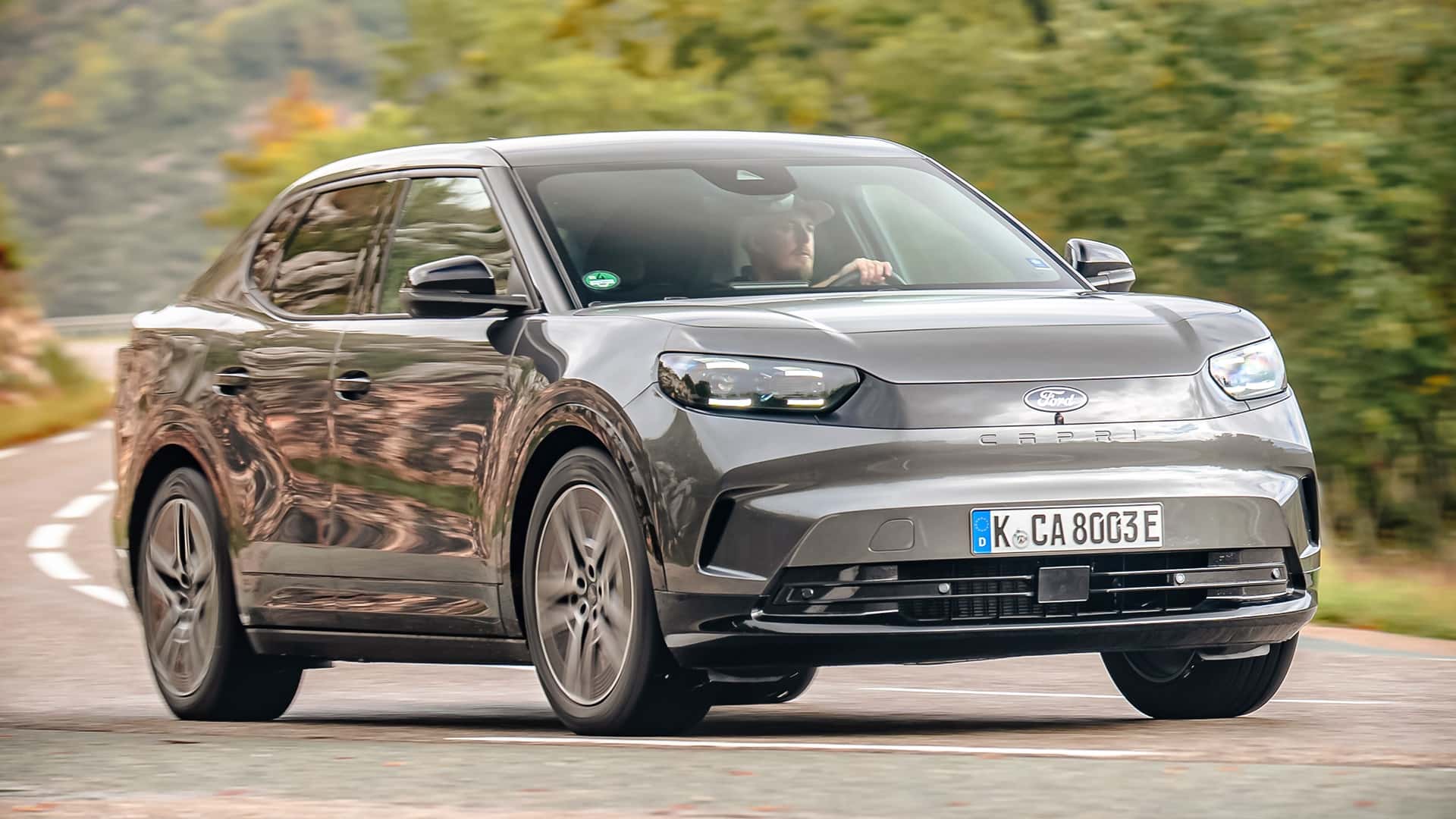
There was a time when Ford of Europe pledged to end sales of combustion-engine passenger cars by 2030. However, that ambitious objective is no longer in place, as the Blue Oval has come to grips with the reality that EV adoption isn’t progressing as quickly as the company had projected at the beginning of the decade.
According to the European Automobile Manufacturers' Association (ACEA), purely electric cars accounted for 19.5 percent of sales last year across the European Union, the UK, Iceland, Liechtenstein, Norway, and Switzerland. In the first quarter of 2026, the share of EVs in total passenger car registrations rose to 20.6 percent. Even so, there’s still a long way to go before everyone switches from gasoline- or diesel-powered vehicles to battery EVs.
Ford believes the EU’s desire to accelerate the demise of combustion engines could backfire. The company argues that forcing the end of ICE vehicles could encourage some people to hold on to their older cars longer rather than replace them with newer, significantly more efficient combustion-powered models.
'CO2 targets must reflect actual consumer demand and infrastructure reality. Forcing a transition faster than the market can move risks slowing the vehicle renewal rate – a critical factor in reducing emissions," according to Ford of Europe's President Jim Baumbick
Stricter Emissions Targets
It’s not just about 2035, when emissions will have to be slashed by 90 percent compared to 2021 levels. Automakers must also meet intermediate CO2 targets before the middle of the next decade. By 2030, fleet emissions must be reduced by 55 percent versus 2021 levels. What happens if a carmaker fails to comply? Massive fines.
Volkswagen Group has already warned it may have to fork out as much as €1.5 billion for exceeding CO2 targets in the 2025-2027 period. The automaker is attempting to limit these projected penalties by selling “more electric cars than the natural demand in Europe is.” On the road to an all-electric future, the forthcoming Euro 7 standard adds another layer of complexity.
Ford’s solution? Regulatory changes that would support plug-in hybrids as well as extended-range electric vehicles. In an EREV, a combustion engine serves as a generator to charge the battery rather than sending power directly to the wheels. Typically, there’s no mechanical connection between the engine and the axle.
Five New Ford Models Are Coming
Of the five new Fords coming to Europe by the end of the decade, three will feature combustion engines. The company is developing a region-specific Bronco along with two “rally-bred” crossovers, all three of which are equipped with multi-energy powertrains. The other two models will be a fully electric hatchback (a new Fiesta, perhaps?) and a small SUV, both without gas engines. Renault is lending a helping hand by developing and manufacturing two EVs.
Ford hopes these new products will reverse its sales slide in Europe following the discontinuation of core models such as the Fiesta, Focus, Mondeo, and the Galaxy minivan. The company has been on a slippery slope on the continent, with its passenger car market share sitting at just 2.8 percent in Q1 2026. ACEA figures show registrations fell 14.6 percent in the first quarter to 100,056 units, dropping below Fiat (including Abarth) by nearly 2,000 vehicles.


Motor1's Take: Ford has a point. Although prices for new EVs are gradually becoming comparable to similarly sized ICE cars, they still tend to be higher more often than not. Additionally, charging infrastructure hasn’t matured evenly across the continent. Those two factors alone help explain why there remains significant reluctance in parts of Europe to switch to EVs.
The regulatory framework has already shifted from the original plan to ban sales of combustion-engine cars from 2035 onward, effectively. Whether the legislation will be relaxed further remains to be seen, but some automakers and suppliers are already pressuring the EU to make additional concessions.
More flexibility to continue selling combustion-engine vehicles would benefit automakers’ bottom lines. ICE models remain more profitable, and those gains could be reinvested to accelerate EV development, as virtually every major carmaker continues pursuing the long-term goal of total decarbonization.