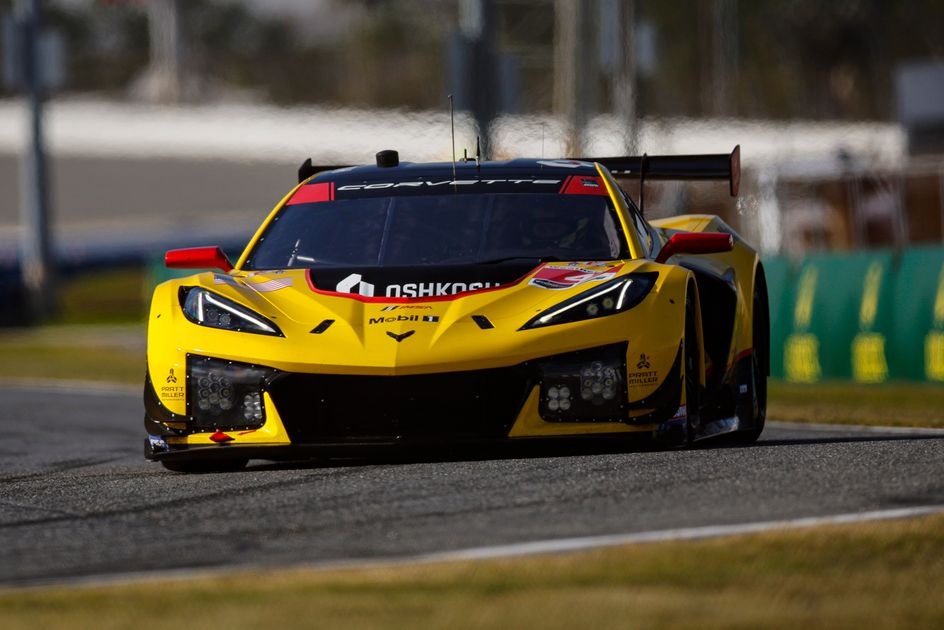
In GTD Pro, the picture has changed compared to the "Roar before the Rolex 24," just like in the GTP class. This comes as no surprise, as Kenny Habul, team owner of 75 Express Racing and himself a driver in the Mercedes-AMG #75 (Habul/Engel/Power/Mostert), described the times at the "Roar" in the run-up to the event as "bullshit" in an interview with Motorsport-Total.com.
The first "real" times were therefore eagerly awaited, although the times in free practice in GTD Pro should still be treated with caution.
We took all the times in GTD Pro that were under 1:53 minutes and calculated the average again. This gives the following picture for the three individual sessions:
The #14 Vasser-Sullivan Lexus (Hawksworth/Barnicoat/Kirkwood) only set meaningful times in the first free practice session. In night practice, they only managed a handful of slow laps over 1:53 minutes, and in the third practice session, they didn't even go out. This was a planned measure, as the sister car from GTD also remained in the pits during the third practice session.
However, the overall picture of all three sessions is more exciting than the individual practice results. Viewed in this way, the picture looks as follows:
1. Pratt-Miller Corvette #4 - 1:48.286 (69 laps under 1:53 minutes)
2. Pratt-Miller Corvette #3 - 1:48.352 (70)
3. GetSpeed Mercedes #69 - 1:48.418 (55)
4. Multimatic Ford #65 - 1:48.613 (26)
5. Manthey Porsche #911 - 1:48.616 (84)
6. 75-Express-Mercedes #75 - 1:48.657 (54)
7. Triarsi-Ferrari #033 - 1:48.702 (68)
8. Multimatic-Ford #64 - 1:48.743 (26)
9. Vasser-Sullivan-Lexus #14 - 1:48.793 (23)
10. RLL-McLaren #59 - 1:48.827 (64)
11. Risi-Ferrari #62 - 1:48.838 (44)
12. AO Porsche #77 - 1:48.866 (52)
13. Paul-Miller-BMW #1 - 1:48.975 (29)
14. Winward-Mercedes #48 - 1:49.105 (64)
15. Pfaff-Lamborghini #9 - 1:49.216 (42)
Although no longer at the very front, Mercedes-AMG is still in a good position, especially with its factory drivers. The minimum driving time for the two bronze drivers Kenny Habul (#75) and Scott Noble (#69) was reduced by IMSA from four and a half to three and a half hours in order to maintain a level playing field.
However, the new favorites are the two Corvette Z06 GT3.R cars from Pratt Miller Motorsports, which clearly have the best average. The two Ford Mustang GT3 Evo cars have fallen slightly behind compared to the Roar and have only completed a small number of laps under 1:53 minutes, but these were competitive.
Manthey Racing is a real bright spot in fifth place overall. The high number of laps completed in under 1:53 minutes also indicates that the "Grello" can replicate the times. Nevertheless, expectations in the Porsche camp were rather subdued on Friday. The AO Porsche "Rexy" was a quarter of a second slower on average.
Ferrari, Lexus, and Ford form the midfield, which also includes the RLL McLaren #59 (Esterson/N. Johnson/Vips/MacDonald). For them, however, the priority is to get through. The undertaking is completely new, and of the drivers, Max Esterson is already the most experienced with a single IMSA race under his belt.
Improvements compared to the "Roar"
Compared to the preliminary test, there have been some significant improvements:
1. GetSpeed Mercedes #69 - 0.964 seconds faster than at the "Roar"
2. Paul Miller BMW #1 - 0.948
3. Pratt-Miller-Corvette #4 - 0.903
4. Winward Mercedes #48 - 0.865
5. Manthey Porsche #911 – 0.823
6. RLL McLaren #59 – 0.819
7. Pratt-Miller-Corvette #3 - 0.778
8. AO Porsche #77 - 0.732
9. Triarsi-Ferrari #033 - 0.610
10. Multimatic-Ford #65 - 0.403
11. Vasser-Sullivan-Lexus #14 - 0.392
12. Risi Ferrari #62 - 0.320
13. Multimatic-Ford #64 - 0.286
14. 75 Express Mercedes #75 - 0.146
15. Pfaff-Lamborghini #9 - -0.005
The improvement of the two Mercedes-AMG cars from GetSpeed and Winward comes as no surprise, as they were still far behind in the preliminary test. The Paul Miller BMW #1 (Verhagen/de Phillippi/Hesse/Harper) also shows a strong improvement after a rather disastrous preliminary test, but is still stuck at the back of the field in terms of average times.
At around 0.7 seconds, the median improvements were significantly greater than in the GTP class, which underscores Habul's statement. There was probably a lot of sandbagging going on in the preliminary test. The AMG #75, on the other hand, improved by only 0.146 seconds. This shows that this team played with its cards on the table from the start.
Ford also made below-average gains compared to the Roar, which slightly set back the Mustangs in the debut of the Evo package. The improvement of the Grello, but also of the McLaren, is unmistakable.
Conspicuously inconspicuous: Ferrari. The two 296 GT3s from Triarsi and Risi have been so restrained so far that it's almost striking. Ferrari is also making its debut with an Evo package. Even if the times so far don't indicate it, it would be a mistake to write off the prancing horse at Daytona.
Pfaff Motorsports put in a puzzling performance. In the first free practice session, the Lamborghini Huracan GT3 Evo2 still had the best average of all GTD Pro cars in its farewell race for the team. Then it disappeared into thin air and was ultimately even five thousandths of a second slower than in the pre-test. It is possible that double stints were attempted here, as there is no other explanation for the sudden slump.
As always in GTD Pro, the real balance of power will only become apparent late in the race. However, the fact that all 15 cars finished within one second of each other on average shows that the BoP got some things right.