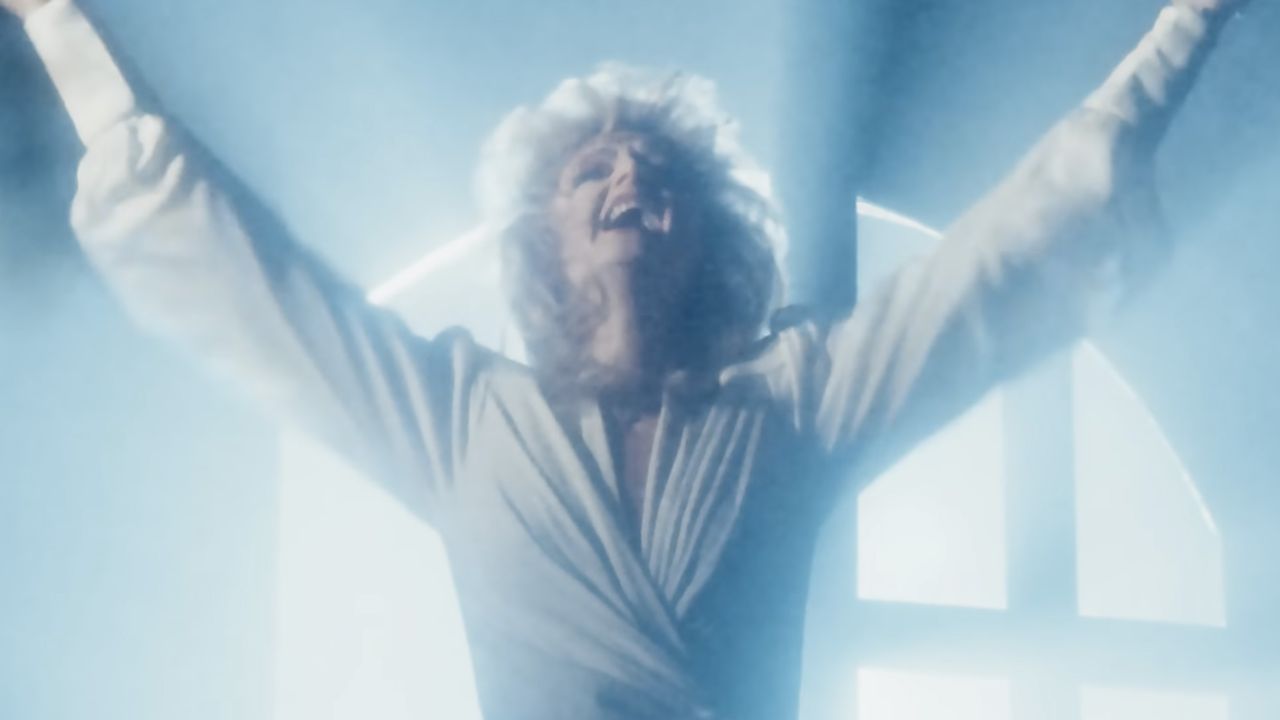
Few songs merit the term ‘power ballad’ quite as emphatically as Total Eclipse Of The Heart, the 1983 mega-hit for Welsh singer, Bonnie Tyler, which shot to No.1 in the UK, US and all across the world, and which, on 26 January 2026, surpassed one billion streams on Spotify.
Total Eclipse Of The Heart has everything a great power ballad needs – melodrama, bombast, massive hooks, a blistering build-up and a voice and lyrics that inspire and excite.
Admittedly, it’s all subtle as a flying mallet at times, but that’s the whole point. This is emotion writ large and it’s all delivered with straight-for-the-jugular emotional impact.
Total Eclipse Of The Heart was written and produced by Jim Steinman, who was best known for writing Meat Loaf’s Bat Out Of Hell album (1977).
Steinman had been a student at Amherst College, Massachusetts in 1969 when he wrote an experimental musical called The Dream Engine. The musical featured nudity. It also featured the line “turn around bright eyes”, which became a pivotal lyric in Total Eclipse Of The Heart.
The song had dark origins, as Steinman told Playbill magazine in 2002.
“I was trying to come up with a love song… its original title was Vampires In Love because I was working on a musical of Nosferatu… if anyone listens to the lyrics, they're really like vampire lines. It's all about the darkness, the power of darkness and love's place in the dark."
Reportedly written during a lunar eclipse, the song remained unfinished when the musical was shelved. Steinman next revisited it when Bonnie Tyler contacted him 13 years later.
By 1982, Tyler had racked up four albums and come a long way from her humble beginnings in the village of Skewen, South Wales.
Born Gaynor Hopkins, she was the daughter of a coal miner and grew up with five siblings in a four-bedroomed council house. She started out as a backing singer and changed her name to Sherene Davis to avoid being confused with the singer Mary Hopkin.
In 1975, she was spotted singing in a Swansea club by a talent scout, which led to RCA Records offering her a record deal. When RCA requested another name change, she hit on Bonnie Tyler.
Her first single flopped but the follow-up Lost In France (1977) reached No.9 in the UK, No.2 in South Africa and charted in Europe and Australia.
Then, in the spring of 1977, an event occurred that gave her the distinct vocal sound for which she would become known. Tyler underwent surgery to remove vocal cord nodules and was advised to rest her voice for six weeks. One day, she screamed with frustration, which resulted in a permanent raspy tone.
“After I got my voice back, I went into the studio for the first time and started singing,” Tyler told The Guardian in 2009. “The band said, ‘Woah, your voice sounds great’. My voice was huskier than before, and had more of an edge… I had my first hit in America with my new husky voice on It's A Heartache.”
Released in 1977, It’s A Heartache reached No.1 in Spain, Sweden, Norway, France, Brazil, Canada, Argentina and Australia and went top five in the UK, US and seven other countries.
Her second studio album Natural Force went platinum but follow-up albums Diamond Cut and Goodbye To The Island fared less well, with the latter only charting in Norway.
By 1982, her career was floundering. RCA offered to extend her contract for another five years, but Tyler declined. Instead, she signed with another label and began looking for a whole new sound.
“I’d just signed to Sony and wanted to change from country rock to rock,” Tyler told The Guardian in 2023. “I’d seen Meat Loaf on the BBC’s Old Grey Whistle Test doing Bat Out Of Hell, so I told [A&R man] Muff Winwood that I wanted to work with Jim Steinman. Muff looked at me like I was barmy and told me that Jim would never do it. ‘I just want you to ask him,’ I said.”
For her next album, Tyler wanted the production to emulate Phil Spector’s Wall Of Sound. As Spector had all but retired, she felt Steinman was the only producer capable of achieving such a sound.
Steinman initially declined Tyler’s request, but after hearing demos of her singing he was swayed, explaining that she had “the perfect voice” for the sound he was striving to achieve.
In April 1982, Tyler and her manager visited Steinman in his New York apartment, where he played her two of his favourite songs – Creedence Clearwater Revival’s Have You Ever Seen the Rain? and Blue Öyster Cult’s Goin’ Through the Motions.
Steinman wanted to gauge her reaction to these songs. Tyler’s response was overwhelmingly positive and Steinman agreed to produce her next album, Faster Than The Speed Of Night. Tyler would cover both songs on the album.
Steinman told People magazine that he wrote Total Eclipse Of The Heart as a showcase for Tyler’s voice. “It sounds ravaged,” he said, “like it's been through a lot. It's what rock 'n' roll is all about.”
He said the song was like “an aria to me, a Wagnerian-like onslaught of sound and emotion”.
A few weeks after their first meeting, Tyler returned to Steinman’s apartment, where he and Canadian vocalist Rory Dodd performed the newly-written Total Eclipse Of The Heart. The song was written as a duet and it was Dodd who would sing the line “Turn around bright eyes”.
Tyler was transfixed by what she heard. “I just had shivers right up my spine,” she told The Times, “I couldn't wait to actually get in and record it.”
Power Station in midtown Manhattan was one of three New York studios chosen by Steinman for the album, and the song was recorded and mixed in the summer of 1982.
When it came to selecting musicians, Steinman recruited some real heavyweights.
On drums was Max Weinberg from Bruce Springteen’s E-Street Band while his equally revered bandmate Roy Bittan played the iconic piano part.
Rick Derringer handled guitar duties and the line-up also included veteran Meat Loaf bassist Steve Buslowe. Larry Fast and Steve Margoshes were on synths while Jimmy Maelen handled percussion.
Total Eclipse Of The Heart is an epic emotional journey and everything about the song is maxed out. As Craig Marks of Time magazine noted in 2024, “Steinman didn’t do understated”.
Steinman built his mixes like Broadway productions and he honoured Tyler’s desire for the symphonic, reverb-laden Spector-style Wall Of Sound. Steinman and engineers Neil Dorfsman and John Jansen fully exploited Power Station's echoey stairwells for optimum reverb, while Steinman’s musical theatre background and Wagnerian strains came to the fore.
“It makes you feel like you're a Norseman in a blizzard,” observed Dr Freya Jarman, from the University of Liverpool's department of music, in an interview with BBC Culture.
In 1983, Tyler told North Carolina newspaper Times-News that the song was "a challenge [to sing]”, adding, “I like songs that need a lot of energy. It’s such a passionate song and it builds all the time… it’s incredible.”
Total Eclipse Of The Heart was recorded at Power Station while backing vocals were recorded at the nearby Right Track Studios.
In an interview with Mix magazine in 2024, engineer Neil Dorfsman says the track was cut live in studio A of Power Station with drummer Max Weinberg and bassist Steve Buslowe in the rhythm room, Roy Bittan in the piano booth and Tyler singing live with Rory Dodd in separate isolation booths. Rick Derringer’s guitar part and Larry Fast’s synth parts were overdubs.
Dorfsman told Mix magazine that Tyler and the band laid down about 20 takes of the track, which included the live lead vocals. He remembers that during the mixing in Studio B at Power Station, they literally ran out of reverb, as every reverb send on every fader on the desk was as far up as it could go, on everything but the kick drum and bass guitar.
Producer and engineer Frank Filipetti was in charge of recording the majority of the background vocals at Right Track Studios.
A “vocal tour de force” is how Filipetti described Total Eclipse Of The Heart. “Jim wasn’t as interested in adhering to traditional ways of doing things. He was always looking for something a little different. He was more interested in the emotional arc that the song was taking rather than going by the verse-chorus-verse-chorus-bridge formula. In doing so, his music took you on a journey.”
The multiple recording and stacking of backing vocals was arduous, recalled Filipetti, but the results were worth it. “Jim really treated everyone first class, so it made all the hard work something you wanted to do.”
The track was mixed on the evening of 4 July 1982 during a 12-hour session at the Power Station’s studio B.
“You can tell from the final mix that Jim wanted the biggest drum sound to ever have been recorded,” Dorfsman told Mix magazine. “In the ’80s there was a competition to see who could have the loudest snare drum… I just remember all the faders just creeping, creeping, creeping, creeping.”
Everything about Total Eclipse Of The Heart is grandiose and it builds and builds, with dramatic shifting keys fuelling the intensity.
A plaintive piano melody intros the song, before Dodd’s sweet, haunting tenor on opening refrain “Turn around” is followed by Tyler’s soulful, gravelly vocal on the first line: “Every now and then I get a little bit lonely/And you're never coming 'round”.
After the first chorus, at 1:50, the whole walloping track powers upwards – “Together we can take it to the end of the line/Your love is like a shadow on me all of the time” sings Tyler in powerful gravelly tones.
Even from a distance of over four decades, Max Weinberg’s snare still sounds all-encompassingly massive in the mix.
There’s a depth and richness to Tyler’s voice as the song develops. It’s powerful, heartrending and defiant, and the call-and-response of Tyler’s and Dodd’s voices creates a compelling contrast.
Total Eclipse Of The Heart was released on 11 February 1983. Steinman’s theatricality made him an easy target for critics. Writing in the Sunday Telegraph, Trevor Dann denounced the song’s lack of subtlety, suggesting that “Bonnie should be taken to see a Joni Mitchell concert”. The Guardian, meanwhile deemed it an “amusing, mildly camp curiosity”.
But Steinman’s theatrical impulses are precisely what make the song so thrilling and audacious.
Legendary songwriter Diane Warren – a doyenne of the power ballad who wrote or co-wrote classics such as Cher’s If I Could Turn Back Time – has nothing but praise for Steinman and Tyler’s achievement.
“It’s a perfect song,” Warren told Time magazine in 2024. “And Bonnie really conveys the drama. That voice brought Jim’s song to life.”