It initially looked like unusual underwater mounds off the California coast but turned out to be something far more extraordinary. Scientists later discovered that the massive structures were ancient asphalt volcanoes formed from hardened crude oil over thousands of years. The findings, published in Nature Geoscience, have also revealed how these extinct formations may have reshaped marine life in the distant past.
Scientists found giant underwater domes off California
When researchers first identified a cluster of strange underwater domes off the coast of Santa Barbara, California, in 2007, they knew they had found something unusual. Years of exploration eventually revealed the remarkable truth. The giant mounds were extinct asphalt volcanoes built from hardened petroleum and marine debris over many decades, or even centuries.
The seven domes lie about 700 feet beneath the ocean surface, roughly 10 miles offshore from Santa Barbara. According to research published in Nature Geoscience, recent dives using the submarine robot Alvin showed that the largest mound stretches as wide as two football fields placed side by side and rises to the height of a six-story building, as per National Geographic.
Unlike traditional volcanoes that erupt molten rock, these formations were created primarily from crude oil.
Lead study author David Valentine, an earth scientist at the University of California, Santa Barbara, explained just how enormous the deposit is. "If I could convert all the asphalt in the largest volcano to gasoline, it would be enough to fuel my Honda Civic for about half a billion miles."
However, he also pointed out that extracting the material would not be worthwhile because its quality is poor compared with lighter crude oil.
What exactly are the underwater domes?
Researchers analyzed samples collected from the structures and concluded they were built gradually through repeated petroleum flows. Evidence suggests the volcanoes last erupted around 35,000 years ago, although building the massive domes likely took decades or even centuries.
For Christopher Reddy, co-author of the study and director of the Woods Hole Oceanographic Institution, the discovery offered a rare opportunity to study ancient petroleum.
"To me, as an oil-spill chemist, this was very exciting. I got to find out what oil looks like after ... 35,000 years."
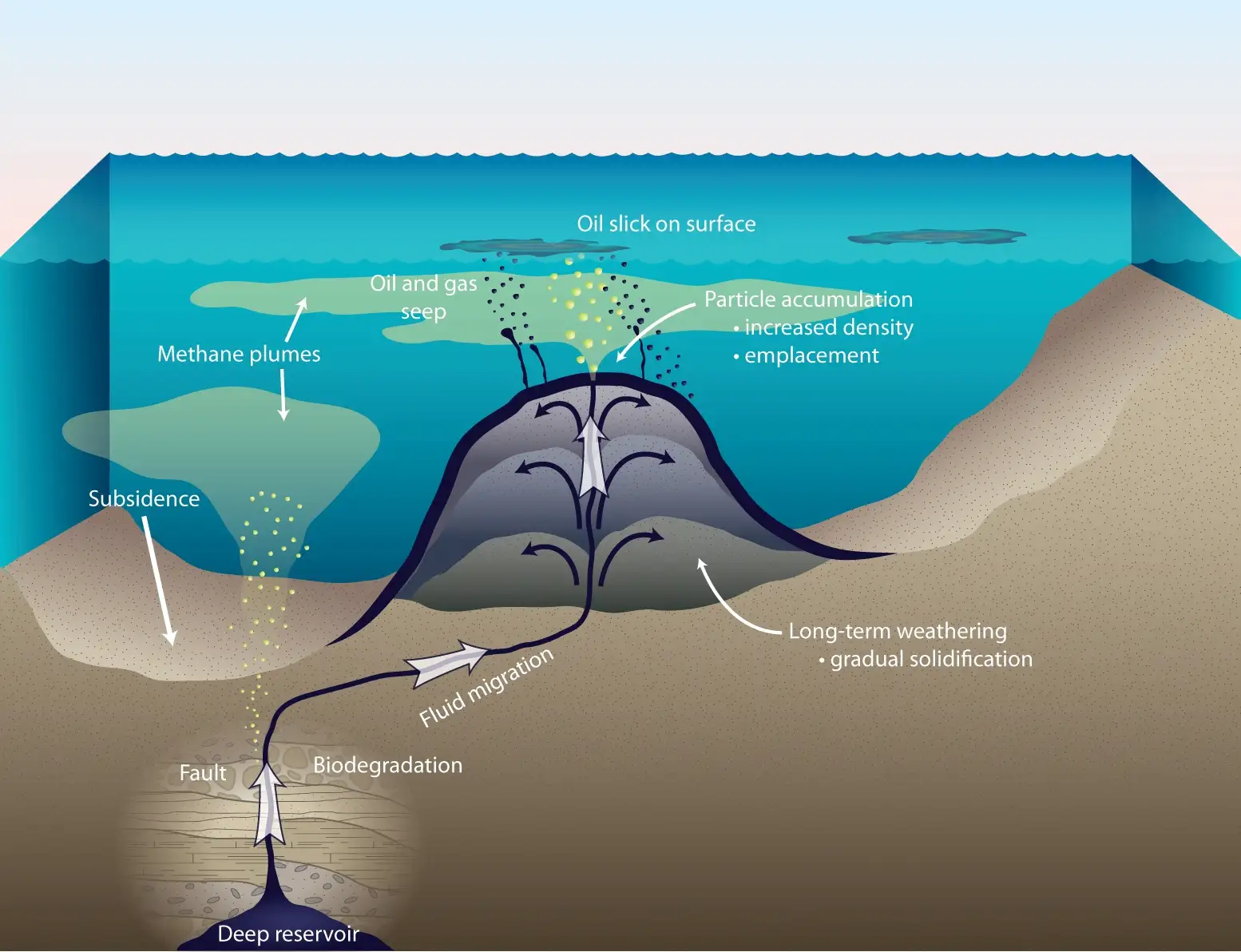
Scientists believe these eruptions occurred where natural oil and gas deposits leaked from deep within the Earth. Although the exact mechanism driving asphalt volcanoes remains unclear, methane gas is still bubbling up near the ancient domes today, even though petroleum flow stopped thousands of years ago.
How did the asphalt volcanoes form?
The researchers suggest the eruptions may explain a mysterious spike in ocean methane recorded roughly 35,000 years ago. Methane released alongside petroleum could have fueled large populations of methane-consuming marine bacteria. As those bacteria multiplied, they would have consumed oxygen from the surrounding seawater, creating a vast "dead zone" where many marine organisms could not survive.
The eruptions also likely produced enormous oil slicks as lighter petroleum components floated to the ocean's surface.
The heavier petroleum behaved differently. Because it had not spent enough time deep underground to fully transform, it remained thick and viscous. Instead of rising, it settled on the seafloor, gradually trapping sand, microscopic organisms and floating debris.
Valentine explained the process, "When we take that material and dissolve away all the oil ... about 20 percent of the mass is accumulated junk."
He added, "As those things accumulated in the [petroleum], it became heavier and settled back down to the seafloor." Over countless years, repeated layers hardened into the giant asphalt mounds scientists see today.
Why are scientists still fascinated by them?
While similar underwater asphalt structures have been identified elsewhere, including the Gulf of Mexico, they remain relatively rare.
Tom Lorenson, a geologist with the U.S. Geological Survey who was not involved in the study, noted that similar formations may also exist in the Caspian Sea, the eastern Mediterranean Sea and possibly the Persian Gulf. However, he questioned whether the California domes are truly 35,000 years old, pointing out that their relatively bare surfaces appear younger than other known asphalt mounds, as per National Geographic.
Another researcher, Ian MacDonald, a biological oceanographer at Florida State University, suggested that petroleum composition may influence how much marine life colonizes each mound, making age estimates based solely on biological growth more difficult.
Despite the debate over their exact age, scientists agree on one important point. These ancient formations created something extremely rare on the deep ocean floor.
MacDonald explained, "Processes that produce hard substrates in the deep ocean are rare. ... Generally speaking, the deep ocean is a muddy place."
He added, "I think it's really cool that there's this other process that we didn't really know about before that, at least in some places, is making pretty extensive hard bottoms for animals to colonize."
The discovery not only revealed an unusual type of extinct volcano but also showed how ancient geological events may have helped shape entirely new habitats for marine life beneath the Pacific Ocean.
FAQs
What are California's asphalt volcanoes made of?They are mainly formed from hardened crude oil mixed with marine debris and fossils.
Why are the asphalt domes important?
They provide rare hard surfaces that allow deep-sea marine life to settle and grow.