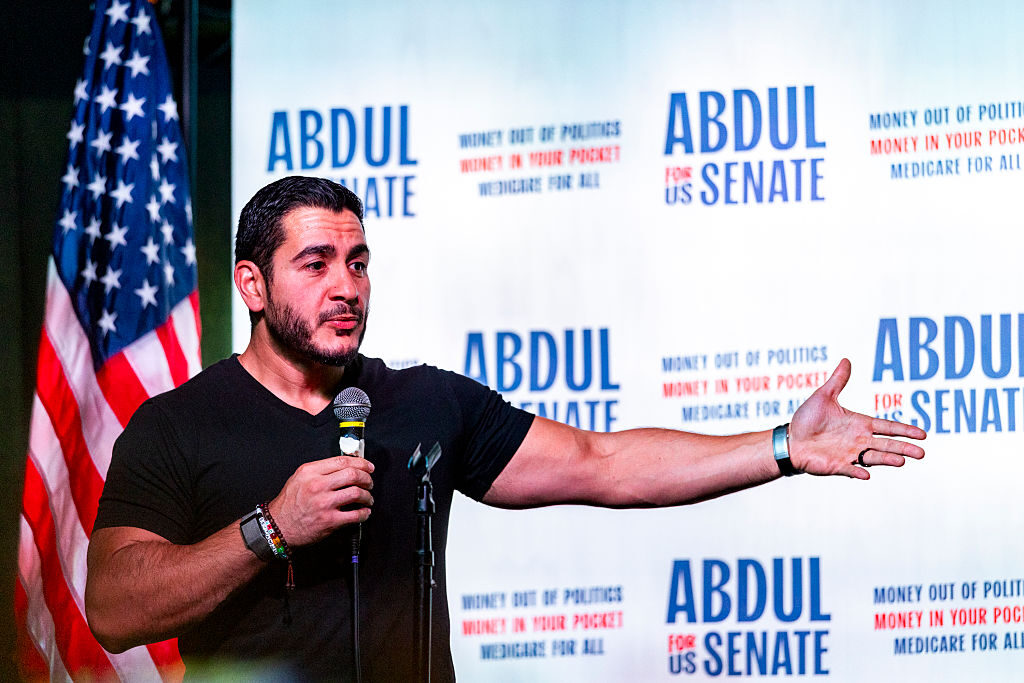
Michigan’s Democratic Senate primary has been among the most contentious elections so far this year.
With a week to go until the Aug. 4 primary, the matchup that pits Rep. Haley Stevens and former Wayne County public health official Abdul El-Sayed highlights the ongoing tension between the party’s moderate and progressive wings.
The winner will face former Rep. Mike Rogers, who is unopposed for the Republican nomination, in a state that both parties consider a priority. For Democrats, holding on to retiring Sen. Gary Peters’ seat is critical to their hopes of winning control of the chamber. For Republicans, flipping the seat could help either pad their majority or serve as a buffer against losses elsewhere.
Stevens, a centrist who has represented suburban Detroit since 2019, has cast herself as the better general electron candidate. Her campaign on Tuesday pointed to a July 22-24 Glengariff poll commissioned by the Michigan Education Association and Business Leaders for Michigan that found her in a statistical tie with Rogers, 46 percent to his 45 percent, in a hypothetical matchup. In contrast, the same poll showed Rogers leading El-Sayed, 49 percent to 39 percent.
“Abdul is running for celebrity. Republicans are propping up his campaign,” Stevens said Monday at their final primary debate, pointing to a report that Rogers said on a private phone call that his campaign would be in “good shape” if El-Sayed emerged as the Democratic nominee.
Stevens won an endorsement Friday from Gov. Gretchen Whitmer, who joined other Democratic establishment figures such as Peters and Senate Minority Leader Charles E. Schumer in backing the congresswoman.
But El-Sayed, seeking to capitalize on Democratic voters’ recent support for outsider candidates, has campaigned with progressives such as Vermont Sen. Bernie Sanders and Massachusetts Sen. Elizabeth Warren, as well as New York Rep. Alexandria Ocasio-Cortez.
Spending by pro-Israel groups has become a major factor in the race. El-Sayed has attacked the congresswoman over her support for ongoing U.S. military aid to Israel and the millions spent on her behalf by groups supportive of the Jewish state. He noted at Monday’s debate that Stevens was among the House Democrats who opposed an amendment earlier this month meant to block U.S. military aid to Israel. Stevens has also benefited, as of last week, from $25 million in spending by the United Democracy Project, the political arm of the American Israel Public Affairs Committee.
El-Sayed has also argued his opponent was too closely tied to corporations, which Stevens pushed back on.
“I’m the only candidate in this race who doesn’t take any money from corporations, never have, never will, and then from there I actually can stand up to them,” he said.
Inside Elections with Nathan L. Gonzales rates the Senate race a Toss-up.
House races
The Wolverine State is also playing host to several key House races, including a handful that could be critical to determining which party wins the majority this fall.
In the battleground 7th District, three Democrats are vying to challenge Republican freshman Tom Barrett, who flipped the Lansing-anchored seat Democrat Elissa Slotkin vacated for her successful Senate run in 2024.
The contenders include Bridget Brink, who resigned as U.S. ambassador to Ukraine last year, retired Navy SEAL Matt Maasdam and William Lawrence, a co-founder of the progressive group Sunrise Movement. Polling on the race has been sparse, but the campaign has gotten tense in recent weeks as outside groups have ramped up spending.
Slotkin is supporting Maasdam, who also has the backing of several labor groups, while Brink has several Lansing officials and EMILY’S List and the Elect Democratic Women PAC in her corner. But the two more establishment-oriented candidates could split the centrist vote, creating a lane for Lawrence, the more progressive candidate, to emerge with the nomination Tuesday.
Lawrence, who campaigned with Sanders last month, has come under scrutiny for past comments criticizing Black Democratic leaders. Rolling Sea Action Fund, a group which focuses on Black voters, has spent $1 million opposing his campaign.
That’s just one of the outside groups that have engaged in the race. Another, Michigan Sunrise PAC, which formed earlier this month and won’t have to disclose its donors until after the election, has spent $658,000 as of Tuesday to oppose Maasdam and support Lawrence. Democrats suspect the outfit is a Republican front group seeking to boost Lawrence as the weaker general election candidate, similar to what’s happened in a handful of other battleground races this year.
Inside Elections rates the 7th District race a Toss-up.
The 10th District, which GOP Rep. John James is vacating for a gubernatorial run, is also likely to be a competitive fall matchup. Trump carried the district, located north of Detroit, by 7 points two years ago and Inside Elections rates the race Tilt Republican.
Army veteran Michael Bouchard Jr., who is endorsed by Trump and the National Republican Congressional Committee, is likely to emerge from a three-way primary.
Democrats also have a three-way primary between former special victims prosecutor Christina Hines, former state House Minority Leader Tim Greimel and former Commerce Department attorney Eric Chung.
Hines, who recently released a poll showing her leading the primary, has emphasized her ties to Macomb County, while Chung is the race’s fundraising leader.
And in the deep-blue 13th District, Democratic Rep. Shri Thanedar faces a primary threat from state Rep. Donavan McKinney, the strongest challenge the incumbent has faced for his Black plurality Detroit-area seat since his 2022 election.
McKinney, who is Black, drew endorsements this week from several members of the Congressional Black Caucus, including former Chair Steven Horsford and Reps. Ayanna S. Pressley, Ilhan Omar, Summer Lee and Lateefah Simon. They followed other notable progressives in backing the state legislator, including Sanders and Michigan Rep. Rashida Tlaib and groups such as Justice Democrats and the Working Families Party.
Thanedar, an entrepreneur who has largely self-funded his campaigns, reported a significant cash advantage over McKinney earlier this month, with $5 million on hand as of July 15, compared with McKinney’s $143,000.
Both candidates have also received outside support. Progressive groups such as Justice Democrats, Indivisible Action and National Nurses United have all spent in support of McKinney, while Thanedar has gotten support from the crypto-backed group Protect Progress and the National Association of Realtors Political Action Committee.
Two other House races in Michigan are also likely to draw national attention this fall. Democratic Rep. Kristen McDonald Rivet is defending her Flint-based seat that Trump carried two years ago. But the freshman appears to be on strong footing, with Inside Elections recently shifting the race rating to Likely Democratic. Republican Amir Hassan is endorsed by Trump and the NRCC, but faces two other candidates in Tuesday’s primary.
Democrats are also targeting the 4th District seat held by GOP Rep. Bill Huizenga. State Sen. Sean McCann, who faces one other Democrat in Tuesday’s primary, is on the Democratic Congressional Campaign Committee’s “Red to Blue” program for strong recruits. Inside Elections rates the race Lean Republican.