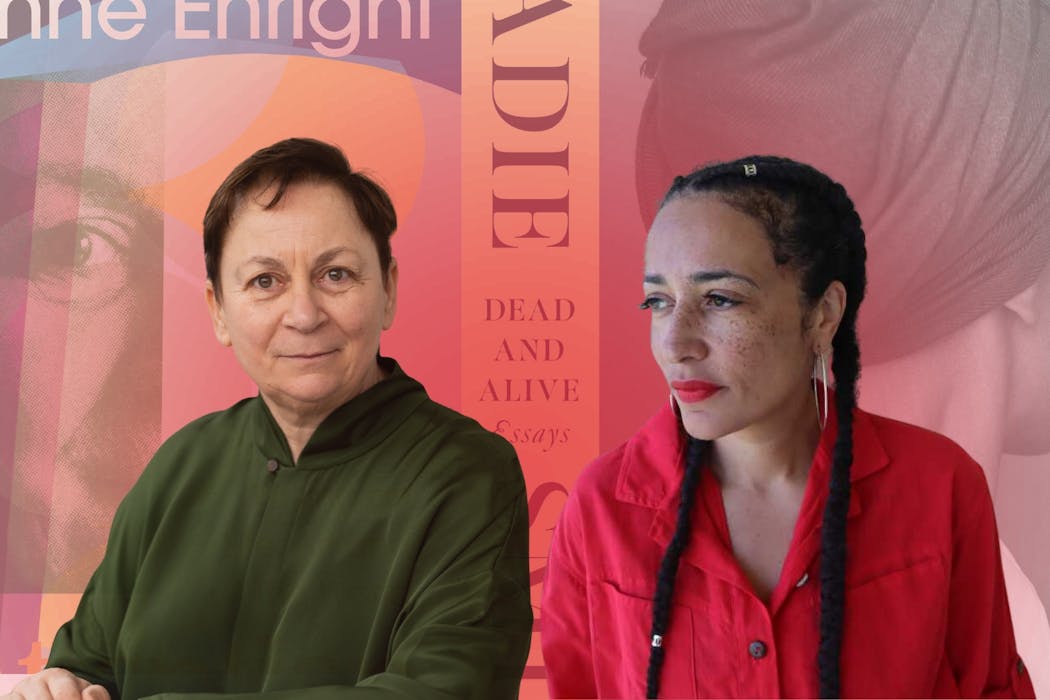
Essay collections gather a writer’s thoughts over time and can be read as an oblique form of memoir, one in which the self is revealed through a series of conversations with the world.
Two new collections by celebrated novelists – Zadie Smith’s Dead and Alive and Anne Enright’s Attention: Writing on Life, Art and the World – tell the stories of our time from within the unfolding cultural moment. The essay, as it appears in these collections, is a response to minds, art, communities and culture, understood through a writer’s body, intellect and being.
Different sensibilities are at work in these collections, but a quotation from each might give an overall sense of the mode. Smith writes:
the people we tend to call geniuses are in reality always in communication with other minds, other artists, their own communities and the culture at large.
Enright, writing on Helen Garner’s diaries, notes something Garner’s former husband “V” said of her:
You think things right through, by prisming them through yourself.
The new commons
Smith has been famous since the publication in 2000 of White Teeth, her dazzling novel of multicultural London, but she has become known as a public intellectual as well as a novelist. She is a prolific essayist. Dead and Alive draws on the past decade, during which she has published two other collections: Intimations and Feel Free.
In her foreword, Smith writes that her essays often emerge from an encounter. This might be with art, film, politics, urban life, history (particularly Black history), literature or writers themselves. The collection includes obituaries for the likes of Toni Morrison, Hilary Mantel and Martin Amis.
These encounters are of their time. “This book cannot scrub its history as the ground shifts beneath it,” Smith writes. “It is not being written by an infinite and eternally unscrolling artificial intelligence, but by a human being in a particular moment.”
Smith is concerned with real people, real intelligence, language formed by experience, and communication with others through writing and reading. Certain terms and themes recur: the crucial and continually eroded space of the commons; freedom in reading, writing and life; language as container and tool, and sometimes as a “battlefield”; and a continual negotiation of self in relation to the larger culture. Thoughts on the predations of the internet and AI work their way through many of these essays.

For Smith, the essay is an important site of the “commons”, originally the place where different interest groups came together to resist the enclosure of open land. As with this earlier space of resistance, it provides a forum in which one might tap into what she calls “solidarity in alterity”.
“Essaying,” Smith wrote recently in the New Yorker, is “a stumbling attempt to recreate, in language, a common space, one that is open to all.”
This tension between difference and togetherness is central to Smith’s essays, particularly in those about the act of writing itself. In a much-discussed essay from 2019, Fascinated to Presume: In Defense of Fiction, she explores the idea of cultural appropriation in fiction. At the time, it was a hot and divisive topic. It is still simmering away in many a creative writing workshop. Marginalised writers, Smith argues, have justifiably sought freedom from the “limited – and limiting – fantasies and projections of other people”. Nevertheless, she resists the idea
that we can and should write only about people who are fundamentally “like” us: racially, sexually, genetically, nationally, politically, personally […] I do not believe that. I could not have written a single one of my books if I did.
Walt Whitman’s line, “I contain multitudes”, has been used as a defence of the ways in which novelists cannibalise the experiences of others to create their worlds. A different American writer, Smith ventures, might offer a friendlier, more curious approach. Emily Dickinson measures “every Grief I meet”, wondering whether it weighs similarly to her own. Dickinson is “fascinated to presume” that some griefs may be understandable in these terms.
We have something in common with other people, Smith argues, and a curiosity about their griefs is an important capacity of writing and reading. She continually seeks ways to navigate between “I” and “we” through language. In a later essay on writing, she asks, via a consideration of James Baldwin:
What would a sentence look like that didn’t follow a formula? One that remains connected to the mysteries of personhood but also committed to the story of the people?
These are sentences in which we are offered “complex depictions of human consciousness”. Identity – one’s story of oneself, as Smith puts it – has shared realities, but is irreducible. This is the essence of art, why it is so necessary.
Shared realities are significant to Smith’s thinking. An ode to Stormzy at Glastonbury begins by referring to the British rapper as “our young black king”. It is a thrilling story of “arrival”, not just of a talent beloved by his community, but of the day
when the hyphenated “Black-British” would appear, to the English ear, as permanent and central a condition as “African American”.
In essays about art and ways of seeing, Smith identifies a similar crime in racism and misogyny: a failure to recognise the agency of the person or people being seen. The subjects of colonial art, she writes, are “never exotic in and of themselves […] they sit at the very centre of their own worlds”.
In her reading of a memoir by Celia Paul – muse to Lucian Freud, but more fundamentally an artist and writer – Smith describes Paul crying through sittings, unable to see her own ambition as Freud reduces her to object. Smith concludes that misogyny is “a form of distortion, a way of not seeing”.
In Toyin Ojih Odutola’s Visions of Power, Smith argues that “love is radical” because “it forces us into a fuller recognition of the other”. Drawing on the work of philosopher Frantz Fanon, in a formulation that feels fundamental to the collection – and to fiction – she proposes that, in the artist’s overturning of colonial power structures, “the right of every being to its dignity is recognized. That is decolonisation.”
Voices, bodies and time
The essays of Booker Prize-winning Irish novelist Anne Enright have a similar commitment to the dignity of the too-often disregarded self. The collection is divided into three sections: Voices, Bodies and Time. These are broadly focused on literature, women and workers, and memory. The question of time is present from the outset, in the brief reflections that preface each essay.
The first piece, The Cat Sat on the Mat, is a brief excerpt from a lecture Enright gave as Laureate for Irish Fiction. It tells the maddening story of an experiment by novelist Catherine Nichols. Sending out queries to agents, Nichols found that she was eight and a half times more likely to receive a positive response if she replaced her name with “George”.
The lecture from which the piece was taken was given in November 2016, the month Donald Trump defeated Hilary Clinton, and its preface includes the following thoughts:
Here is a piece from a mere eight years and two lifetimes ago. In the first lifetime, the work of women writers started to get its due; in the second, everything else happened.
Enright’s prefaces ask the reader to think about how things have gone since the essay’s appearance. In the preface to another essay, titled The Monsters of #MeToo, she writes: “I am glad I was here to record this moment, before the push-back came.” Recalling the outpouring of stories of sexual assault following the exposure of Harvey Weinstein’s crimes, she draws attention, in the essay itself, to the way time works on the understanding of an event:
It is difficult to remember a time when this information was new – perhaps it never was – but there was a day – two years ago – when it was all said together…
This consideration of how the moment unfolds, registers, lingers, and is possibly disavowed, calls attention to the relationship between essays and our understanding of events. Essays are not quite the “first draft of history” attributed to journalism. They carry the charge – the disruptive energy – of the moment, but time, knowledge and synthesis are brought to bear.
Essays of this kind do not claim objectivity. One of the compelling qualities of The Monsters of #MeToo, and others in the collection, is the controlled fury evident in the accumulation and placement of stories of injustice. The wry tone and graceful orchestration of thoughts draw you in and enable you to share the anger, without being consumed by it.

Stories, to this most literate of intellects, are a way to think through the forms of wrong. In Antigone in Galway, the unsettled dead of Sophocles’ play are brought into relation with the 796 unlocated dead babies and children of the Mother and Baby Home in Tuam, Galway.
In her recounting of the facts and her reading of Antigone, Enright amplifies the question of what justice is owed to the dead. Her discussions with local historian Catherine Corless, who first raised the question of where these dead children had been buried, open up the wider shame of the Magdalene Laundries in Ireland, where “fallen women” were confined, and the discovery of other mass graves.
Discussions of literature – and the lives of writers – allow Enright to ask powerful questions. She reflects on the story of Canadian Nobel laureate Alice Munro, whose daughter Andrea revealed, after Munro’s death, that she had been abused by her stepfather Gerald Fremlin. Munro suppressed her knowledge of the abuse in order to stay with her husband, to the lasting pain of her daughters.
Other essayists have also explored the ways in which Munro’s secrets now seem to vibrate powerfully in the stories. As much as we may wish to keep the lives of writers separate from their work, there are instances where it is just not possible.
An early book of Munro’s was titled The Lives of Girls and Women, and it is perhaps her lifelong commitment to this subject matter that made her a writer who inspired fierce love. Enright recalls being an exchange student in Canada and walking into Munro’s Books in Victoria, British Columbia, where she was given life-changing books by Munro and Margaret Atwood. She has read Munro all her life and finds that she cannot retract her love for her writing: “it was too freely given”.
But her final paragraph is given to Munro’s daughters, in which she quotes Andrea’s sister, Jenny Munro:
Whether people love her fiction or hate it doesn’t matter. Andrea’s truth is here to stay.
There is much compelling work on writers and writing in Enright’s collection. Essays rather than reviews, these explorations are not confined to the pages of particular books. An essay on James Joyce’s Ulysses spills over into memories of first readings (“at fourteen, it was like mainlining language”), shared locations (Enright once “lived in sin” in the house of a minor character) and the language of Dublin: “tricks of speech that are as real and abiding as the streets of the city that Joyce worked so hard to recreate”.
In writing about Ulysses, it seems, naturally, that Enright cannot help but write about her life, place, language, memory and culture. Yet she does so without ever reducing the vivid strangeness of the book to something wholly knowable.
Joyce returns in an essay titled Dublin Made Me, along with other figures of Irish literature, whose lives and work overlap with Enright’s. Family stories, contentious memories and literary lives are laid over the living map of her city. Earlsfort Terrace, where she was born, is a street she experiences “in many dimensions; the map gives way to previous maps as the decades swap and speak to each other”. The poet Derek Mahon, she says, “knew how the city yielded itself without warning to every past version of itself”.

Enright the novelist is present, as always. She ends this essay with the story of her first journey home as a newborn, her father driving slowly with the window open a crack to let his cigarette smoke escape, children and a neighbour gathering to welcome the baby home.
Her parents appear here and there, most movingly in two essays in which she describes clearing out their house. She comes upon an X-ray of her father’s “long thigh bones”, the index of his “great size”. After her mother’s death, she lingers in the kitchen, looking at the crockery and towels, measuring “every tiny choice in its balance of frugality and pleasure”.
I was reminded, in these moments, of Enright’s fiction: the way her details require a moment’s pause before continuing to read.
Both of these collections by cosmopolitan, publicly engaged writers are threaded through with tenderness for people and home. The interplay of the personal with the larger world makes them human and humane, providing courageous and enlivening company in dizzying times. Like their novels, the essays of these gifted writers offer stories to help us make sense of it all, or at least keep us company, like a funny straight-talking friend. People and art can be wonderful, they say. On we go.

Belinda Castles does not work for, consult, own shares in or receive funding from any company or organisation that would benefit from this article, and has disclosed no relevant affiliations beyond their academic appointment.
This article was originally published on The Conversation. Read the original article.