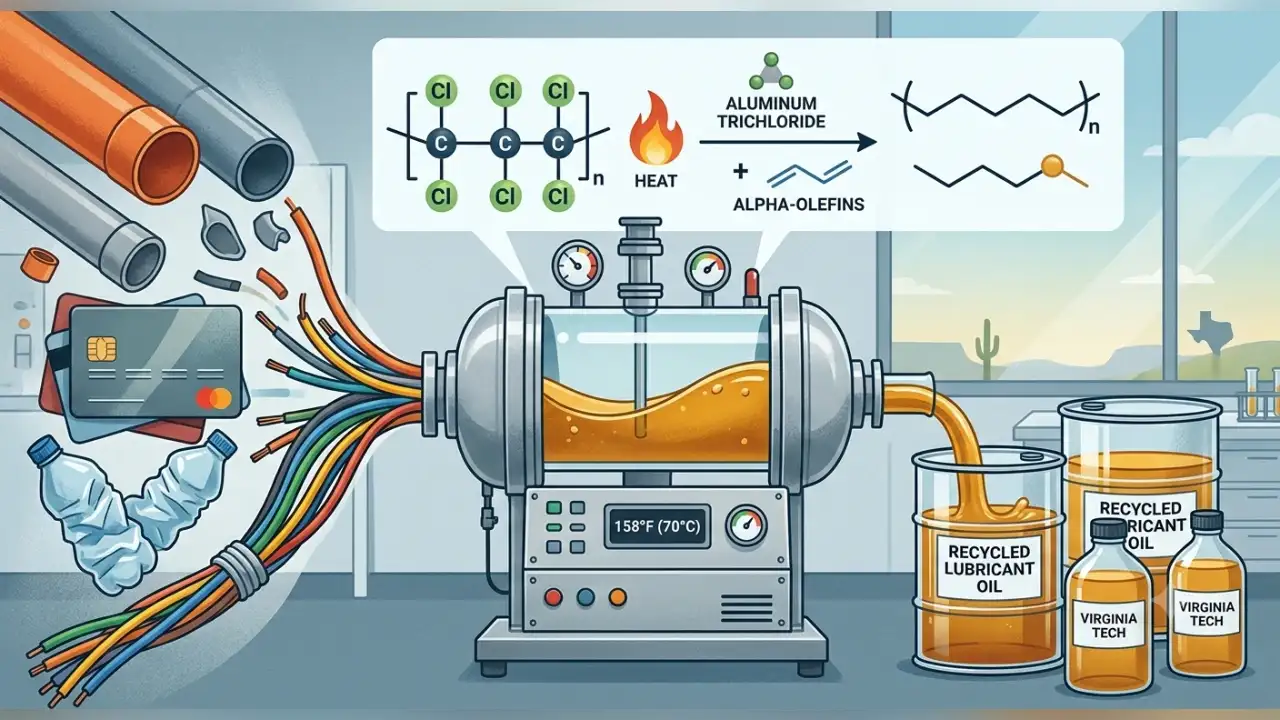
PVC is used in daily-use products ranging from pipes and credit cards to plastic bottles and electrical cable insulation. Around 40 million tons of the material are produced each year, but its additives and high chlorine content make it one of the more difficult plastics to recycle. The vast majority ends up in landfills.
Researchers at Virginia Tech have developed a process that breaks down discarded PVC and produces a thick oil that can be used as a lubricant. The study, published in Nature, describes how the plastic can be converted into a different useful material rather than being treated only as waste.
Why PVC is such a difficult plastic to recycle
Guioliang “Greg” Liu, a chemical engineer at Virginia Tech, and his team were interested in finding another use for PVC because of the way its molecules can be activated. The researchers believed that replacing the chlorine atoms could allow the polymer to be converted into other useful molecules, as per a Popular Science report.
Their first attempts, however, produced a material that was too soft and gooey for high-performance industrial lubricants. That setback led Liu to rethink how far the polymer chains should be broken down.
The process uses heat and chemicals
The researchers place PVC in a solvent with compounds including aluminum trichloride and alpha-olefins. The mixture is heated for three hours at 158°F.
The treatment breaks the polymer chains into smaller segments that can mimic lubricants, producing a substantially thick oil.
Liu described the change in approach after the early experiments failed. He said, “One day I realized—if this polymer is so gooey and so soft, why don’t I just keep breaking the polymer chains down to smaller segments that mimic lubricants?” as quoted in Popular Science.
After further refinement, the team produced a comparatively eco-friendly oil that could potentially be used in industrial lubricants.
The researchers are still working on the process
The Virginia Tech team is now working to make the method more sustainable, scalable and affordable for general use.
The research provides a potential way to give discarded PVC another use by converting it into an oil rather than attempting to turn it back into the same type of plastic.
For Liu, the result also highlights the importance of a material that often goes unnoticed. He said, “Lubricants are the silent hero out there. We often don’t recognize they exist, but they are out there working quietly,” as quoted in Popular Science.