The grapefruit found in Texas grocery stores today has an unusual connection to the early days of atomic research.
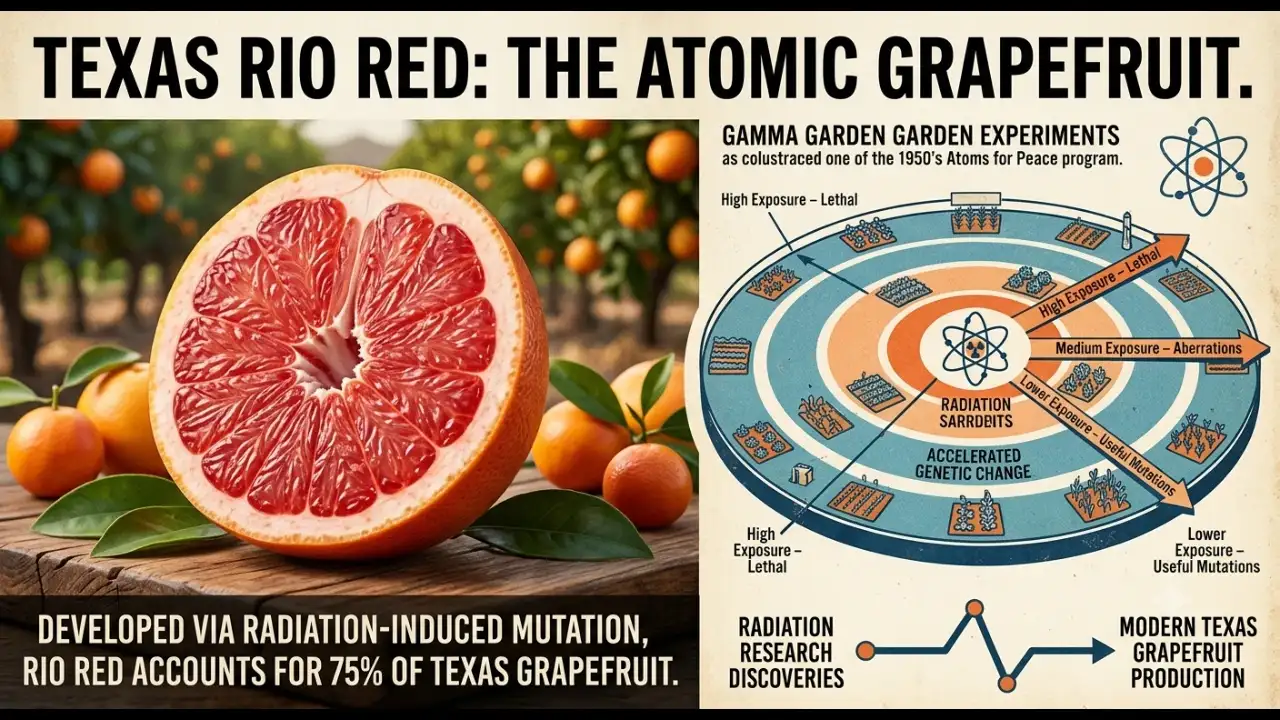
In 1984, researchers at Texas A&M University developed the Rio Red grapefruit using radiation-induced mutations, as per a report. The variety produced vibrant pink flesh, proved hardier, and produced more fruit than other grapefruit varieties.
More than four decades later, Rio Red accounts for around 75% of all grapefruits produced in Texas. The story behind its success began long before the variety itself was developed, when scientists were learning how radiation could alter living things.
Grapefruit started as an accidental hybrid
Grapefruit itself was not created through a planned breeding program. The first known grapefruit seedling appeared in Barbados in the 18th century after a Jamaican sweet orange crossed with an Indonesian pomelo, as per a Popular Science report. Early English colonists called the fruit “forbidden fruit.”
A naturally occurring mutation produced the first pink grapefruit in 1906. Growers liked the new color and began propagating the pink-fleshed fruit. But the grapefruit varieties that later became popular in Texas had a different connection to radiation research.
Radiation became a tool for changing plants
The scientific story began in the late 19th century with the discovery of X-rays and radioactivity.
In 1896, Wilhelm Roentgen discovered X-ray fluorescence. Two years later, Marie and Pierre Curie discovered radium while working with uranium ore and introduced the term “radioactivity” for the energy it emitted, as per the Popular Science report.
Radiation was initially celebrated for its potential uses. Over time, however, scientists learned that radioactive materials could cause serious harm.
Researchers also discovered that radiation could alter the DNA of living organisms by breaking molecular bonds or causing mutations that could be passed to future generations. That eventually led to experiments using radiation to deliberately create changes in plants.
The rise of the gamma garden
By the 1950s, the United States was promoting peaceful applications of nuclear technology through the Atoms for Peace program.
One result was the development of so-called gamma gardens, research facilities designed to study how radiation affected plants.
These gardens were often arranged in large circles around a radiation source. Plants were placed at different distances from the source and exposed to different levels of radiation.
The strongest exposure usually killed plants. Other levels could produce abnormal growth or other damage. Farther away, researchers could find mutations that were potentially useful.
The approach essentially accelerated genetic changes that would otherwise occur naturally over much longer periods.
Rio Red emerged from this research
Texas A&M University used radiation-induced mutation to develop Rio Red in 1984. The resulting grapefruit had the vibrant pink flesh that consumers associated with pink and ruby-red varieties. It was also hardier and produced more fruit than other grapefruit varieties.
The new traits helped the variety become widely grown in Texas. Today, Rio Red accounts for around 75% of all grapefruits produced in the state.
The legacy goes beyond grapefruit
Grapefruit was not the only crop affected by radiation-based plant research.
Descendants of irradiated plants include a peppermint variety resistant to a serious fungal disease. Radiation research also contributed to Calrose rice, now the most common rice produced in California, and Golden Promise, a high-yield barley variety that became popular in the 1970s and 1980s, as per the Popular Science report.
Gamma gardening has largely faded, although radiation-breeding facilities have continued to exist, including one in Japan.