

तमसो मा ज्योतिर्गमय।
मृत्योर्मा अमृतं गमय॥
Most people don’t wake up one day and decide to “follow” Hinduism. They grow into it through everyday life, through family habits, moral choices, festivals, food, and the way they are taught to understand success, failure, time, and responsibility. That is why many people who identify as Hindu struggle to explain what Hinduism actually is. It does not behave like other religions.
Hinduism has no single founder, no compulsory belief system, no formal conversion process, and no central authority that defines who belongs and who does not. What it offers instead is Sanātana Dharma, a framework for living that has evolved alongside civilization itself. Calling this vast, adaptive system a religion may sound convenient, but it hides more than it explains.
1. The Concept of “Religion” Did Not Exist When Hinduism Took Shape
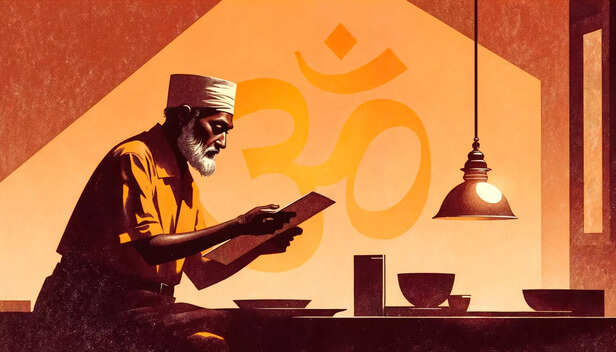
The word religion comes from the Latin term religio, which refers to binding belief, obligation, or worship toward a deity. This concept emerged in a specific historical and cultural context in the West. Ancient India did not have an equivalent term.
Texts like the Vedas, Upanishads, and Dharmashastras never describe themselves as a religion. Instead, they speak of dharma, which refers to sustaining order, ethical responsibility, and harmony. Scholars such as Radhakrishnan and Wilhelm Halbfass have noted that applying the word religion to Hindu traditions is an act of translation, not equivalence.
Hinduism developed long before the idea of organized religion existed. Labeling it as such retroactively forces it into a framework it was never designed to occupy.
2. Sanātana Dharma Means Eternal Law, Not Faith System
Sanātana Dharma translates to eternal order or timeless law. It does not describe belief in a god, prophet, or scripture. It describes principles that govern existence, such as cause and effect, moral responsibility, and the interdependence of life.
The Vedas focus heavily on ṛta, the cosmic order that sustains the universe. Dharma emerges as the human expression of that order. One’s duty changes with age, role, profession, and context. This makes Hinduism adaptive rather than prescriptive.
Religions typically define universal rules applicable to all followers. Sanātana Dharma defines contextual responsibility. That difference alone places Hinduism closer to a way of life than a belief based religion.
3. Hinduism Encourages Questioning, Not Blind Acceptance

Most religions have a final authority, whether a book, a prophet, or a central institution. Hinduism has none. The Vedas, Upanishads, Epics, Puranas, Agamas, and philosophical schools often present differing viewpoints.
For example, Advaita Vedanta argues that reality is non dual, while Dvaita Vedanta insists on eternal duality. Sāṃkhya philosophy is non theistic, while Bhakti traditions are deeply devotional. These systems contradict each other philosophically, yet all coexist within Hindu thought.
A system that allows internal contradiction without collapse is not enforcing belief. It is encouraging exploration. This intellectual openness is incompatible with the structure of organized religion.
4. Hinduism Prioritizes Practice Over Belief
In Hindu thought, belief is secondary to conduct. One may question the existence of God and still follow dharma. Schools like Cārvāka openly rejected metaphysics and divinity, yet existed within the Hindu philosophical ecosystem.
The Bhagavad Gita emphasizes karma yoga, right action without attachment to outcome. Ethical living is valued more than verbal affirmation of belief. Rituals exist, but they are tools, not mandates.
Religions usually define identity through belief. Hinduism defines maturity through behavior. This focus on living rightly rather than believing correctly aligns more with philosophy and ethics than religion.
5. There Is No Concept of Conversion or Exclusive Identity
Hinduism has no scriptural mandate for conversion. There is no initiation that declares entry, nor any excommunication for departure. Identity is fluid. One can practice yoga, meditation, devotion, or philosophy without formal affiliation.
Historically, Hindu society absorbed ideas from Buddhism, Jainism, local traditions, and later even Islamic and Christian influences in regional practices. This porous boundary shows that Hinduism was never designed to compete for followers.
Religions are usually exclusive by definition. Hinduism is inclusive by structure. A system that does not demand allegiance cannot be accurately described as religion.
6. Hinduism Integrates Spirituality With Social and Material Life

In many religions, spiritual life is separate from worldly life. Hinduism rejects this division. It recognizes four legitimate pursuits known as puruṣārthas: dharma, artha, kāma, and mokṣa.
Wealth, pleasure, duty, and liberation are all valid goals when pursued responsibly. Texts discuss governance, economics, family structure, sexuality, medicine, ecology, and warfare alongside metaphysics.
This integration shows that Hinduism is concerned with total life management, not just salvation or worship. It functions as a civilizational operating system rather than a religious institution.
7. Hinduism Evolves Without Losing Its Core
Sanātana Dharma is described as eternal not because it is rigid, but because it adapts. Over centuries, Hindu thought absorbed new languages, sciences, philosophies, and social changes.
Yoga evolved from ascetic practice to global wellness science. Ayurveda interacts with modern medicine. Meditation is studied by neuroscience. These adaptations occur without central approval because Hinduism has no centralized authority.
Religions often preserve original forms to maintain purity. Hinduism preserves principles while allowing form to change. That evolutionary resilience is a defining trait of living philosophies, not static religions.