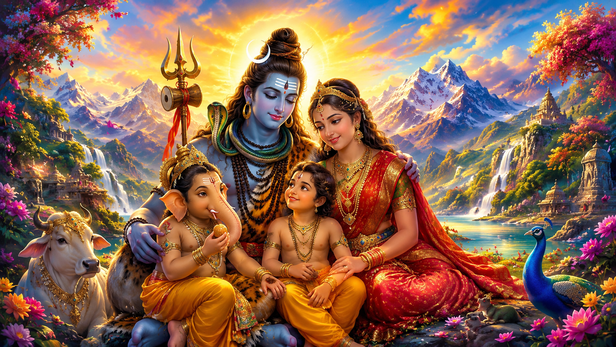
At first glance, Lord Shiva's family appears ordinary to devotees. But look a little deeper, and a fascinating mystery emerges. The snake around Shiva's neck is a natural predator of the mouse, which serves as Lord Ganesha's vehicle. The peacock of Kartikeya can prey on snakes, while Nandi the bull could easily become prey for Maa Durga's lion. In nature, these creatures are connected through fear, survival, and conflict. Yet, in Shiva's divine family, they coexist peacefully. Why? What message is hidden behind this extraordinary arrangement? The answer may hold one of the most profound lessons about harmony, coexistence, and human society.
A Family Unlike Any Other
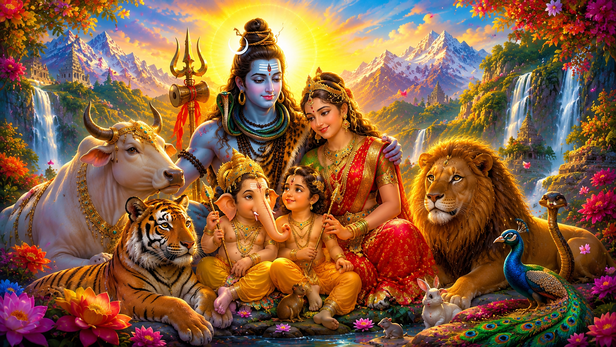
The most remarkable aspect of Shiva's family is that its members represent creatures that would rarely coexist in nature. A snake and a mouse, a peacock and a snake, a lion and a bull all are connected through the cycle of predator and prey. Yet, in Kailash, there is no fear, no chase, and no violence. This is not a coincidence. Hindu symbolism uses these relationships to show that when higher consciousness guides life, even the strongest differences can exist together. The family becomes a living example of unity beyond natural instincts.
The Message Hidden in the Snake and Mouse
In the natural world, a mouse fears a snake because survival depends on avoiding danger. Yet Ganesha's mouse and Shiva's serpent share the same sacred space. This powerful image suggests that fear is not the foundation of life. When wisdom and divine awareness enter the picture, fear begins to dissolve. The symbolism encourages people to rise above suspicion and hostility. Communities often break apart because individuals focus on differences. Shiva's family teaches that trust and understanding can transform even the most unlikely relationships into peaceful coexistence.
Why the Peacock Changes Everything
The peacock, vehicle of Lord Kartikeya, naturally preys on snakes. Yet the peacock does not attack Shiva's serpent. This detail carries a profound lesson. Power does not become meaningful when it dominates others; it becomes meaningful when it is controlled. The peacock demonstrates restraint despite possessing strength. In human life, many conflicts arise because people use power to prove superiority. The symbolism here suggests that true strength is not aggression but self-control. The ability to live peacefully with those who are different reflects a much higher form of power.
The Lion and Nandi Share the Same Space
Maa Durga's lion and Shiva's beloved Nandi symbolize another extraordinary contrast. One represents fierce power, while the other represents patience and devotion. In the wild, their relationship would be defined by survival. But within the divine family, both serve higher purposes. This teaches that balance emerges when every being understands its role. Society often struggles because individuals compete for dominance. The lion and Nandi reveal that peace becomes possible when strength and humility work together instead of against each other.
Harmony Is Greater Than Similarity
Many people believe harmony exists only when everyone thinks alike. Shiva's family challenges that idea completely. Every member is different in nature, appearance, and symbolism. Yet those differences do not create division. Instead, they create completeness. Diversity is not presented as a problem but as a strength. The deeper lesson is that unity does not require uniformity. Families, communities, and nations become stronger when differences are respected rather than feared. This ancient symbolism remains incredibly relevant in today's divided world.
A Lesson Modern Society Often Forgets
Modern life is filled with disagreements over beliefs, backgrounds, and identities. People increasingly see differences as threats rather than opportunities for growth. Shiva's family offers a powerful alternative perspective. It reminds us that coexistence is possible when mutual respect becomes more important than personal ego. The divine family does not erase differences; it honors them. This message feels especially relevant in a world where division often dominates public conversations. The symbolism encourages people to seek understanding before judgment.
The Real Meaning of Kailash
Kailash is more than the home of Lord Shiva. Symbolically, it represents a state of consciousness where fear, conflict, and hostility lose their power. Every creature there exists without anxiety because each one is protected by a higher sense of purpose. The deeper message is that true harmony begins within. When individuals overcome fear, jealousy, and ego, peaceful coexistence becomes possible. Kailash reminds us that the most sacred place is not merely a mountain it is a mindset where every living being is accepted and respected.
Unlock insightful tips and inspiration on personal growth, productivity, and well-being. Stay motivated and updated with the latest at My Life XP.
Frequently Asked Questions (FAQs)
1. Why do natural enemies coexist peacefully in Lord Shiva's family?Lord Shiva's family symbolizes harmony beyond natural instincts. Animals that are predators and prey in nature live together peacefully to convey the message that higher wisdom, mutual respect, and divine consciousness can overcome fear and conflict.
2. What does the snake around Lord Shiva's neck represent?
The snake symbolizes power, awareness, transformation, and control over fear. It also reminds devotees that potentially dangerous forces can be mastered and transformed through spiritual wisdom.
3. Why is Lord Ganesha's vehicle a mouse?
The mouse represents desires, restlessness, and the wandering mind. By riding the mouse, Lord Ganesha symbolizes mastery over desires and teaches that wisdom should guide impulses rather than be controlled by them.
4. What is the significance of Kartikeya's peacock?
The peacock symbolizes courage, victory, beauty, and the ability to overcome negative tendencies. Its peaceful coexistence with Shiva's serpent reflects the idea that strength should be guided by discipline rather than aggression.
5.What do Nandi and Maa Durga's lion symbolize?
Nandi represents devotion, patience, loyalty, and righteousness, while the lion symbolizes courage, strength, and divine power. Together, they demonstrate that humility and strength can coexist harmoniously.