The Numbers Are Stranger Than You Think
The African elephant sleeps roughly two hours per night, often while standing. The little brown bat, Myotis lucifugus, sleeps close to twenty hours. The domestic cat, which most Indian households treat as an occasional visitor or a permanent resident depending on the building's bylaws, averages fifteen hours. These are not approximations, sleep researchers have measured them with electroencephalogram recordings across dozens of species, and the spread is enormous.
What determines where a species lands on this scale? Three things, primarily: metabolic rate, predator exposure, and the caloric cost of the food that species eats. Small animals burn energy fast. A shrew's heart beats over a thousand times per minute. Its metabolism is so rapid that sleep, which is when cellular repair, memory consolidation, and immune function happen, must be compressed into high-intensity bursts. Large herbivores on open plains cannot afford long unconscious stretches. A sleeping wildebeest is a dead wildebeest.
What REM Sleep Tells Us About a Brain
REM sleep, rapid eye movement sleep, is where most dreaming happens, and it correlates strongly with brain complexity and social learning. Mammals and birds experience REM. Reptiles show something resembling it, but the debate among sleep scientists about whether it is genuinely homologous to mammalian REM is still active. Fish and insects show sleep-like states, periods of reduced responsiveness and metabolic slowdown, but no confirmed REM equivalent.
The platypus is the most startling case. It logs more REM sleep than almost any other mammal, sometimes eight hours of it per day. Jerome Siegel at UCLA's Center for Sleep Research has studied platypus sleep and found that its high REM proportion may reflect the brain's need to process complex sensory information, the platypus hunts using electroreception, detecting electrical fields from prey in murky water. That is a cognitively demanding skill. The brain apparently needs the extra processing time.
Dolphins and certain whales solve the predator-versus-sleep problem differently. They practice unihemispheric slow-wave sleep: one brain hemisphere sleeps while the other stays awake. The animal keeps swimming, keeps breathing, keeps one eye open, literally. Bottlenose dolphins have been observed doing this for days at a time during long ocean crossings.
Nocturnal Animals and the Circadian Shift
Most nocturnal animals did not start out nocturnal. The leading theory, supported by genomic studies published in Science in 2017 by a team at University College London, is that early mammals were pushed into nocturnality by dinosaur predation over roughly 166 million years. They evolved better night vision, sharper hearing, and a circadian rhythm tuned to darkness. When the dinosaurs disappeared, many mammal lineages moved back toward daylight, but the nocturnal wiring stayed partially intact, which is why even humans retain some sensitivity to light-dark cycles that goes far deeper than just feeling sleepy at night.
The circadian rhythm itself is driven by a cluster of about 20,000 neurons in the hypothalamus called the suprachiasmatic nucleus. Every vertebrate studied has one. The genes that run it, Clock, Bmal1, Per1, Per2, are so conserved across species that a mouse Clock gene can partially restore circadian function in a fruit fly with a broken clock gene. The mechanism is ancient. What varies is how each species has tuned it to its ecological niche.
Hibernation Is Not Sleep, But It Reveals Something About Both
Bears, hedgehogs, and ground squirrels hibernate. During hibernation, body temperature drops, heart rate crashes, and metabolism slows to a fraction of its waking rate. A hibernating Arctic ground squirrel can drop its core body temperature to below freezing, minus 2.9 degrees Celsius, without dying. But here is the counterintuitive finding: hibernating animals are actually sleep-deprived. Their brains, during torpor, are not getting the restorative sleep they need. Studies on ground squirrels show that they periodically wake during hibernation specifically to sleep properly, full, normal sleep, before going back into torpor.
This tells us that sleep is not just rest. It is a specific biological process that even metabolic shutdown cannot replace. The brain needs it separately from the body's need for energy conservation. That distinction matters for understanding why sleep disorders in humans are not simply fatigue problems, they are failures of a repair process that evolution has been refining for hundreds of millions of years.
What Pets Reveal When You Watch Them Sleep
Indian households that keep dogs will have noticed that a street dog adopted off the road sleeps very differently from a dog that has never experienced predator threat. Street dogs sleep lightly, often with one ear tracking sound, and wake fast. Dogs raised entirely indoors from puppies often sleep heavily, on their backs, completely exposed, a posture no wild canid would risk. The depth and posture of sleep is a direct readout of felt safety.
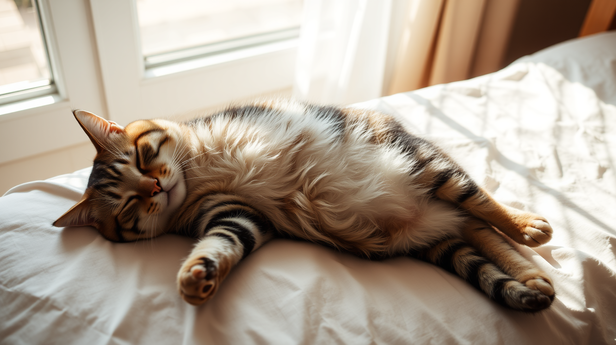
Cats show something related. A cat that sleeps curled tight is thermoregulating and maintaining a defensive posture. A cat that sleeps fully stretched, belly exposed, has assessed its environment as safe. These are not personality quirks, they are evolved responses that the animal's nervous system is running automatically, regardless of whether there is any actual threat in a third-floor Mumbai apartment.
The variation in animal sleep cycles is not biological noise. Each species' sleep architecture is a compressed record of its evolutionary pressures, what ate it, what it had to find and eat, how much brain it needed to run, and how safe it ever got to feel. When a cat stretches out across your bed at 2 a.m. and sleeps like it owns the place, it does. It's just that the ownership is written in a hundred million years of survival math.