
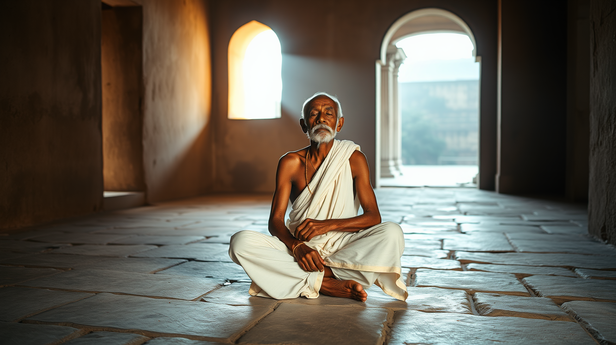
The mind the texts begin with is not peaceful
Patanjali opens the Yoga Sutras with a definition, not an instruction. Yogas chitta vritti nirodhah, yoga is the cessation of the fluctuations of the mind. The word chitta covers the entire field of mental activity: memory, ego, intellect, the restless surface that registers every sensation and immediately begins interpreting it. The vrittis are these fluctuations, not thoughts exactly, but the movement that generates thought, the constant modifying of awareness by whatever it touches. The texts do not frame this as a problem to fix. They frame it as the default condition of a mind that has not yet been trained. You are not broken. You are simply unsteady, the way a lamp is unsteady in wind.
The Bhagavad Gita uses exactly that image. In Chapter 6, verse 19, Krishna describes the mind of the yogi in deep meditation as a lamp in a windless place, yatha dipo nivata-stho, the flame that does not flicker. The verse is not describing an achievement. It is describing what the mind becomes when the wind stops. The question the texts spend thousands of verses answering is: what stops the wind?
The first thing that changes is where attention lands
Patanjali's eight-limbed path places dharana, dhyana, and samadhi as its final three stages, and they are not separate practices. They are the same practice at increasing depth. Dharana is holding attention on a single point, a mantra, the breath, a form. The mind still wanders. You bring it back. This is not meditation yet in the sense the texts mean. It is the preparation for meditation, the way tuning an instrument is not yet music.
Dhyana begins when the gaps close. The mind no longer alternates between the object and distraction. It stays. The Yoga Sutras describe this as an unbroken flow of awareness toward the object, tatra pratyaya-ekatanata, a continuity of the same mental content. What changes is not the object but the quality of contact with it. The mind stops producing commentary. It stops comparing this moment to the last one. The ordinary cognitive machinery, the part that names, evaluates, and files experience, goes quiet. You are still conscious. But the self-narrating voice that usually runs underneath everything has stopped narrating.
Then the one who is watching disappears
Samadhi is where the texts become difficult to translate without losing the point. The Yoga Sutras describe two broad forms. Sabija samadhi, samadhi with seed, is a state of absorption so complete that the boundary between the meditator and the object of meditation dissolves, but a subtle impression remains. The mind has merged with what it was contemplating, but the capacity for individuation has not been extinguished. Nirbija samadhi, without seed, is the state the texts treat as the furthest the mind can go. No object. No impression. No observer. Patanjali's Yoga Sutras 1.3 states what remains: tada drashtuh svarupe avasthanam, then the seer abides in its own nature. The seer, not the seen. Not a thought, not a feeling, not a state that can be described from outside itself.
This is the point at which the Yoga Sutras and the Upanishads converge. What the meditating mind arrives at is not emptiness. It is something the texts insist cannot be reached by the mind's usual operations, only by the mind becoming still enough to stop obscuring it.
What the Upanishads say is underneath
The Mandukya Upanishad maps four states of consciousness: jagrat, the waking state; svapna, the dreaming state; sushupti, deep dreamless sleep; and turiya, the fourth. The first three are states the ordinary mind moves through without choosing. Turiya is not a state in the same sense. The Mandukya describes it as that which is aware of all three states but is not itself any of them, the witnessing ground that does not come and go. Deep meditation, in the Upanishadic understanding, is not the creation of turiya. It is the removal of everything that was covering it.
This is where the texts make their most radical claim about the mind. The chitta, all that mental activity, all those vrittis, is not the mind's true nature. It is what the mind does when it is not resting in atman. Consciousness, in the Upanishadic view, is not produced by the brain or the body. It is the substrate. The mind in deep meditation does not generate a new state. It stops generating the noise that made the substrate invisible.
The Kena Upanishad asks directly: who is the knower behind the knower? The eye cannot see itself seeing. The mind cannot think the thought that thinks. What the ancient texts are pointing at is not a mystical experience layered on top of ordinary consciousness. It is ordinary consciousness stripped of its additions, down to whatever was there before the additions began.
What this means for the mind that tries
The texts are not describing something that happens to exceptional people in mountain caves. Patanjali's Yoga Sutras were written as a technical manual. The Upanishads were taught in dialogue, teacher to student, in the forests outside ordinary life, but the forests were accessible. The practice was considered learnable. What the texts insist on, across every school, is that the mind cannot be forced into samadhi. Dharana can be forced. Dhyana cannot. Samadhi is what happens when dhyana is sustained long enough that the meditator stops trying to meditate.
This is the paradox every serious practitioner eventually meets. The mind that wants to reach samadhi is precisely the mind that must go quiet for samadhi to occur. The wanting is a vritti. The striving is a vritti. The ancient texts do not resolve this by telling you to stop wanting. They resolve it by giving you so much to do, posture, breath, withdrawal of the senses, concentration, that by the time you reach the final stages, the doing has exhausted itself.
What remains when the doing stops is what the texts were pointing at from the first line.
The mind that emerges from deep meditation, even a partial approach to these states, is not the same mind that sat down. The ancient Indian understanding is not that meditation calms you. It is that meditation shows you what was always there beneath the calm and the agitation both, and that what was there has no edges you can find.