Good morning. What a difference a new job can make. “To have a shot at staying within 1.5C global warming, we can’t have any new oil or gasfields … It’s irresponsible and shortsighted to be funding new #fossilfuels when we need to be getting to #NetZero.”
This was the 2022 message from Miatta Fahnbulleh, now the secretary of state for energy security and net zero. It’s a testament to her remarkable rise that Fahnbulleh wasn’t even an MP when she posted it four years ago. Today, she is in the cabinet, facing (or is the face of, at least) one of the most challenging, and potentially controversial questions looming for the new government: to drill or not to drill, baby?
Two sites are the focus of fierce debate. Yesterday, a public consultation on whether to greenlight extraction at one of them – Jackdaw – closed. Next Monday, it’ll be the same for the other, Rosebank. Andy Burnham has been silent about the climate crisis since taking office. As we enter yet another heatwave, what his government does next will be a defining signal of intent on the issue.
But what would extraction actually mean, and how many options are open to Fahnbulleh? That’s the subject of today’s First Edition, after a roundup of this morning’s headlines.
Five big stories
-
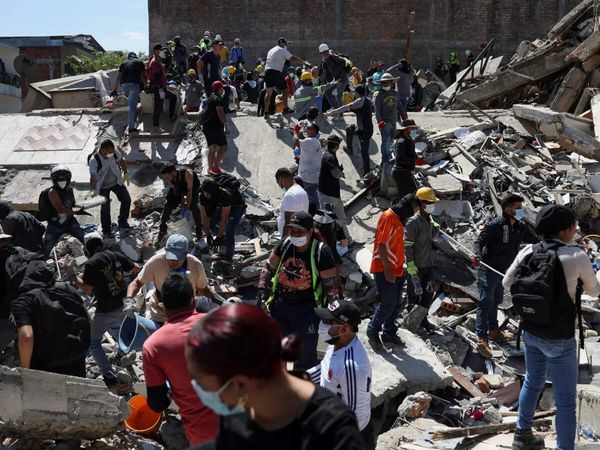
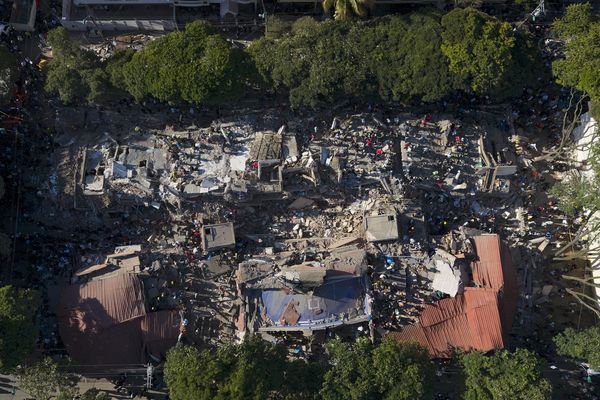
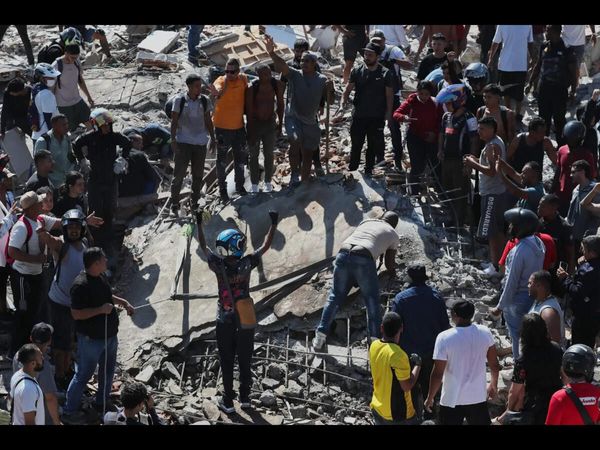
Colombia | More than 100 people have died after a powerful earthquake struck western Colombia, collapsing and severely damaging scores of buildings in major cities including Cali and Pereira.
-
UK weather | Almost three-quarters of England is now in drought, with four more regions officially declared, and as much of Europe braces for its fifth climate crisis-driven heatwave this summer.
-
Crime | Police are investigating whether Joshua Kerry, the man charged with the murder of the former Reform UK and Conservative politician Ann Widdecombe, had any role in an attempted burglary last year at the then London home of Nigel Farage.
-
China | More than a million people were moved to safety across eastern China by Sunday evening as powerful Typhoon Dolphin made landfall amid fears torrential rain would cause flooding and landslides.
-
Ukraine | Russia has banned voting against the war in September’s elections, after the supreme court upheld a suit brought by a small pro-Kremlin nationalist party, and stripped voters of their last option on the ballot: Yabloko, the country’s only remaining anti-war party.
In depth: Two fields, one very big decision
While often lumped together, Rosebank and Jackdaw are two separate sites, hundreds of miles apart.
Rosebank is a proposed new oilfield 80 miles off the Shetland coast, containing 300 to 500m barrels of oil. It’s the UK’s last major undeveloped oil site. There is also gas at Rosebank, equating to roughly 1% of current demand.
Jackdaw is a gasfield 150 miles east of Aberdeen. If operational, it could probably produce approximately 40,000 barrels of oil equivalent per day (bpd), which at peak is equivalent to 6% of the UK’s North Sea gas supply. Jackdaw could displace 2% of the UK’s imports of gas over its nine- to 12-year lifetime.
Under UK law, all oil and gas under the ground or seabed is owned by the state. It’s our collective asset. The government then dishes out licences for exploration and extraction of these fossil fuels to business. Often, these have complicated structures.
Shell holds the licence to extract at Jackdaw. Rosebank is majority owned by Adura, a joint venture between Shell and Equinor (mostly owned by the Norwegian state). A minority stake of Rosebank is owned by UK-based Ithaca Energy, a subsidiary of the Israeli energy conglomerate Delek Group. Delek operates in Israeli settlements in the occupied Palestinian territories.
***
The case for drilling – and the holes in it
Unsurprisingly, the PR from fossil fuel companies on Rosebank and Jackdaw is full of optimism. It will bring down bills! Energy security! Jobs! These are all claims that have been repeatedly debunked.
The UK Energy Research Centre is scathing in its assessment: “Assertions that drilling the North Sea will provide energy resilience and affordability in the face of current fuel price shocks are a delusion.”
Jackdaw would create only 27 direct full-time jobs, according to its owner. Across both sites, there would be 880 jobs created during production, and 2,700 temporary construction roles. That’s no fix for structural decline. At least 70,000 jobs in the industry were lost in the decade to 2024, despite the Tories granting hundreds of licences. BP is now shutting down its North Sea operations. As our environment editor, Fiona Harvey tells me: “Whatever government does, jobs will decline. It’s unavoidable.”
Because, the UK’s gas and oil is running out. Even if extraction is minimised, supplies are depleting: 90% has already been drained dry. Experts point to this as proof that new drilling won’t bolster long-term energy security.
***
Who benefits from oil and gas?
Drill or not, our household energy prices will unlikely be affected. Anything extracted wouldn’t be funnelled to UK residents at a knock-down rate: oil and gas are sold by private companies on international markets, which set the price. The scale of output from UK production is negligible in this global context. As we’ve seen, it takes one unreliable actor in charge of the world’s largest military to send global prices spiralling.
Of course, there’s money to be made from tax – though these companies aren’t famed for coughing up when HMRC comes knocking. In 2024, Shell reported a negative UK tax figure of £12.5m while posting global post-tax profits of £18bn. In the same year, Equinor’s record was no better.
Even if North Sea tax revenues were collected and somehow funnelled directly into energy bill subsidies, the impact would be limited. For context, after Russia’s full-scale invasion of Ukraine, the Conservatives spent up to £80bn across two years shielding households and businesses from energy price hikes. Even by the oil and gas industry’s own estimates, the Rosebank and Jackdaw tax take would pale in comparison.
And given the scale of tax subsidies available, campaigners suggest Rosebank could actually cost taxpayers money. That means underwriting the very businesses who help to cause the climate crisis we’re experiencing.
This, of course, would be exacerbated by any fossil fuels extracted by Jackdaw and Rosebank. Burning just Rosebank’s oil and gas would produce about 250m tonnes of CO2 over its lifetime. As Areeba Hamid, co-executive director of Greenpeace UK, put it to me: “Sections of the media just keep repeating myths and lies. We are expecting a fifth summer heatwave, wild fires are burning the country, oil and gas companies are posting billions in profits, while the rightwing press and fossil fuel companies are pushing for Rosebank and Jackdaw approval. It’s pure cognitive dissonance.”
***
Over to Burnham
Under the Conservatives, Rosebank and Jackdaw were approved, but a court ruled these permits unlawful after a legal challenge from Greenpeace and Uplift. New approval needed to be sought – the results of which are impending.
Labour’s 2024 manifesto ruled out new licences for North Sea exploration, while stating existing ones would not be revoked. Insiders say a compromise might be struck, with only Jackdaw OK-ed. Gas is needed for home heating and electricity generation, though in what should be diminishing quantities, and its extraction is less carbon intensive than oil. “Allowing it to go ahead is far less harmful than Rosebank,” Fiona tells me. And Jackdaw is a tieback, so can be connected to existing infrastructure. “It could therefore come online quicker.”
Fahnbulleh is on holiday for the next couple of weeks. In the absence of answers, the briefing wars are in full swing. Reports that oil and gas execs are “near certain” that Rosebank and Jackdaw will get the go-ahead should be treated with caution, given their incentive to will this into fruition. Remember how Shabana Mahmood was definitely going to be Burnham’s chancellor?
For all his flip-floppery, Starmer was generally steadfast in his climate commitments while PM, even if rightwing backlash tempered his ambitions. Burnham had a strong environmental track record as Manchester mayor. But he’s an unknown entity in Downing Street. Until last month, Ed Miliband held the energy brief, driving the last government’s decarbonisation agenda. An experienced Westminster operator with decades of experience and press attacks, Miliband was resolute enough to stick with climate plans, however often he was heralded the “MOST DANGEROUS MAN IN BRITAIN”.
Fahnbulleh looks like continuity. She has Miliband’s backing and before entering parliament, she held top jobs at left-leaning thinktanks, including as CEO of the New Economics Foundation (NEF), which expressed opposition to further fossil fuel extraction. But she’s a parliamentary newbie. How she’ll respond to power and significant external pressure remains uncertain.
In an interview last weekend, she struck a vague but cautious note: “We’ve always been clear that oil and gas are part of the mix … We are doing the hard trade-offs to make sure that we are doing this transition in a way that still delivers affordability.”
“It’s going to be tough,” Hamid says, “but Miatta has to stick to her position. Otherwise, it’s a slippery slope: the pressure won’t stop at Rosebank and Jackdaw.”
We want to hear from you
What comes next after the A-level results land? We’d like to hear from students, parents and teachers about the educational and working landscape facing young people once they get their results this Thursday. To get in touch hit reply or email first.edition@theguardian.com
What else we’ve been enjoying
-
I enjoyed this interview with the UK Palestinian comic Sami Abu Wardeh – another reason I’m still trying to plot a trip to the Edinburgh fringe this year. Michael
-
My grandmother introduced me to Beryl Bainbridge via a dog-eared copy of the Dressmaker, which I found rivetingly adult as a 10-year-old. Our ranking of her greatest novels reminds me I’ve still, happily, got a few more to discover. Libby
-
Simon Hattenstone’s column on prisons is characteristically compelling, and a reminder that amid all the talk of early release, some have been forgotten. Michael
-
The Guardian’s senior economics commentator, Aditya Chakrabortty, is brilliant on Over the Top Under the Radar podcast, discussing why he doesn’t think a wealth tax is the magic bullet many progressives claim it to be. Libby
-
Deadpan, full of warmth and generous to a fault – do make time to read one of Sam Neill’s final interviews, on the making of Taika Waititi’s Hunt for the Wilderpeople. Libby
Sport
European championships | Britain’s Amy Hunt sprinted to women’s 100m glory in 11.00sec in Birmingham, with Ewa Swoboda claiming silver and Delphine Nkansa a bronze.
Fifa | US president Donald Trump has warned Fifa would be making a “terrible mistake” if they get rid of Gianni Infantino as the head of world football’s governing body.
Football | A consortium including the Amazon founder, Jeff Bezos, is close to completing a deal for a 30% stake in Liverpool after months of talks with Fenway Sports Group.
The front pages
“Firefighters raise alarm over surge in ‘unprecedented’ summer blazes”, is the Guardian’s front page today, while the i Paper writes “45 million people in the UK now living in drought”, the Mirror says “High & dry”, and Metro has “It never rains … but it pours”.
On politics, the Times has “Burnham demands plan to keep PC’s killers in jail” and the Express writes “Kemi: Rule out new taxes to prevent more hardship”. The Mail’s headline is “Day small boats crisis became a BIG boats crisis”, the Telegraph says “‘No limit’ to migrant mega dinghies”, and the Sun’s take is “Not-so-small boats crisis”. Finally, the FT splashes “Wall Street big names join Nvidia to build $500bn AI financing package”.
Today in Focus
Why did Saudi Arabia just spend billions on a video games company?
Last week Saudi Arabia’s wealth fund and a group of investors spent $55bn (£41bn) on Electronic Arts, the video games company behind the Sims, Madden NFL and Battlefield. But why would such a powerful government take a risk with video games? As Keith Stuart and George Osborn tell Annie Kelly, it’s part of a pattern of superpowers and authoritarian regimes seeing games as handy propaganda tools.
Cartoon of the day | Martin Rowson
The Upside
A bit of good news to remind you that the world’s not all bad
At 60, Darren Miles is about to represent Great Britain at the world championships in slalom skateboarding – a sport he took up only in his late 50s. After a lifetime on a skateboard, he noticed his flexibility fading and his old tricks becoming increasingly difficult to do. Then, during lockdown, a stranger praised him for performing a simple 180 manoeuvre. It was a life-changing inflection point.
Rather than give up, Miles found a new challenge in slalom, racing downhill between cones and learning to move his body in a different way. Now, after years of skating for the joy of it, he is discovering what he can still achieve – and seeing how far he can push himself.
Sign up here for a weekly roundup of The Upside, sent to you every Sunday
Bored at work?
And finally, the Guardian’s puzzles are here to keep you entertained throughout the day. Until tomorrow.