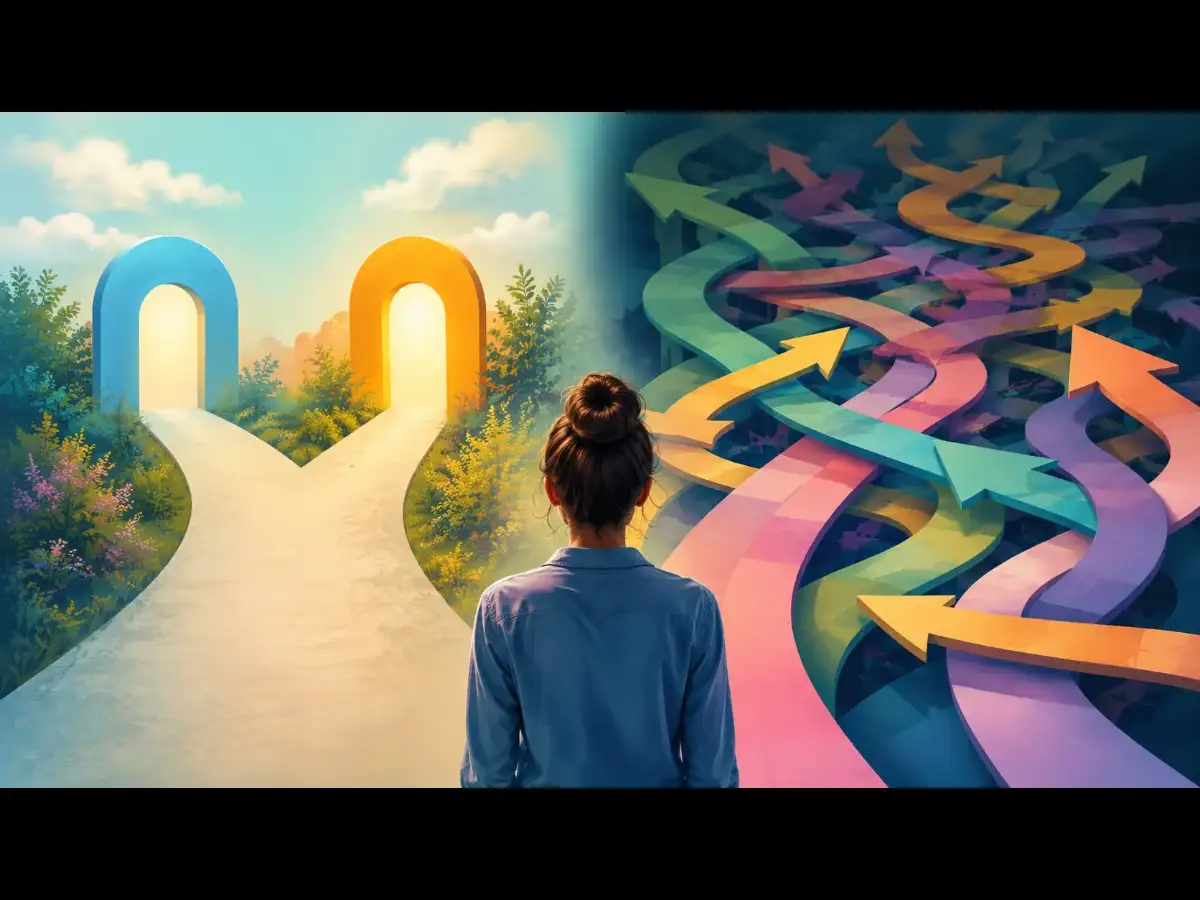
Imagine walking into a restaurant and being offered two desserts: chocolate cake or cheesecake. The decision takes seconds. Now imagine opening a menu with 10 desserts, each with different flavors, toppings and reviews. Suddenly, choosing becomes a project. You start comparing ingredients, prices and what you might be missing by picking one over another. Psychology suggests that this reaction is not simply indecisiveness. It can be an example of choice overload , a phenomenon in which having more options can sometimes make decisions harder rather than easier. Research by psychologists Sheena Iyengar and Mark Lepper famously found that people were more likely to make a purchase when presented with a smaller assortment than a much larger one, and those who chose from the smaller set could also report greater satisfaction.
Later research has shown that choice overload is not inevitable and depends on factors such as how difficult the decision is, how complex the options are and how certain people feel about what they want.
Psychology says more choices can create more mental work
Every option carries information. If you are choosing between two phones, you might compare their cameras, prices and battery life. With 10 phones, the number of comparisons grows quickly.
READ ALSO: Psychology says walking into a room can make you forget why you went there, here's why
Your brain must determine which features matter, which differences are meaningful and which options can be eliminated.
This relates to cognitive load , the amount of mental effort required to process information. The more complicated a choice becomes, the more mental resources may be required to evaluate it.
That is why two choices can sometimes feel wonderfully simple. You do not have to find the absolute best option. You only have to decide which of two options better fits your needs.
The "paradox of choice" explains the uncomfortable feeling
Psychologist Barry Schwartz popularized the phrase paradox of choice to describe how an abundance of options can sometimes undermine the benefits of freedom.
The basic idea is counterintuitive: having choices is generally valuable, but unlimited choice can create its own psychological costs.
Imagine buying cereal. With two options, you can quickly ask, "Which one do I prefer?" With 20 options, a different question may appear: "What if one of these is better?"
READ ALSO: Psychology says your brain may remember things in the shower for a surprising reason
That second question can keep the decision open. You are no longer simply choosing. You are searching for the possibility that you might choose incorrectly.
The famous jam experiment showed how choice can change behavior
One of the best-known examples comes from Iyengar and Lepper's research on consumer choice. At a gourmet food store, shoppers encountered either an extensive display of 24 jams or a limited display of six.
The larger display attracted more attention, but shoppers who encountered the smaller selection were more likely to purchase a jam. The researchers also found greater satisfaction in some conditions when people chose from the smaller assortment.
The finding became influential because it challenged the assumption that more options automatically produce better outcomes. More choice can make a display look attractive. But too much choice can make the actual decision harder.
Choice overload is not simply about the number of options
This is where the research becomes more interesting. A major meta-analysis by Alexander Chernev, Ulf Böckenholt and Joseph Goodman examined 99 observations involving 7,202 participants.
The researchers found that the impact of assortment size depended on four important factors: choice-set complexity, decision-task difficulty, preference uncertainty and the person's decision goal .
That means 10 options are not automatically overwhelming. If you already know exactly what you want, 10 choices may feel easy. If you have no idea what you want, even five options might feel exhausting. For example, a coffee expert may happily compare 12 varieties of beans. Someone who simply wants "a normal cup of coffee" may prefer two options.
Knowing what you want changes everything
Preference uncertainty is particularly important. When people have strong preferences, they can eliminate options quickly. Suppose you know you want vanilla ice cream. If a menu offers vanilla, chocolate, strawberry and pistachio, your decision is easy. But if you are unsure what you want, every option remains a possibility. That creates more mental comparison.
This is one reason choice overload can be particularly frustrating when shopping for something unfamiliar. You do not just need to select an option; you first have to figure out your own preferences.
Too many choices can increase the fear of regret
Another psychological cost is anticipated regret . When there are many alternatives, it becomes easier to imagine that another choice might have been better.
You buy one pair of shoes and later wonder whether the other pair was more comfortable. You choose one hotel and start looking at reviews of another.
You select a movie and immediately wonder whether the other 10 options were better. The problem is not necessarily that the chosen option is bad. It is that the alternatives remain psychologically available. With only two choices, there is still a rejected alternative, but the comparison set is much smaller.
More options can make people delay decisions
Choice overload can also lead to choice deferral , meaning people postpone choosing altogether. The 2015 meta-analysis found that choice overload can be reflected in outcomes including reduced satisfaction or confidence, greater regret, choice deferral and switching behavior.
Think about streaming services. You have hundreds of movies available, but instead of watching one, you scroll for 30 minutes and eventually give up.
The abundance of entertainment has not made the experience easier. It has created another decision to solve: Which one is worth my time? Two recommendations can sometimes feel more helpful than 200.
The brain may prefer a clear decision rule
One way people manage complex choices is by using heuristics , or mental shortcuts. Instead of comparing every feature, someone might say, "I'll choose the cheaper one," "I'll pick the highest-rated option" or "I'll choose the brand I already trust."
These rules reduce mental effort. This idea connects with Herbert Simon's concept of bounded rationality . People have limited time, information and cognitive resources, so they often aim for a choice that is good enough rather than mathematically perfect.
This strategy is sometimes called satisficing . For everyday decisions, satisficing can prevent an endless search for the perfect option.
Fewer choices can also increase satisfaction
An important psychological difference exists between having freedom and feeling satisfied with a decision . More options can initially feel empowering because they increase the sense of possibility. But once the decision becomes difficult, the same freedom can become a burden.
Research on choice overload suggests that the relationship between assortment size and decision quality is more complicated than simply "fewer is always better." In some situations, larger assortments can be useful, particularly when people have clear preferences or when the options provide meaningful variety.
So the goal is not to eliminate choice. It is to provide enough meaningful choices without creating unnecessary comparison .
Why two choices can sometimes feel just right
This is why being asked, "Do you want tea or coffee?" can feel easier than being handed a menu with 15 drinks. Two options create a manageable comparison. Ten options require filtering. Twenty options may require a strategy. The difference is not simply mathematical. It is psychological.
A small choice set can reduce cognitive demands, limit opportunities for regret and make the decision feel more manageable.
That does not mean everyone prefers fewer options. Some people enjoy exploring alternatives, and having more choices can be valuable when preferences are clear. But when a decision is complicated and you are unsure what you want, fewer options can feel like relief.
Psychology's lesson is surprisingly simple: more freedom does not always feel like more freedom when every option creates another decision to make. Sometimes, two good choices are enough to help the brain stop searching and start choosing.
FAQs
Why can two choices feel better than 10?
Two choices usually require less comparison and evaluation. When people are uncertain about what they want, a larger selection can increase cognitive effort and make the decision feel more difficult.
What is choice overload?
Choice overload is the tendency for a large number or complex assortment of options to sometimes make choosing more difficult or less satisfying. Research shows that the effect depends on factors including decision difficulty, preference uncertainty and the complexity of the options.