When construction workers in Malta broke through a layer of limestone in 1902, they expected to find little more than space for a new housing development. Instead, they stumbled upon one of the most extraordinary archaeological discoveries in Europe. Hidden beneath the town of Paola was a vast underground complex unlike anything previously known on the islands. Today, the Hal Saflieni Hypogeum is recognised as the world's only known prehistoric subterranean temple and a UNESCO World Heritage Site . Carved thousands of years before the Roman Empire and predating many famous ancient monuments, the site has fuelled generations of speculation. Tales of giants, elongated skulls, missing artefacts and unexplored chambers continue to circulate, but what does the archaeological evidence actually reveal? The answer is every bit as fascinating as the legends themselves. Far from being merely a burial site, the Hypogeum offers a rare window into the spiritual beliefs, engineering skills and ritual practices of a sophisticated prehistoric society.
Get breaking news anytime, anywhere. Download the TOI app now!
How construction workers accidentally discovered Malta's hidden underground world
The discovery of the Hal Saflieni Hypogeum was entirely accidental. In 1902, labourers excavating cisterns for a residential development broke through the roof of a previously unknown underground structure. Initially, the find was concealed to avoid disrupting construction, but authorities were eventually informed, and archaeological investigations began.
Excavations revealed an extensive network of chambers, halls and passages carved directly into limestone across three interconnected levels. Archaeologists later determined that the oldest parts of the complex date to around 4000 BC, making it one of the oldest known monumental structures in the Mediterranean.
According to the Malta Tourism Authority :
"Hypogeum Malta is Europe’s only known prehistoric underground temple and necropolis. Unlike above-ground sites, it was carved entirely into limestone. Archaeological evidence shows use from 4000 BC to 2500 BC, serving both religious and burial functions."
The discovery transformed understanding of Malta's prehistoric civilisation and provided evidence of a sophisticated society capable of large-scale architectural projects thousands of years before written history appeared on the islands.
The Hal Saflieni Hypogeum: 7,000 skeletons, ancient rituals and remarkable engineering
The Hypogeum was not simply a burial chamber. Archaeologists believe it served both ceremonial and funerary functions over many centuries. Human remains recovered from the site indicate that thousands of individuals were interred there between roughly 4000 BC and 2500 BC.
According to archaeological analysis of the Ħal Saflieni Hypogeum in Malta published by the American Research Institute for Policy Development, the Maltese hypogeum played two roles: the first as a sanctuary dedicated to worship, possibly of a Mother Goddess; the second as a burial place, as evidenced by the remains of thousands of skeletons with their ornaments and their pottery. It has been hypothesised by Evans (1971) that the interconnected holes in the floor in front of the entrance to an area known as the “Holy of Holies” could have been used to collect the libation of animals destined for sacrifice or for solid offerings, with rope being run through the holes.
Estimates suggest the remains of between 6,000 and 7,000 people were once present within the complex.
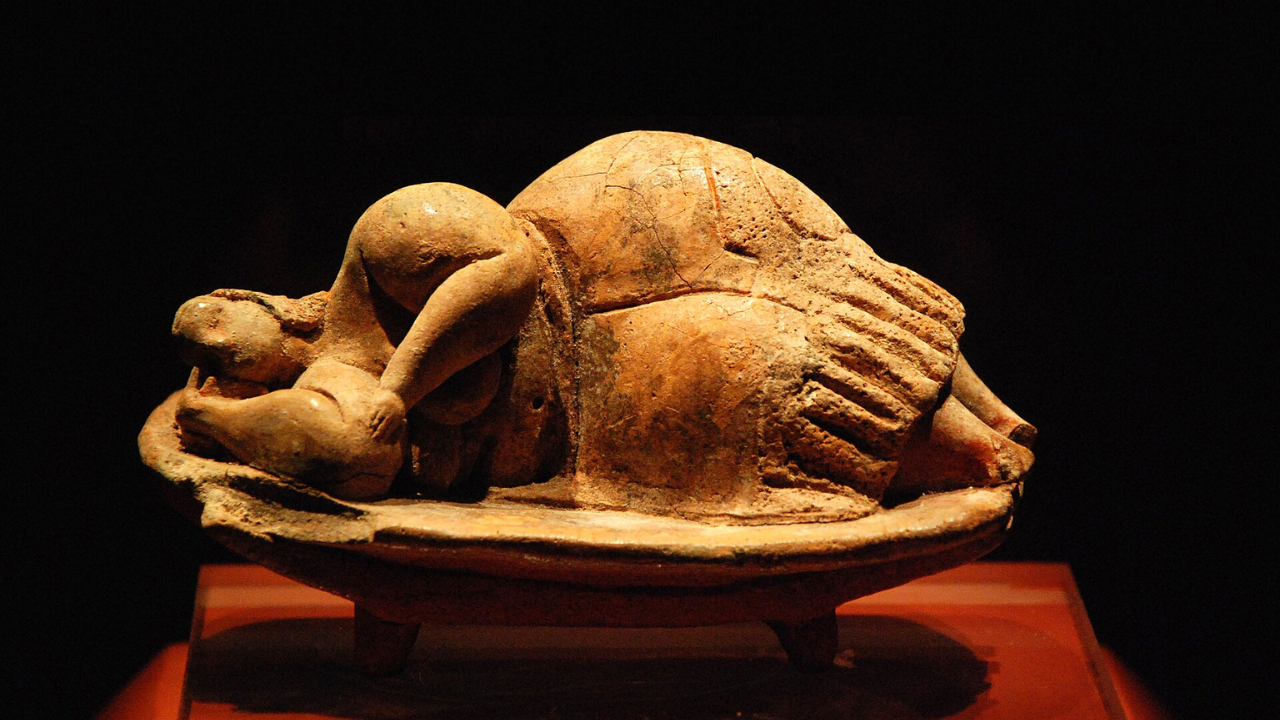
Among the discoveries kept at the National Museum of Archaeology, Malta , were pottery vessels, amulets, beads, carved figurines and the famous "Sleeping Lady" sculpture, one of Malta's most iconic prehistoric artefacts.
Researchers have also studied the site's unusual acoustics. A 2020 scientific analysis concluded that the geometry of parts of the Hypogeum appears intentionally designed to create distinctive resonance effects.
The researchers wrote:
"The Hypogeum's creators shaped the site's geometry to create or amplify its frequency spectrum."
These findings suggest that sound may have played an important role in rituals conducted within the underground chambers.
Did archaeologists find evidence of giants? The truth behind Malta's enduring mystery
Stories of a lost giant race are among the most persistent legends associated with the Hypogeum. The rumours largely stem from the discovery of several unusual skulls, some displaying cranial elongation or other anatomical features that differed from typical modern skulls.
However, no peer-reviewed archaeological evidence has demonstrated the existence of a race of giants in prehistoric Malta. Archaeological reports document human remains, skull collections and cranial variations, but not giant skeletons.
The giant narrative developed later through speculation, popular mythology and internet folklore. Heritage Malta and archaeological researchers continue to classify the Hypogeum as a Neolithic sanctuary and necropolis built by Malta's prehistoric inhabitants rather than evidence of an unknown giant civilisation.
What remains genuinely remarkable is not a lost race of giants but the achievement of the people who created the structure. Using stone tools and extraordinary planning, they excavated a complex underground monument that has survived for more than 5,000 years.
Even today, archaeologists are still uncovering new insights into how and why this unique subterranean world was built.