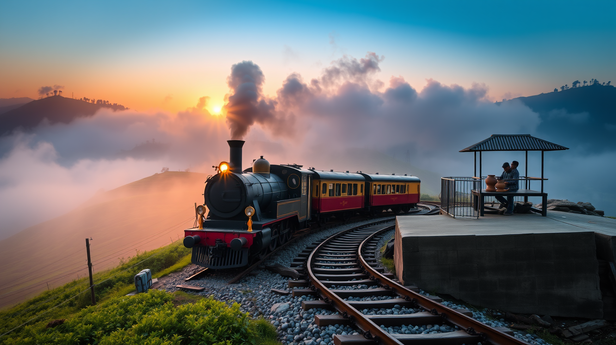
The Train That Was Never in a Hurry
The Darjeeling Himalayan Railway has been climbing the same 88 kilometres since 1881, coiling up from New Jalpaiguri through Ghum and into Darjeeling at a speed that a determined cyclist could match on a flat road. The steam engine, still coal-fired on the heritage loop runs, breathes in a way diesel never does. You hear it working. You feel it deciding. At Batasia Loop, where the track spirals back on itself so the train can gain elevation without a gradient that would break the engine, you look out and see the track you were on four minutes ago sitting below you like a memory.
This is not a scenic railway that happens to be old. It is a piece of engineering that solved a specific Himalayan problem, how to get a train up a wall, and the solution looks, from the window, like the most beautiful accident in Indian rail history.
What the Chai Stops Actually Are
The train halts at places that are not quite stations. A platform, a vendor, a kettle that has been boiling since before you arrived. At Kurseong, the chai comes in small clay kulhads and costs less than a rupee used to buy anything. You step off, hold the cup with both hands because the mountain air is always cooler than you dressed for, and the train waits. It does not honk. It does not announce a departure time with the urgency of a Mumbai local. It simply stands there, releasing steam slowly, as if it too needed the break.
These stops are not interruptions to the ride. They are the intervals in which the ride becomes real. You have been watching the tea gardens scroll past for an hour, the Himalayan slopes terraced in that particular shade of green that exists nowhere else in India, and the chai stop is where you put down the window frame and step into what you were looking at.
The Ghum Problem
Ghum sits at 2,258 metres, the highest railway station in India on a broad-gauge or narrow-gauge mountain line. The air is thin enough that you notice it on a flight of stairs. The Ghum Monastery, a few minutes' walk from the station, is painted in the deep ochre and red of Tibetan Buddhism, and the prayer flags outside it snap in a wind that comes from somewhere you cannot see.
Most people photograph Ghum and move on. The train schedule allows for more than that, if you let it. The error visitors make is treating the toy train as transport between two Instagram coordinates, Darjeeling town and Tiger Hill at dawn, rather than as a place that moves. Ghum is not a waypoint. It is the argument the whole journey is making: that altitude changes more than temperature.
Why the Steam Engine Still Matters
The Darjeeling Himalayan Railway is a UNESCO World Heritage Site, designated in 1999 alongside the Nilgiri Mountain Railway and later the Kalka-Shimla Railway as part of the Mountain Railways of India listing. The heritage designation matters less than what it points at. The steam locomotive on the toy train loop run from Darjeeling to Ghum and back is one of the last working examples of a B-class loco doing revenue passenger service in South Asia. The engine number varies by day. The mechanic who tends it knows it the way a doctor knows a patient, by sound, by resistance, by the particular way it labours on the Agony Point curve where the track bends at an angle that makes first-time passengers grip the seat.
You can ride the diesel service between New Jalpaiguri and Darjeeling. It is more reliable and covers the full route. But the steam heritage run is the version that tells you why the British built this thing in the first place, not just to move tea down from the Bengal highlands, but because the mountain made them want to try.
What You Are Actually Slowing Down For
The Darjeeling toy train runs through bazaars. Not near them. Through them. At Darjeeling town, the track shares the road with cars, vendors, schoolchildren, and dogs who have learned to step aside without looking up. The engine passes close enough to the tea stalls that you could theoretically hand your cup back without standing. This is not a design flaw. It is the original design, a railway built into the life of the hill towns rather than around them, because the mountain left no room for the polite distance that flat-land railways maintain.
When you sit in the wooden-slatted seat of the toy train and the town moves past at walking speed, something specific happens. You stop processing the view as scenery. The woman hanging washing on a line above the track, the schoolboy who waves at every passing train without looking up from his phone, the smell of wood smoke and eucalyptus that the Darjeeling air carries even in summer, these stop being picturesque and start being ordinary. That shift, from tourist to witness, is what the slow pace is for. No express train has ever produced it.
The chai, the steam, the spiral at Batasia, the prayer flags at Ghum, each of these is a separate sensation. But together they add up to the same thing: a mountain that has been insisting, for over a century, that speed is not the point of getting somewhere.