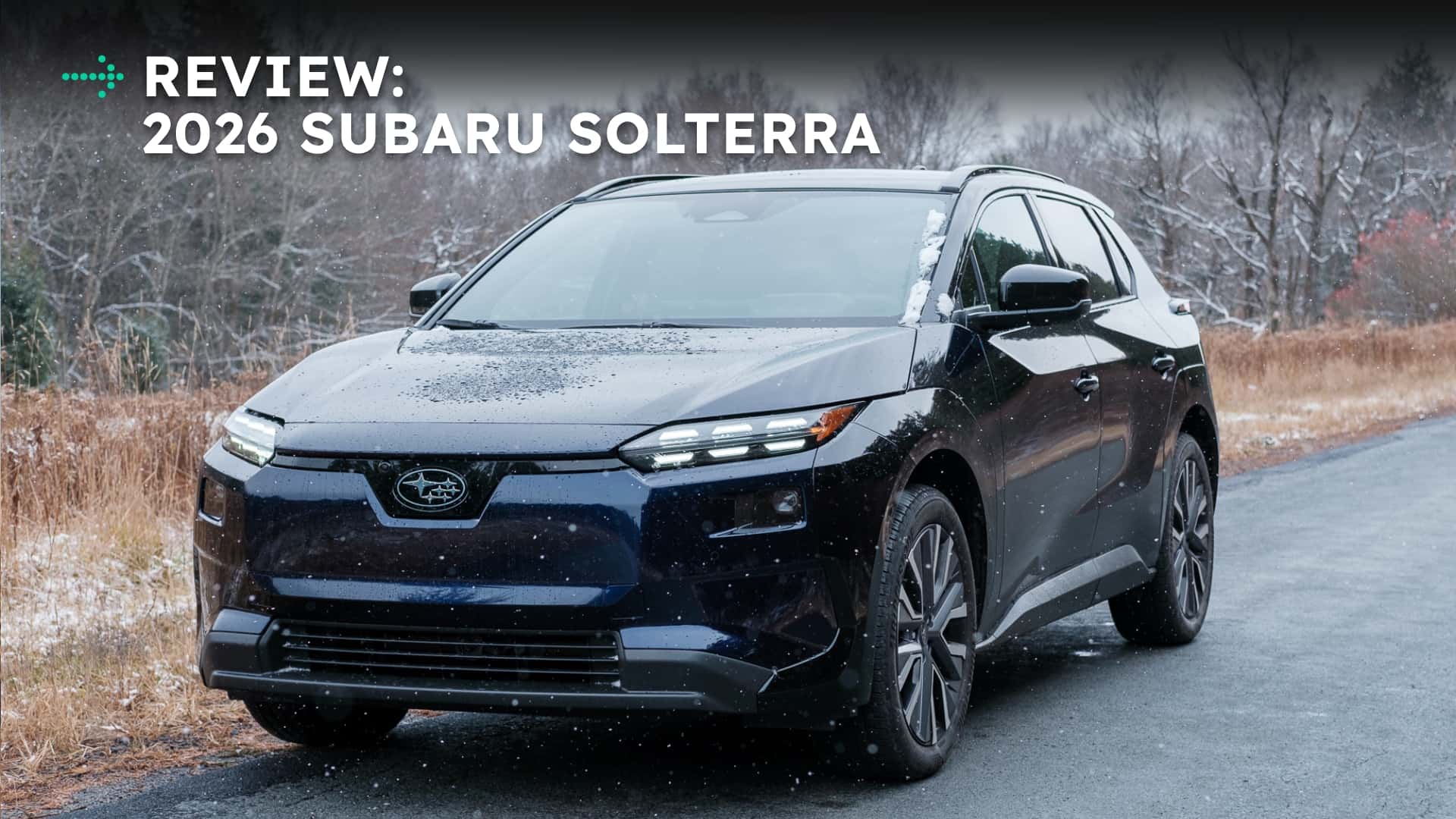
The concept of "kaizen" may have been widely popularized by Japan's auto industry, but it's now a staple in business school classrooms worldwide. It means "improvement"—often the continuous, gradual, methodical kind. And Toyota’s first electric vehicles, including the Subaru Solterra, badly needed some of it.
On paper, those EVs should've capitalized on the uber-popularity of cars like the Toyota RAV4 and the Subaru Forester. Instead, the original Solterra offered middling range figures, delivered abysmal fast-charging times and lacked key EV software features, like automatic route-planning. Its Toyota twin, the bZ4X, had all of the same problems.

But for 2026, Subaru's EV crossover—which will soon be joined by two other electric models—benefits from some significant improvements. It is a dramatically better EV than it used to be, but there's one area where it still fails to hit the mark, and that will still make road trips harder than they need to be.
(Full Disclosure: Subaru loaned me a 2026 Solterra for a week of testing.)
2026 Subaru Solterra: Specs And Features
As before, the Solterra is really a Toyota, built in a Toyota factory and then sent out to the world with a unique Subaru face and an array of off-road driving modes (more on those in a bit.) But that also means it got the same improvements as Toyota's latest crop of EVs.
The battery for all Solterra trims is now slightly larger at 74.7 kilowatt-hours, so it remedies the previous model's fairly abysmal range of just 225 miles. Thanks to the increased size, better cell insulation and upgraded cooling, it now offers up to 285 miles, depending on the trim level. My top-of-the-line Touring XT tester was rated at 278 miles, and it largely delivered on that. When upstate New York's temperatures dropped, the Solterra did 255 miles on a full charge, so I'd say it's within acceptable winter range-loss parameters.
All-wheel drive is standard on the Solterra. Its dirt-road pretenses and raised ground clearance make it less efficient than the most efficient Toyota. The Toyota's front-wheel-drive model is rated at up to 314 miles of range.
Thanks to upgraded front and rear electric motors with silicon carbide semiconductors, power is up to a much healthier 338 horsepower now, going from zero to 60 mph in a little under five seconds. That's faster than any comparable gas crossover, and even quick among mainstream EVs.
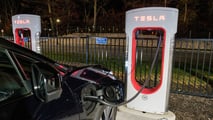
A Tesla-style North American Charging Standard (NACS) plug replaces the old one for more seamless, adapter-free Supercharger use. You’ll need an adapter to use the standard CCS chargers now, of course. But if you prefer the slimness of a NACS plug as I do, it’s a lovely change of pace.
2026 Subaru Solterra: Driving Experience
For all the (often justified) criticism, the Toyota EVs had one thing going for them: they're actually pretty fun to drive, all things considered. That's even more true for the 2026 Solterra.
Engineers clearly put a lot of thought into this car's chassis and handling dynamics. It doesn't feel as heavy as General Motors' EVs, for example, and even has a bit more cornering agility than your average Hyundai Ioniq 5. And with the new power boost, it's got an edge that most gas-powered Subarus don't. Not bad for a family crossover that weighs in at 4,510 pounds. You get four different levels of regenerative breaking via the steering wheel paddles, but the system will not bring you to a full stop on its own.
While it's not really a Subaru—whatever that means, or doesn't—the Solterra's low, long and wagon-like body makes it fit in just fine. That stuff is Subaru's bread and butter. The Solterra could easily be mistaken for an Outback or a Forester and generally flies a bit under the radar, styling-wise. I didn't love the new grille when I first saw it in pictures, but in real life, it looks pretty sharp.
You'd want this over the Toyota for the X-Mode terrain settings, which include Snow/Dirt and Deep Snow/Mud. It also has hill descent control built in. I didn't go rock-crawling in the Solterra, but I did take it on some wet, unpaved roads and some surprise Thanksgiving snow, and even on all-season tires it performed with the utmost confidence. I don't care who makes it—it'll do bad weather like a proper Subaru.
The inside is comfortable as well. The cockpit has been redesigned to be less fighter jet-esque, and the steering wheel no longer blocks the central driver display (which looks hilariously low-tech in late 2025.) The cabin certainly isn't fancy, but it's got a refreshing array of physical switches and buttons that make operation quite easy. The Touring XT's blue accents were a welcome change from the drab black and gray too common inside most Subarus.
And while the Solterra's platform doesn't offer a frunk, it does give you 27.7 cubic feet of cargo space behind the rear seats and 63.5 cubic feet of cargo space when they're folded down, so it's well-suited for family gear-hauling duty.
In a lot of ways, the Solterra is the dream: a good, everyday, normal car that just happens to be electric. It's not an overpowered, overpriced spaceship, and it doesn't really feel all that different from your average Toyota or Subaru crossover.
2026 Subaru Solterra: Tech And Charging
Almost everybody knows that the big weakness for the old Solterra (and bZ4X) was road-tripping, since it was notoriously slow on DC fast-chargers and often couldn't pull repeated performances in the same day. But the engineers behind this car heard the feedback and turned in a sharper draft this time.
Charging speeds are still a fairly middling 150 kilowatts, but overall charging performance has been drastically improved. While the earliest iterations of the Solterra could take as much as an hour to fast-charge, Subaru says 10-80% here happens in 28 minutes, all with more range at the end of it thanks to that bigger battery. That's on par with a Tesla Model Y, and quicker than comparable EVs from General Motors and Ford.
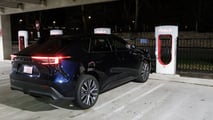
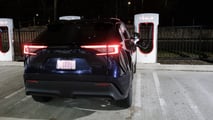
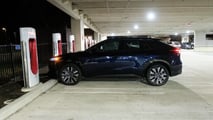
I took the Solterra from 16% to 80% in about 25 minutes on a Tesla Supercharger—a better performance than I've seen with EVs from other brands on that plug. As an added bonus, AC charging is now up to 11 kW, if you can find one that delivers that much juice.
At this point, you may be asking: if it's so much better now, then what's the big problem? Well, it's not with EV chargers—it's with finding them. The Solterra's software suite has been lifted right out of a gas-powered Toyota, with a few extra EV-related menus and options here and there. But its navigation system will still not find you the best nearby EV fast chargers.
Moreover, and perhaps worst of all, setting a route in the navigation system will not give you any information about when and where to charge. Need to drive from New York City to Washington D.C.? It'll give you the ETA involved as if it were a gas car, but if you run out of electrons, you're on your own. All you get is a generic warning: You'll need to charge at some point.
Granted, the EV-specific features aren't a total afterthought. You can monitor your energy use, manually activate battery preconditioning and schedule your charging. But the lack of EV route-planning is a huge and baffling omission for an otherwise vastly improved car.
Right now, the Toyota bZ will offer route-planning via Apple Maps, and that's nicely built into Apple CarPlay (which I'd recommend over these cars' native navigation systems). But that Apple Maps functionality is not available for Subaru yet—and I have no idea why. I spent a while looking for it and came up empty. I even asked a Subaru rep if this was really the case or just user error, and here's what I was told:
"We are always looking at ways to improve the driver experience for our vehicles. Currently, Subaru doesn't have plans to offer route planning that incorporates real-time battery data," the rep said. "However, if the driver selects a destination that exceeds the vehicle's battery range, the vehicle will provide a notice on the head unit to inform the driver."
I hope Subaru can find a way to add true route-planning to this car, because I can't even think of a modern EV that doesn't offer it. As much as I enjoyed driving the new Solterra—and I really did otherwise—I had brief flashbacks to driving around New York City in 2018 in a Chevy Bolt and spending most of the day looking for a non-Tesla plug. Sure, you can use any number of smartphone apps to find chargers, including Google Maps with Apple CarPlay.
But why should you have to?
2026 Subaru Solterra: Price And Verdict
The 2026 Solterra starts at a respectable $38,495. The Touring XT trim starts at $45,855. My loaded tester didn't come with a final sticker, but it also didn't seem to have many extra options, so we can safely say it lands around $46,000.
For that price, you get a competent, NACS-equipped, all-weather electric wagon that will surprise some folks at a stoplight. And you get an EV that feels like just a regular car anyone could drive. But for now, at least, the lack of route-planning is too much of a compromise. What's the point of that NACS plug upgrade and Tesla Supercharger access if you can't even find them?
Gallery: 2026 Subaru Solterra
Ultimately, the Subaru badge goes a long way for many people. But there's nothing the Solterra can do that an Ioniq 5, or a Tesla Model Y, or even the Toyota bZ with its Apple Maps routing can't do better for the same price (save for, as one reader pointed out, better ground clearance.)
Otherwise, the bones are there for the Solterra to be great. It just needs a bit more kaizen, and the way the market is going, it needs that soon.
Contact the author: patrick.george@insideevs.com