Astronomers are uncovering previously hidden structures within some of the universe’s largest objects, known as galaxy clusters. Using the powerful MeerKAT radio telescope in South Africa, researchers have mapped faint, diffuse radio emissions, an imprint that reveals energy processes taking place in the vast spaces between galaxies when galaxy clusters collide or merge.
Konstantinos Kolokythas, a radio astronomer and postdoctoral research fellow at Rhodes University and the South African Radio Astronomy Observatory (SARAO), has led research into what these radio emissions reveal about our cosmic history. His findings provide a glimpse of what powerful instruments like MeerKAT and the upcoming Square Kilometre Array (SKA) will discover as they explore the “invisible” radio universe.
What has MeerKAT found, thanks to its sensitivity?
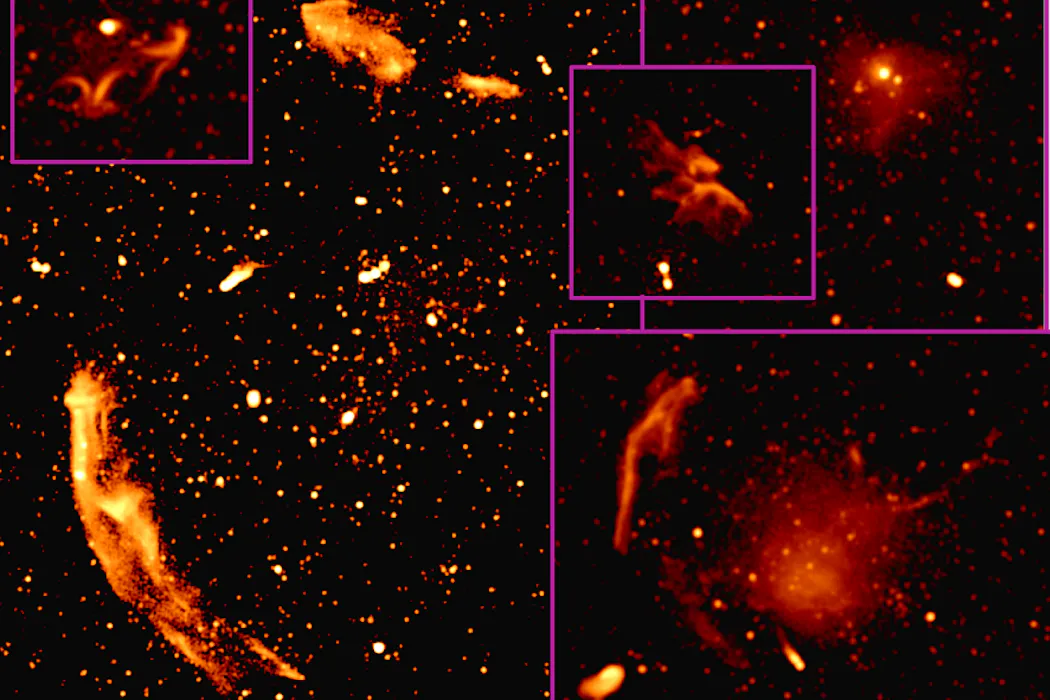
Think of a galaxy cluster not as a collection of thousands of galaxies, but as a bustling city. While telescopes usually see the “bright lights” of individual galaxies, MeerKAT has enabled us to detect the faint “smog” or “mist” filling the streets between them. Our search has been for this extremely faint “diffuse radio emission”. It is spread over millions of light-years, like a thin, glowing fog.
In the vast spaces between galaxies lies the Intracluster Medium – an incredibly hot, thin gas that fills the cluster. While the gas itself is usually seen by X-ray telescopes, it also contains magnetic fields and electrons travelling at nearly the speed of light.
When galaxy clusters merge, it is like a cosmic dance: the electrons encountering a magnetic field are compelled to spiral along the magnetic field lines, emitting energy as radio waves. This is the radio emission we see at 1.28 GHz with MeerKAT. It reveals the places of shock accelerations (the aftermath of cosmic collisions).
Our research within the MeerKAT Galaxy Cluster Legacy Survey (MGCLS), a programme led by the South African Radio Astronomy Observatory, used this capability to map 115 of these “cosmic cities”. We identified 103 diffuse sources, including 60 structures that were completely invisible to previous generations of telescopes. The legacy survey also produced its own overview.
We have essentially moved from having a blurry map of the neighbourhood to a high-definition atlas, revealing that the “empty” space between galaxies is actually teeming with energy. By combining this radio data with X-ray and optical observations, we can calculate the “energy budget” – essentially a full accounting of all the power, heat and magnetic energy moving through these massive structures.
How does this clarify or add to what was known before?
Before this work, we mainly observed only the brightest, most violent merger events. With our new catalogue, we can see the broader picture of cosmic evolution, detecting the faintest structures arising from galaxy cluster collisions. By identifying these features in over half (54%) of the surveyed clusters, we can study how energy is processed on a cosmic scale.
These radio signatures are the “scars” left by cluster mergers – colossal, slow-motion collisions where gravity draws two massive collections of galaxies together. This process generates turbulence and shockwaves that “kick” particles to extreme speeds.
Our findings demonstrate that these high-energy events are a fundamental part of a cluster’s life cycle and the universe’s evolution. Clusters that appear “quiet” or “relaxed” in X-ray light often conceal a history of radio activity. We are mapping the secret structures of magnetic fields over billions of years. In radio astronomy, the universe is never truly silent.
What direction does this point to for future research?
This catalogue serves as a high-resolution “baseline” for the coming decade. With MeerKAT, we have pushed the limits further, allowing us to observe more “ultra-steep spectrum” sources – faint emissions from the oldest, most “tired” particles in the universe. These are vital for understanding the long-term lifecycle of cosmic energy.
Looking forward, this research paves the way for the Square Kilometre Array (SKA) observatory, the world’s largest and most sensitive radio telescope, which is expected to be fully operational by 2030. If MeerKAT can detect 60 new structures in a small patch of the sky, the SKA will likely find thousands.
Why does this matter?
Because these structures forming in clusters are the largest “natural laboratories” in the universe. By studying them, we aren’t just looking at pretty pictures; we are learning how gravity, magnetism and matter behave on a scale that is otherwise impossible to recreate and the human mind can barely conceive.
This research proves that South Africa is at the forefront of this discovery, using homegrown technology to answer the deepest questions about the fabric of our universe, where our universe came from and how it evolves.

Dr Konstantinos Kolokythas receives funding from the South African Radio Astronomy Observatory (SARAO) and the National Research Foundation (grant UID: 97930), an agency of the Department of Science and Innovation. He works for Rhodes University / SARAO. He is also affiliated with the Istituto di Radioastronomia (INAF) in Bologna, Italy.
This article was originally published on The Conversation. Read the original article.