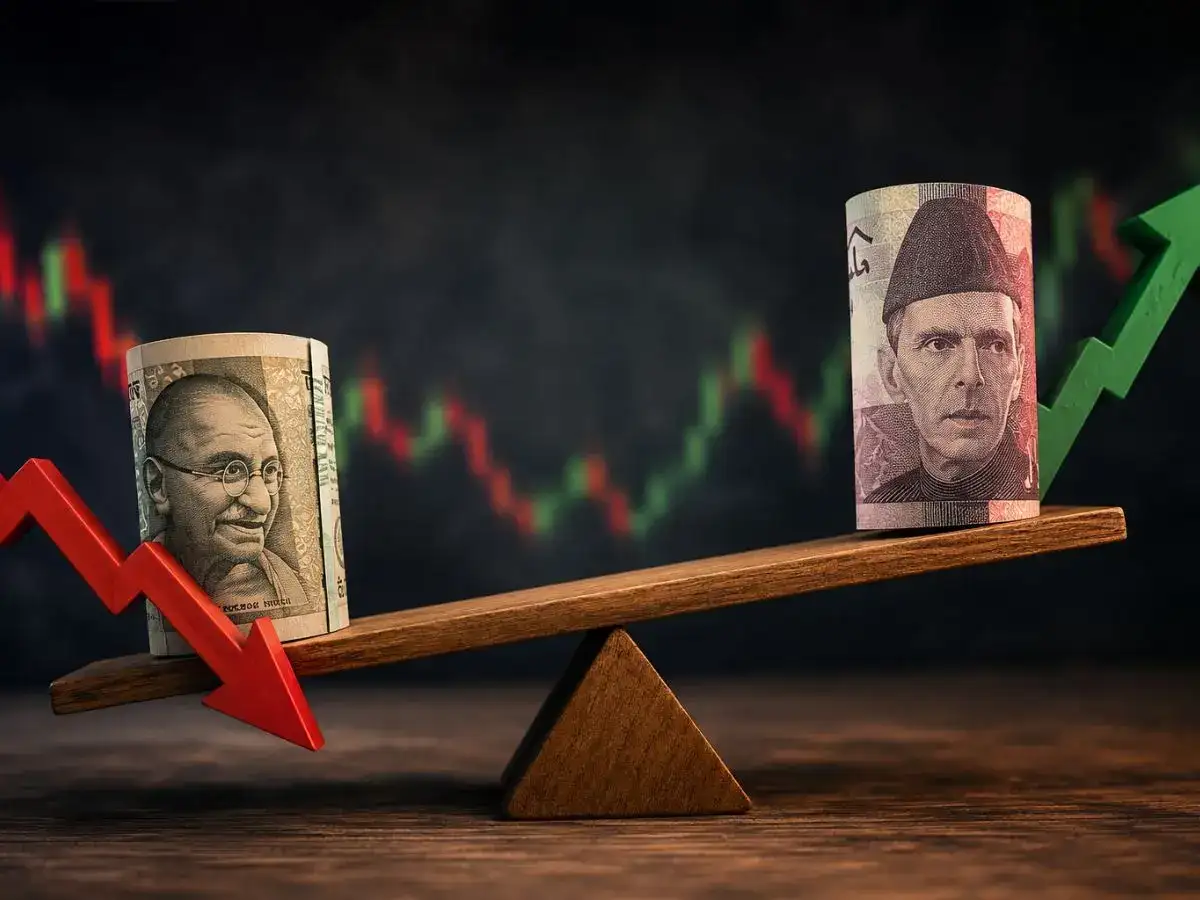
The Indian rupee’s slide is no longer limited to the US dollar. Over the past year, the Indian currency has also weakened sharply against the Pakistani rupee, highlighting the broader pressure facing the INR amid rising oil prices, weak foreign inflows and global market uncertainty.
Data shows that 1 Indian rupee, which was equal to 3.2913 Pakistani rupees in May 2025, has now dropped to around 2.9010 Pakistani rupees in May 2026. That marks a fall of nearly 11.86% in one year, including a decline of about 6.8% in 2026 alone. The development comes at a time when the rupee has already hit a record low against the US dollar, falling to 96.96 per dollar on Wednesday.
Oil shock and global tensions hit rupee
The latest weakness in the Indian currency has largely been linked to elevated crude oil prices and global financial uncertainty triggered by stalled US-Iran peace talks.
India imports a major share of its crude oil needs, and higher energy prices increase pressure on the country’s import bill. At the same time, rising bond yields globally have reduced foreign investment flows into emerging markets like India, weighing further on the rupee.
Why the rupee’s decline matters
A falling rupee affects more than just currency markets. It makes overseas education, foreign travel, imported goods and international business expenses costlier for Indians. Economists also warn that prolonged currency weakness can widen India’s balance of payments deficit if import costs continue to rise faster than exports and capital inflows.
Rupee also weakens against Bangladesh taka
The Indian currency has not only slipped against the Pakistani rupee but also weakened against the Bangladesh taka over the same period.
The exchange rate moved from around 1.42 Bangladeshi taka per rupee to nearly 1.28 taka per rupee in the last one year, reflecting a decline of close to 10%.
Long-term trend still tells a larger story
Despite the recent decline, the longer-term trend shows that the Indian rupee had strengthened significantly against the Pakistani currency over the past decade before the latest correction.
| Year | 1 Indian Rupee (INR) = Pakistani Rupee (PKR) |
|---|---|
| 2016 | 1.56 PKR |
| 2018 | 1.99 PKR |
| 2020 | 2.19 PKR |
| 2022 | 2.74 PKR |
| 2024 | 3.34 PKR |
| 2026 | 2.89 PKR |
The table shows that while the rupee has weakened recently, it still remains much stronger against the Pakistani rupee compared to levels seen a decade ago.
What Financial Times said about rupee weakness
A Financial Times report recently highlighted the impact of the rupee’s prolonged weakness on ordinary Indians and international spending. The report stated:
“The rupee has been one of the worst-performing major currencies for several quarters, driving up the cost of everything from education abroad to foreign business and leisure travel. Over the weekend, a media report speculating that the government was considering a tax or surcharge on overseas travel triggered an avalanche of public anger on social media. In a rare and direct rebuttal that indicates how seriously he took this, Modi personally dismissed the story on social media, calling it “totally false” with “not an iota of truth” to it.”
Why experts remain cautious
Analysts say the rupee could remain volatile in the near term if crude oil prices stay high and global investors continue moving money toward safer assets. Much will also depend on inflation trends, foreign investment flows and how global geopolitical tensions evolve in the coming months.