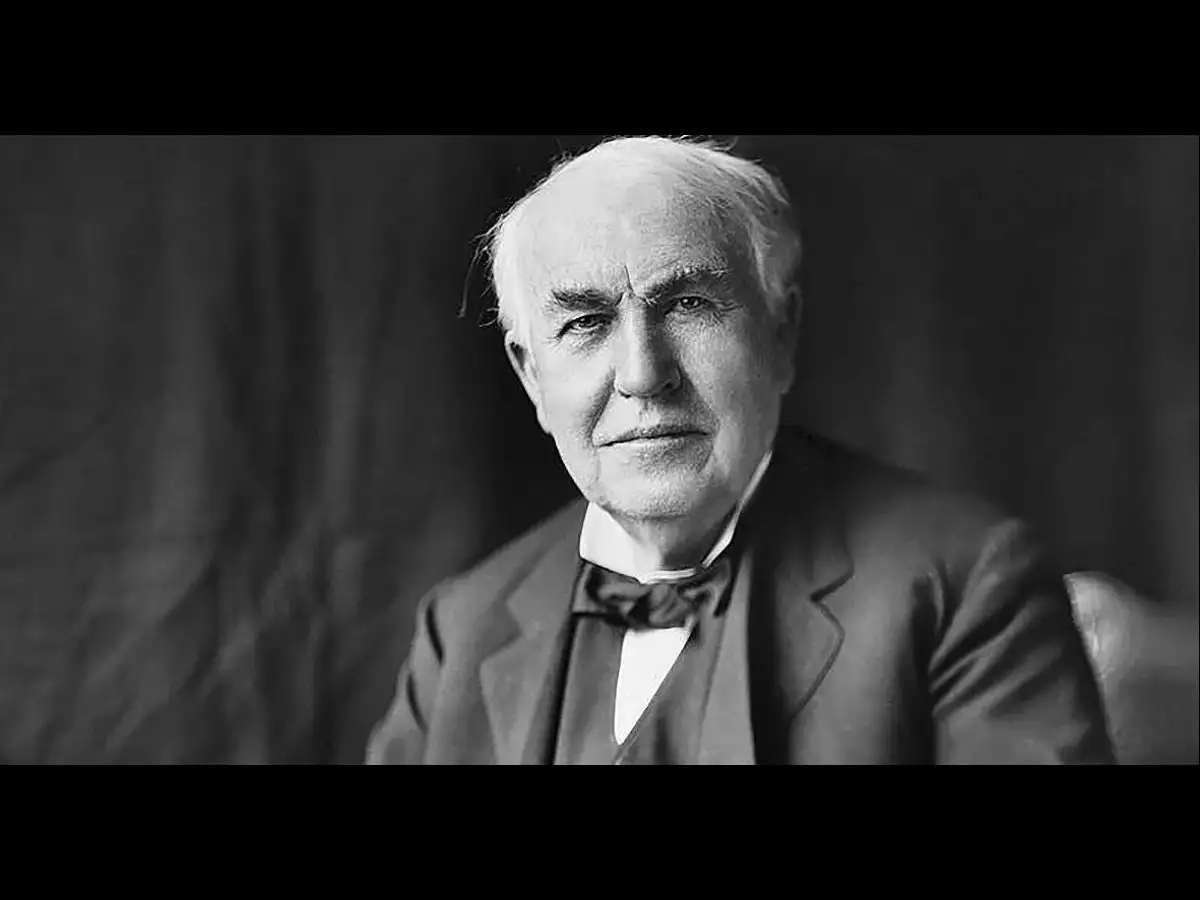
Quote of the day by Thomas Edison is: “Good fortune is what happens when opportunity meets with planning.” The statement connects success with preparation rather than luck alone. It suggests that opportunities can appear without warning, but a person needs skills, knowledge and a plan to use them. The quote also explains why two people can face the same opportunity and get different results. One may be ready to act, while the other may not have prepared. The message remains relevant to work, education, business, personal goals and other areas where people wait for a chance to make progress. The quote is widely attributed to Thomas Edison.
What does the quote say about good fortune?
Thomas Edison’s quote,
“Good fortune is what happens when opportunity meets with planning.”
It presents good fortune as the meeting point between a chance and preparation. The quote does not say that every result can be planned. People cannot decide when an opportunity will arrive. They cannot predict every change in life or know when a useful opening will appear. They can, however, decide how they spend their time before that moment arrives.
A person who learns a skill, studies a subject, saves money, builds experience or prepares a business plan is creating readiness. When an opportunity appears, that preparation can make action possible. This is the central idea behind the quote.
Quote of the day today: Why planning matters?
Planning gives a person a path to follow. A goal without steps can remain an idea. A plan turns the idea into actions that can be completed and reviewed. For example, someone who wants a new job may wait for an opening. The opening is outside that person's control. Preparing a resume, learning a required skill, researching companies and practising for interviews are within that person's control.
If an opening appears, the preparation can reduce the time needed to respond. The same principle can apply to education. A student cannot know exactly when an opportunity for a scholarship, competition or course will appear. But studying, developing skills and keeping documents ready can make it easier to use that opportunity. Planning therefore does not guarantee success. It creates conditions in which a person can respond when circumstances change.
The meaning behind opportunity and preparation
The quote meaning can be understood through four points:
- Opportunity can arrive without warning: A chance may appear at a time when a person does not expect it.
- Preparation takes time: Skills and knowledge are built before they are needed.
- Planning creates direction: A plan helps a person decide what to do after an opportunity appears.
- Action completes preparation: Preparation matters only when a person uses it to act.
This is why the quote links opportunity with planning. A chance by itself does not always produce an outcome. A person may have an opportunity but lack the knowledge or resources to use it. Another person may have prepared for the same situation and be able to respond.
Life lessons from the quote
The life lessons are:
Preparation over luck
One of the main life lessons is to focus on preparation instead of waiting for luck. People often describe success as luck when they see only the final result. They may not see the years spent learning, practising, planning and working before the opportunity arrived. Preparation does not remove uncertainty. It gives a person something they can control.
The value of planning
Planning helps turn goals into steps. A person can write down a goal, identify what is needed, set deadlines and review progress. This creates a process that can continue even when no opportunity is visible. Planning also helps identify problems before they become urgent. A person can change the plan when circumstances change.
Build skills before the chance arrives
Another lesson is to prepare early. People should not wait for an opportunity before developing the skills required to use it. Learning can begin before a person knows where the skill will be needed. This applies to communication, technology, education, business, finance and many other areas. The opportunity may be temporary. Preparation needs to happen over a longer period.
Control what you can
The quote also separates what people can control from what they cannot. A person cannot control when a company will create a job. They cannot control when a business partner will appear. They cannot control every change in an industry. They can control their daily work, learning, planning and response. This approach can help people focus on actions rather than waiting for circumstances to change.
Hard work and real achievement
The quote also connects with the idea of hard work. Real achievement often requires repeated effort before other people notice the result. Thomas Edison’s career provides an example of work organised around experimentation, invention and business. He held 1,093 US patents during his lifetime and helped establish the industrial research laboratory as a model for organised invention.
His work included the phonograph, telephone transmitter, incandescent electric lighting, electric power systems and motion-picture technology. His laboratories brought together equipment, workers, experiments and methods for developing inventions. The role of planning can therefore be considered alongside his approach to invention. Ideas needed testing, equipment, workers and repeated experiments before they could become working products.
Thomas Edison’s early life and work
Thomas Alva Edison was born on February 11, 1847, in Milan, Ohio, and died on October 18, 1931, in West Orange, New Jersey, at the age of 84. He was the seventh and last child of Samuel Edison Jr. and Nancy Elliot Edison, with four children surviving childhood. His family later lived in Port Huron, Michigan, after his father became a lighthouse keeper and carpenter at Fort Gratiot.
Edison attended school there but did not remain in formal education for long. He had hearing problems and found the teaching method difficult. He became a regular reader and continued much of his learning outside school.
In 1859, he left school and worked as a trainboy on the railroad between Detroit and Port Huron. The railroad was connected with the development of the telegraph. Edison used this environment to learn about telegraphy. In 1863, he became an apprentice telegrapher.
How telegraphy shaped his inventions?
Edison worked as an itinerant telegrapher for about six years across parts of the Midwest, South, Canada and New England. Early Morse telegraph messages were recorded as dots and dashes on paper. This meant his hearing problem was less of a limitation. Later equipment increasingly used sound from a key, which made the work more dependent on hearing.
Edison responded by working on equipment that could make telegraph operations easier. He developed a duplex telegraph that could send two messages over one wire. He also developed a printer that converted electrical signals into letters. By January 1869, he had made enough progress to leave telegraphy and focus on invention and entrepreneurship.
This part of his life also connects with the quote. His opportunity came through the growing telegraph industry. He prepared himself by learning the technology and then worked on ways to improve it.
Edison and systematic preparation
Edison later developed laboratories where invention involved research, testing and organisation. In 1876, he established a laboratory at Menlo Park. There he worked on a telephone transmitter, the phonograph and incandescent electric lighting.
In 1887, he built another industrial research laboratory in West Orange, New Jersey. His work there covered areas including sound recording, motion pictures, mining, batteries and other technologies. His career shows why systematic preparation is part of the quote’s message. An idea may begin as an opportunity, but research, planning, testing and work are needed to turn it into a result.
What the quote means for everyday life?
The message can be applied without waiting for a major opportunity. A person preparing for a career can learn skills before applying for jobs. Someone planning to start a business can study costs and customers before investing money. A student can prepare for examinations before the dates are announced. Someone working toward a personal goal can create daily habits instead of waiting for motivation. The main lesson is simple: people cannot schedule every opportunity, but they can prepare for one.
Key life lessons at a glance
- Plan before you need the plan.
- Build skills before an opportunity appears.
- Use daily habits to create readiness.
- Do not depend only on luck.
- Review plans when circumstances change.
- Act when an opportunity appears.
- Focus on actions within your control.
- Understand that preparation can improve your response to chance.