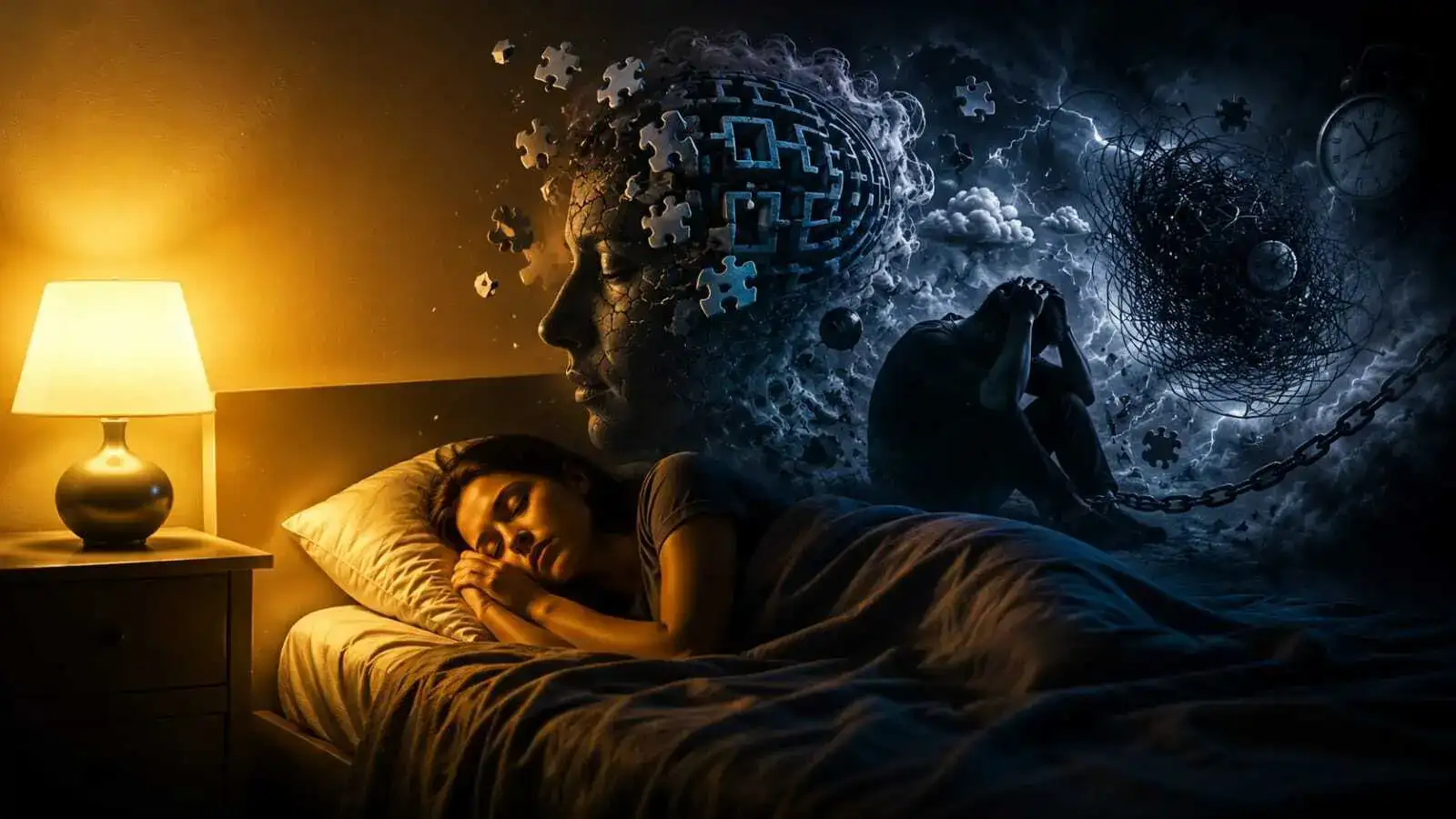
Most people assume that adults who sleep with their lights on are simply afraid of the dark. But psychology suggests the answer is often much deeper than that. For many people, a small lamp, television glow, hallway light, or dim bedside lamp acts as an invisible source of comfort. It is not necessarily childhood fear following them into adulthood. Sometimes, it is their brain trying to stay prepared, protected, and emotionally regulated.
Modern life has quietly created a generation of people whose minds struggle to completely switch off at night. Emails, social media notifications, stressful work schedules, financial uncertainty, and constant exposure to information have trained many brains to remain alert long after the day has ended. Psychologists often describe this state as hyperarousal. The body is physically tired, but the mind refuses to believe that it is safe enough to rest.
Here is what psychology says may actually be happening.
The brain may be stuck in a state of hypervigilance
One of the strongest explanations is a psychological state known as hypervigilance. Hypervigilance happens when the brain remains highly alert to potential threats, even when no danger exists. It is commonly associated with chronic stress, burnout, anxiety, and emotionally demanding environments.
People experiencing this state may find complete darkness uncomfortable because darkness removes environmental awareness. A small source of light creates a feeling of control. The brain essentially says, "If I can see my surroundings, I can relax."
This does not mean someone has an anxiety disorder. It simply means their nervous system may have become accustomed to staying alert. Researchers at the American Psychological Association have repeatedly discussed how prolonged stress can keep the body's stress response activated longer than necessary.
It may be an emotional security blanket for adults
Children often use stuffed animals and nightlights for comfort. Adults create their own versions of emotional safety. Psychologists call these comfort objects or transitional security mechanisms. Instead of a teddy bear, adults may rely on a lamp, background television, white noise, or a glowing digital clock. This idea connects to Donald Winnicott's Transitional Object Theory, which explains how humans use external objects to create emotional stability during moments of vulnerability. Sleep is one of the most vulnerable states humans experience because consciousness temporarily shuts down.
For some people, light becomes a subtle reminder that they are safe.
Their brain may struggle with cognitive off-switching
Some people do not overthink because they want to. Their brains simply have difficulty disengaging from stimulation. Psychologists sometimes call this cognitive hyperarousal. These individuals may replay conversations, think about unfinished tasks, or mentally prepare for tomorrow's problems.
Modern examples are everywhere. Remote workers often blur the line between home and work. Social media users consume information until bedtime. Many people also develop a habit called "revenge bedtime procrastination," where they delay sleep to reclaim personal time after a busy day.
In these situations, darkness can feel uncomfortable because the brain has not fully transitioned into rest mode. Researchers from Harvard Medical School have frequently highlighted the relationship between stress, mental stimulation, and disrupted sleep quality.
Attachment theory may also play a role
Another explanation comes from Attachment Theory. Originally developed by John Bowlby, the theory explains how early emotional experiences influence feelings of safety later in life. People with anxious attachment tendencies sometimes seek external reassurance in subtle ways.
That reassurance may not come from another person. It could come from routines and environmental conditions. A light left on creates predictability. Predictability reduces uncertainty. And uncertainty is something anxious minds often dislike. This does not mean everyone who sleeps with lights on has attachment issues. Rather, attachment patterns can influence how people build environments that help them feel secure.
The modern world has trained many brains to fear silence
There is another overlooked factor: sensory dependence. Humans today are surrounded by stimulation 24 hours a day. Smartphones, televisions, music, and constant notifications have made silence and darkness feel unfamiliar.
The brain gradually adapts to whatever environment it experiences most. This concept is explained by Neuroplasticity, the brain's ability to reshape itself based on repeated experiences. If someone spends years surrounded by artificial light and digital stimulation, complete darkness may initially feel uncomfortable. The issue is not fear. It is unfamiliarity. Many people are essentially trying to withdraw from an overstimulated lifestyle every single night.
Psychology says the habit is often a symptom, not a personality trait
Sleeping with lights on is rarely a random behavior. Psychology teaches us that everyday habits often act as clues rather than labels. The light itself is not the story. The story is what the light represents. For some people, it symbolizes safety. For others, it represents control, emotional comfort, predictability, or a nervous system that has forgotten how to truly relax.
At the same time, experts from organizations such as the National Sleep Foundation and Sleep Foundation advise limiting bright light exposure before bedtime because it can interfere with melatonin production and long-term sleep quality. The takeaway is simple: do not judge the habit too quickly. Sometimes, people are not afraid of darkness at all. They are simply trying to quiet a mind that has been fighting invisible battles all day.
FAQs
Is sleeping with the lights on a sign of anxiety?
Not always. However, it can sometimes be associated with stress, hypervigilance, or a brain that struggles to fully relax before sleep.
Is sleeping with lights on unhealthy?
Bright light exposure at night can interfere with melatonin production and potentially reduce sleep quality over time.