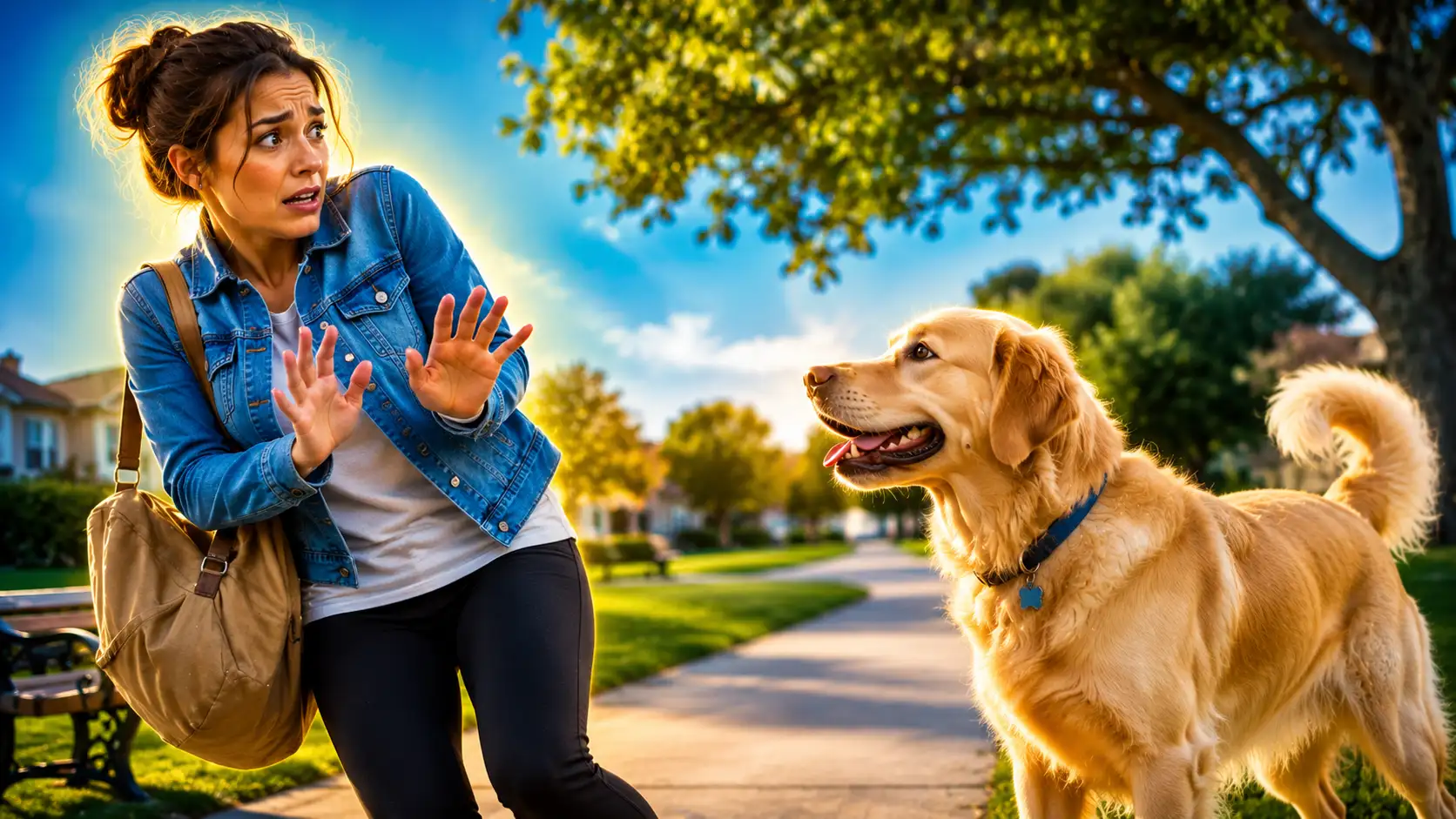
Dogs are often described as "man's best friend." Millions of people enjoy spending time with them, and many families consider them beloved members of the household. Yet not everyone feels comfortable around dogs. Some people instinctively step back when a dog approaches. Others avoid parks where dogs are off-leash or become anxious even when a friendly puppy walks toward them. These reactions are sometimes misunderstood. Friends may say, "Don't worry, he's friendly," assuming the fear is an overreaction.
Psychology suggests the experience is often far more complex. Fear is one of the brain's natural protective systems. It develops through personal experiences, observation, biological predispositions, and the way individuals perceive risk. In many cases, a person's fear of dogs is not a conscious choice but a learned emotional response.
It's also important to distinguish between everyday caution and cynophobia, the clinical term for an intense fear of dogs. While some people simply feel uneasy, others experience significant anxiety that interferes with daily life.
A frightening experience can leave a lasting impression
One of the best-known explanations comes from Classical Conditioning, developed by psychologist Ivan Pavlov and later applied to fears through the work of John B. Watson. If someone was bitten, chased, or startled by a dog as a child, the brain may begin linking dogs with danger.
Even years later, seeing a dog can trigger anxiety, despite knowing logically that not every dog is aggressive. The emotional memory often lasts longer than the actual event.
Fear can also be learned by watching others
Another explanation comes from Social Learning Theory, developed by psychologist Albert Bandura. Children frequently learn emotional responses by observing parents, siblings, and other adults.
Imagine a child whose parent becomes visibly frightened every time a dog comes near. Without having any negative experience themselves, the child may gradually learn that dogs are something to fear. Observation can be just as powerful as direct experience.
The brain is naturally alert to possible threats
Psychologists also describe Preparedness Theory, proposed by psychologist Martin Seligman. The theory suggests humans evolved to learn certain fears more easily because they once helped our ancestors survive.
Although dogs are domesticated today, large animals capable of causing injury may still activate ancient threat-detection systems in some individuals. Preparedness doesn't create fear by itself, but it can make fear easier to develop after a negative experience.
People perceive risk differently
Research on Risk Perception shows that individuals vary in how they evaluate potential danger. One person may confidently pet an unfamiliar dog after asking the owner's permission.
Another may focus on uncertainty, wondering whether the dog could suddenly bark or bite. Neither response is automatically right or wrong. People simply weigh possible risks differently based on personality, past experiences, and confidence.
Anxiety sensitivity can make fears feel stronger
Psychologists also study Anxiety Sensitivity, which refers to how strongly people react to feelings of anxiety. Someone who notices their heart racing near a dog may interpret those physical sensations as evidence that the situation is dangerous. This can create a cycle in which anxiety increases even further. Over time, avoiding dogs may temporarily reduce stress, unintentionally reinforcing the fear.
Avoidance can strengthen fear over time
Behavioral psychologists explain this through Negative Reinforcement. When someone avoids something that makes them anxious, they immediately feel relief. That relief rewards the avoidance behavior.
As a result, the person may become even less comfortable around dogs because they never have opportunities to learn that many interactions are safe. This is one reason gradual exposure is commonly used by mental health professionals when treating phobias.
Being afraid of dogs doesn't mean someone dislikes animals
People usually feel that people who fear dogs must dislike pets. Psychology doesn't support that conclusion. Many individuals who are anxious around dogs still love animals, support animal welfare, or enjoy watching dogs from a comfortable distance.
Their fear reflects how the brain processes perceived danger, not necessarily how they feel about animals themselves.
FAQs:
Why are some people afraid of dogs?
Psychologists say fear may develop through personal experiences, observing others, natural threat detection, or differences in how people perceive risk.
Is being scared of dogs a psychological condition?
Not always. Mild fear is common, but an intense and persistent fear that interferes with daily life may be classified as cynophobia, a specific phobia.