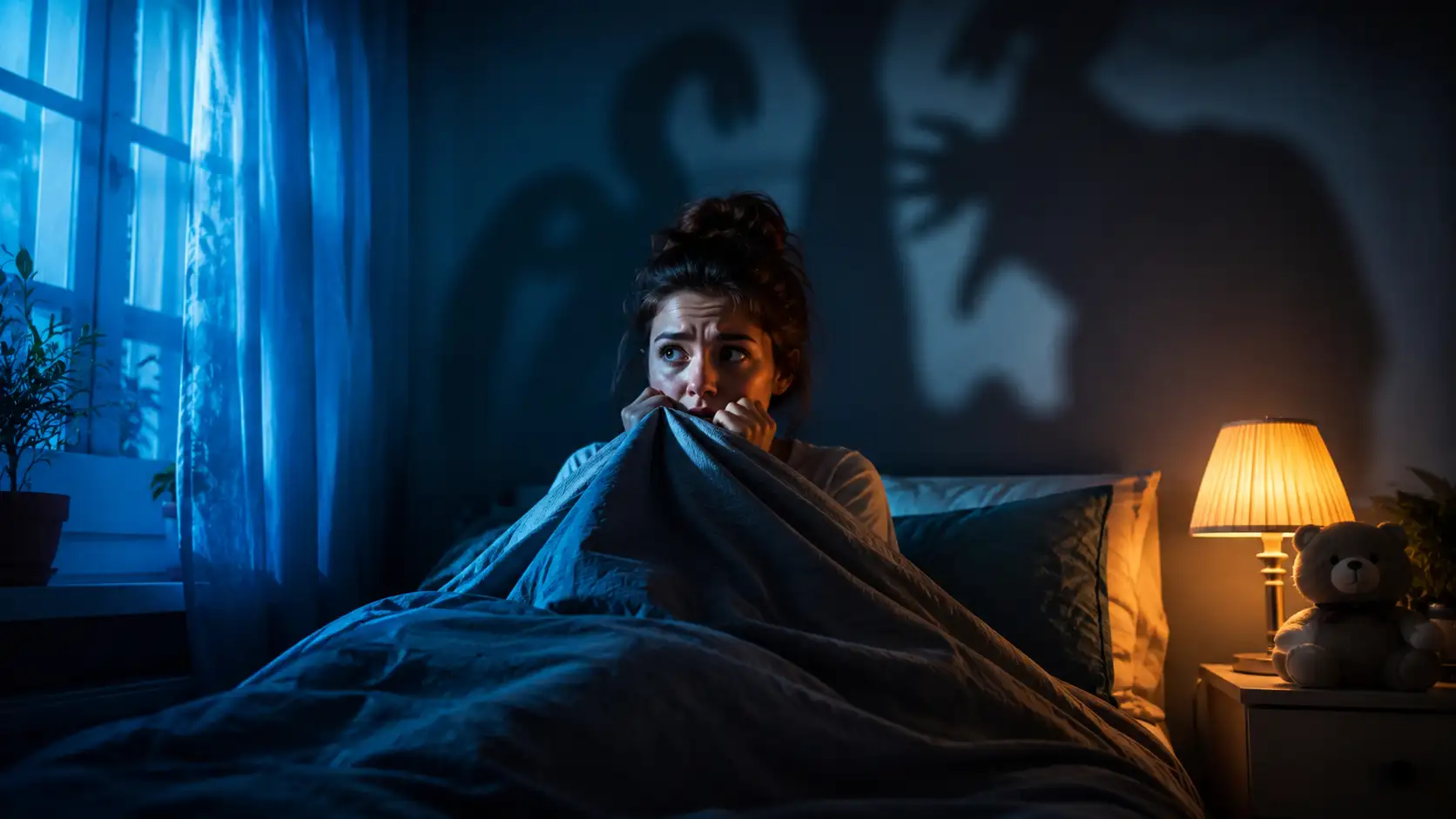
Many people become noticeably more alert the moment a room goes dark. A hallway that feels ordinary during the day may suddenly seem unsettling at night. Familiar sounds appear louder, shadows look different, and the imagination begins filling in details that cannot be seen.
Children commonly experience fear of the dark, but many adults do as well. Psychology suggests this reaction is not necessarily irrational. In many cases, it reflects how the human brain responds when visual information becomes limited.
While there is no scientific evidence that everyone who fears darkness has the same personality or life history, several well-established psychological theories help explain why darkness can feel threatening.
Fear can be shaped by biology, childhood experiences, culture, anxiety levels, and individual temperament.
The brain is wired to notice possible danger
One explanation comes from Evolutionary Psychology. For most of human history, darkness reduced visibility and made it harder to detect predators, dangerous terrain, or other threats.
Because survival depended on identifying danger quickly, the brain evolved to become more cautious when visual information was limited. Today, most people are physically safe in their homes at night, but the brain can still react as if uncertainty might signal risk.
This evolutionary tendency helps explain why even confident adults sometimes feel uneasy in complete darkness.
Fear can be learned through experience
Another explanation comes from Classical Conditioning, developed by psychologist Ivan Pavlov, and later research on Fear Conditioning.
If someone experienced a frightening event in the dark, such as getting lost, hearing alarming noises, or watching a frightening movie as a child, the brain may begin linking darkness with danger.
For example, a child who repeatedly hears scary stories before bedtime may later associate nighttime with fear even when no real threat exists. Over time, the emotional response can become automatic.
Uncertainty often increases anxiety
Psychologists also study Intolerance of Uncertainty, which refers to finding uncertain situations especially stressful. Darkness removes information that people usually rely on to judge their surroundings.
When the brain cannot clearly identify what is happening, some individuals naturally imagine multiple possibilities. Most of those possibilities never occur, but the uncertainty itself can increase anxiety.
Hypervigilance keeps the brain on alert
Another important concept is Hypervigilance, a state in which the brain continuously scans the environment for possible threats. People experiencing high levels of stress or anxiety may become especially aware of unfamiliar sounds, movements, or shadows in dark environments.
For example, the sound of a house settling at night may seem far more alarming than it does during the day because the brain is already searching for potential danger.
The amygdala reacts before logic catches up
Neuroscientists have found that the amygdala, a brain region involved in detecting threats, often reacts rapidly to possible danger. This quick response is useful because it prepares the body to respond before every detail has been analyzed. Later, areas such as the prefrontal cortex help evaluate whether the situation is actually dangerous. That is why someone may briefly jump at a shadow before realizing it is only a chair or a coat hanging on a door.
Childhood fears don't always disappear completely
Developmental psychologists note that fear of darkness is common during childhood because imagination develops faster than the ability to accurately evaluate risk.
Most children gradually become less fearful as they gain experience and confidence. However, some adults continue to experience discomfort in dark environments, especially if earlier fears were reinforced by stressful experiences or ongoing anxiety. This does not automatically indicate a psychological disorder.
Fear of darkness doesn't mean someone lacks courage
One common misconception is that adults who fear darkness are immature or emotionally weak. Psychology does not support that conclusion. Courage is not the absence of fear, it is the ability to continue functioning despite feeling afraid.
Many firefighters, police officers, military personnel, healthcare professionals, and rescue workers acknowledge feeling fear in uncertain situations while still performing their responsibilities. Fear is a normal human response.
FAQs
Why are some adults still afraid of the dark?
Psychologists say fear of darkness may result from evolutionary instincts, learned experiences, anxiety, or discomfort with uncertainty.
Is fear of darkness a mental illness?
Not necessarily. Fear of darkness is common and becomes a concern only if it causes significant distress or interferes with daily life.