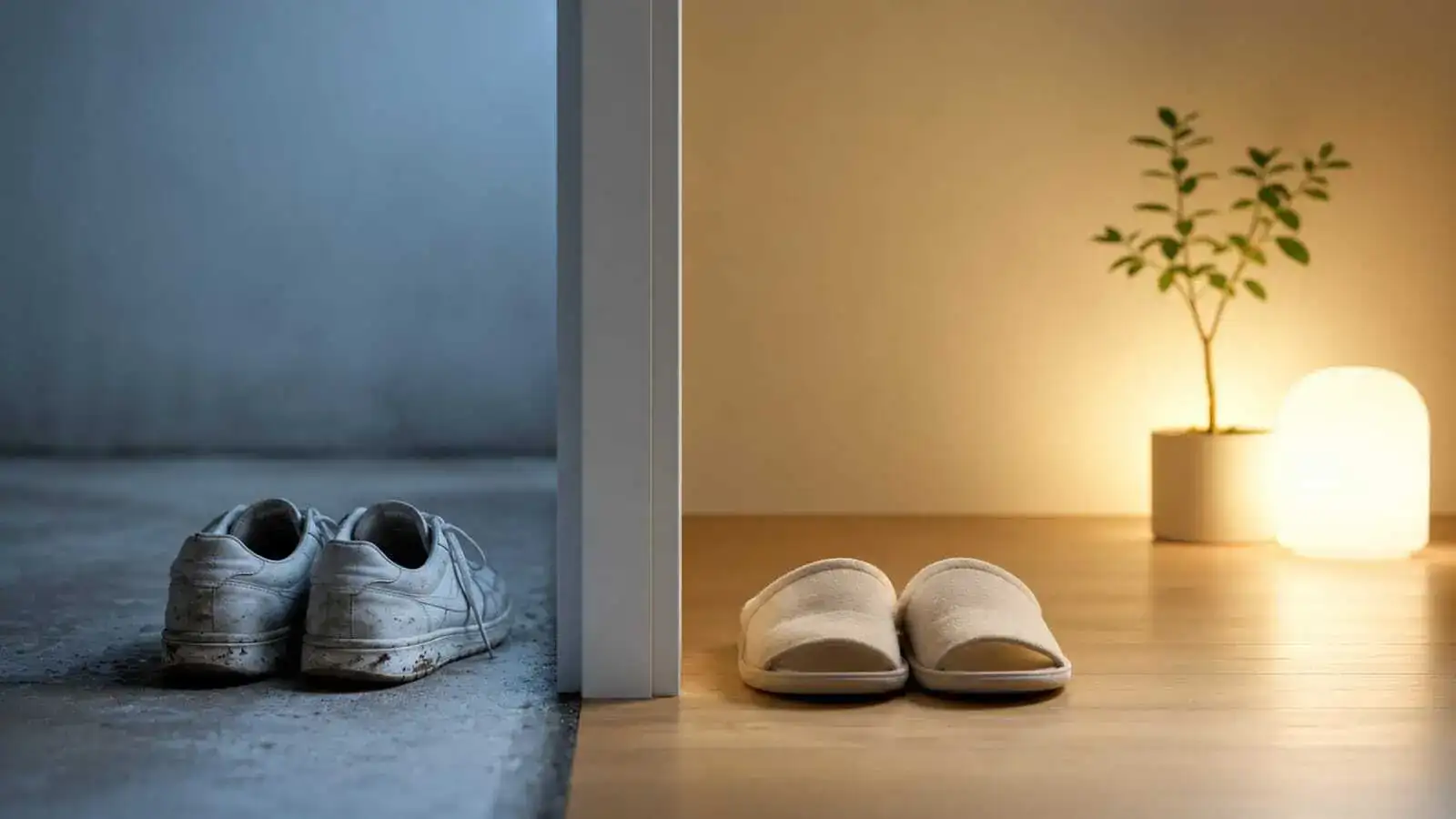
Most people think adults who insist on wearing separate indoor slippers and outside shoes are simply neat freaks. But psychology suggests the habit often goes far beyond cleanliness. For some, it is about hygiene. For others, it is an invisible boundary that separates the outside world's chaos from the comfort of home. It is a small ritual that signals to the brain that one environment has ended and another has begun. In a world where work emails enter bedrooms, social media enters dinner tables, and stress follows people everywhere, many adults are unconsciously creating tiny systems to regain control.
That pair of indoor slippers may be doing much more psychological work than people realize. Here is what psychology says may actually be happening.
Psychology says they are creating mental boundaries, not just physical ones
One of the strongest explanations comes from Boundary Theory. Boundary Theory explains how people mentally separate different parts of their lives to reduce emotional overload. Humans naturally function better when they can distinguish between work, public life, and personal space.
Changing from outside shoes to indoor slippers acts as a transition ritual. It tells the brain, "The outside world stays there. Home begins here." This small action can help reduce mental clutter because rituals create predictability, and predictability often reduces stress.
Researchers from American Psychological Association have frequently highlighted that routines and environmental structure can improve emotional well-being and lower stress levels.
Their brains may crave a sense of control in an unpredictable world
Psychologists often talk about the concept called the Illusion of Control. Humans naturally seek ways to feel stable when life becomes uncertain. Small daily habits provide a sense of order. Keeping outdoor dirt outside is one example. When adults consistently separate indoor and outdoor spaces, they create one area they can fully manage.
The world outside may be chaotic, but their home environment remains predictable. Modern examples are everywhere. Remote employees transition from work mode to home mode by changing clothes after office hours. Some people light candles after work. Others make tea before relaxing. Separate slippers work in a similar way. The habit may look insignificant, but it sends a calming message to the nervous system.
It may be connected to environmental psychology
Environmental psychology studies how physical spaces influence emotions, behavior, and mental health. Humans are deeply affected by their surroundings, even when they do not realize it. A clean, organized home often creates feelings of calmness and safety.
When people avoid bringing outdoor shoes inside, they are preserving what psychologists call a restorative environment. A restorative environment helps the brain recover from cognitive fatigue. This is becoming increasingly important because modern adults are exposed to constant stimulation throughout the day.
Researchers from Harvard Medical School have frequently discussed how clutter, stress, and overstimulation can negatively impact mental well-being.
The habit may reflect conscientiousness, one of psychology's biggest personality traits
Another explanation comes from the Big Five Personality Theory. One of the five major personality dimensions is conscientiousness. Conscientious people tend to value organization, planning, responsibility, and consistency.
Adults who maintain separate footwear systems often display these characteristics in subtle ways. However, this does not mean every organized person is highly conscientious, nor does it mean every conscientious person uses indoor slippers.
It simply shows that consistent routines are often associated with people who enjoy structure. The behavior becomes less about shoes and more about creating systems that reduce decision fatigue.
Rituals help calm the brain more than people realize
Humans are ritualistic creatures. Research repeatedly shows that rituals help regulate emotions because they provide familiarity. Psychologists call this self-regulation. Self-regulation is the ability to manage emotions, behaviors, and attention. Tiny actions repeated every day can have surprisingly large effects. Think about today's world. People use sleep routines, skincare routines, workout routines, and digital detox habits. Switching footwear is another version of the same principle. It marks a psychological transition. The brain begins associating slippers with relaxation and outside shoes with activity. Over time, the habit becomes automatic.
Cultural influences also play an important role
This behavior is also deeply influenced by culture. Countries such as Japan, South Korea and parts of India have long traditions of separating indoor and outdoor footwear. These practices developed for hygiene reasons, but they also strengthened a symbolic distinction between public and private life. In recent years, social media platforms have made these habits more visible globally.
Many people adopted similar practices after spending more time at home during the pandemic era. What once looked old-fashioned now feels intentional.
Psychology says the slippers are not the story, the boundaries are
Psychology teaches us that everyday habits are often symbols rather than random actions. The slippers themselves are not important. What they represent is. For some people, they represent comfort. For others, they represent order, peace, identity, or emotional recovery.
In today's always-connected world, adults are searching for ways to create small pockets of safety. Sometimes, those solutions are surprisingly simple. A pair of indoor slippers may quietly be telling the brain, "You've done enough for today. You can rest now." And perhaps that is why the habit feels so satisfying.
FAQs
Is keeping separate indoor slippers a sign of obsessive behavior?
No. For most people, it is simply a routine connected to comfort, boundaries, and organization rather than obsession.
What personality type is associated with this habit?
People who value structure and consistency may display higher levels of conscientiousness, one of the Big Five personality traits.