Global oil prices continued their decline Thursday, fueled by growing optimism that a diplomatic agreement between the United States and Iran could soon allow crude tankers to resume deliveries from the Persian Gulf. This positive sentiment, however, saw the S&P 500 dip slightly from its record high as markets reacted to the evolving geopolitical landscape.
Brent crude, the international benchmark, fell 0.5 percent to $100.71, a notable drop from $115 earlier in the week. While still considerably higher than pre-war levels, financial markets are buoyed by Iran's announcement that it is reviewing the latest U.S. proposals aimed at ending their conflict.
On Wall Street, the S&P 500 retreated 0.3 percent from the all-time high it reached the previous day. This came after a spokesperson for Pakistan’s Foreign Ministry, acting as a mediator between the two nations, stated, "We expect an agreement sooner rather than later."
Such a deal is anticipated to reopen the Strait of Hormuz, whose closure during the war has trapped oil tankers in the Persian Gulf and contributed to soaring prices for crude and various other commodities.
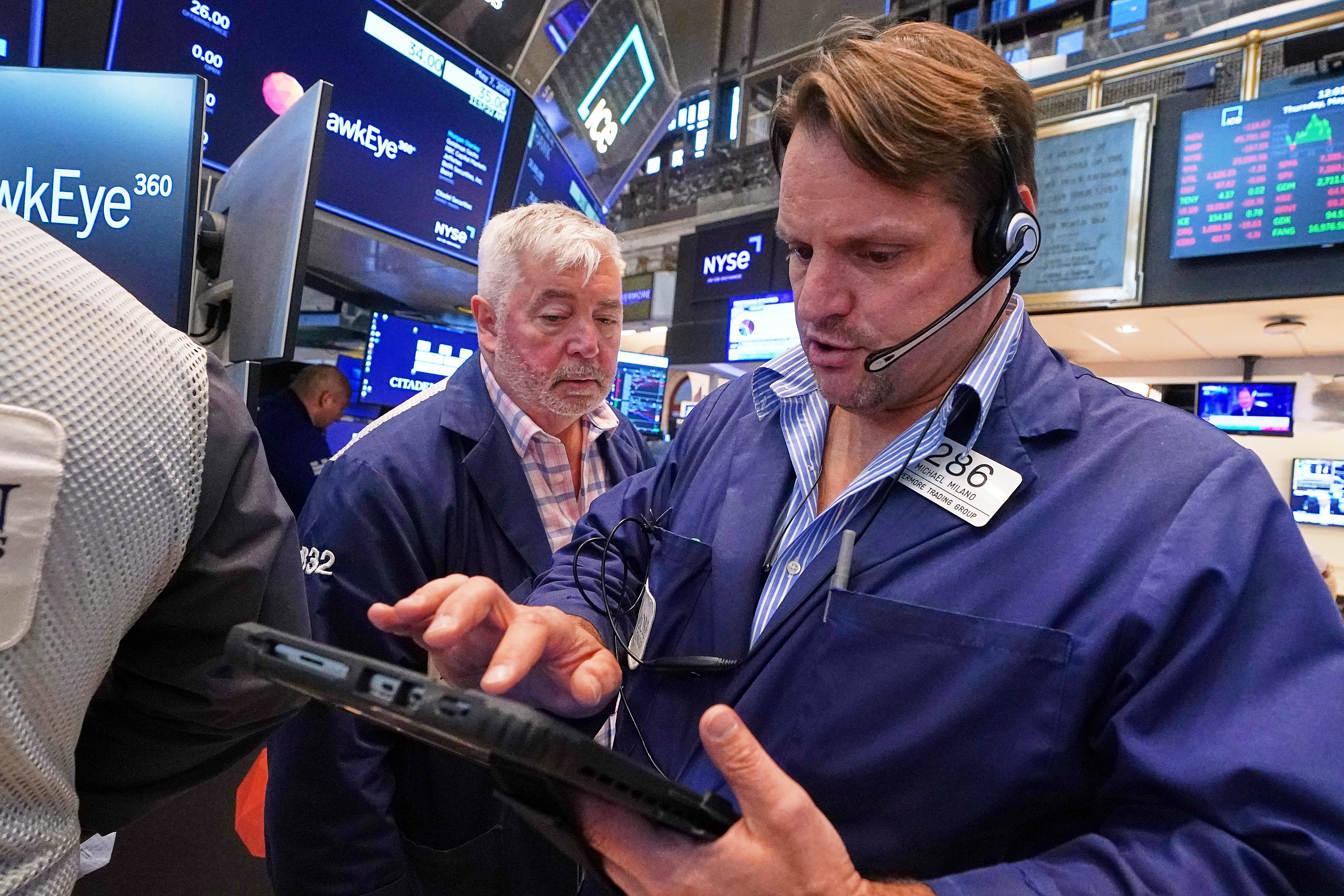
The Dow Jones Industrial Average was down 285 points, or 0.6 percent, as of 2:09 p.m. Eastern time, and the Nasdaq composite fell 0.1 percent from its own record.
Of course, Wall Street has rallied strongly before on hopes for a coming end to the war with Iran, only to get quickly disappointed. That could happen again, and tensions are still high in the Middle East after a U.S. fighter jet shot out the rudder of an Iranian oil tanker in the Gulf of Oman Wednesday as it tried to breach the American blockade of Iran’s ports.
Despite all those uncertainties, a powerful parade of U.S. companies saying they made even bigger profits during the first three months of the year than analysts expected has helped support the U.S. stock market. Stock prices tend to follow the path of corporate profits over the long term.
Datadog leaped 28.2 percent to help lead the U.S. market after the monitoring and security platform for cloud applications topped analysts' expectations for profit in the latest quarter.
Albemarle rose 5.7 percent after the lithium products and specialty chemicals company likewise delivered better-than-expected results. Taser maker Axon Enterprise rallied 10.7 percent after raising its forecast for revenue this year in part because of big growth for its counter-drone products.
They helped offset a 13.2 percent drop for Whirlpool, which tumbled after reporting much weaker results than analysts expected. It announced the largest price increases in a decade for its major appliances in North America, while accelerating cuts to its costs, as it contends with weaker confidence among U.S. consumers.
Shake Shack dropped 29 percent after its results for the latest quarter fell well below analysts' expectations.
McDonald’s was mostly unchanged even though its revenue for the latest quarter edged past analysts’ expectations. CEO Chris Kempczinski said high gasoline prices and consumer anxiety over the Iran war could dent its sales this spring.
In the bond market, Treasury yields held relatively steady. The yield on the 10-year Treasury rose to 4.39 percent from 4.36 percent late Wednesday, but remains down from 4.45 percent early this week.
Lower yields can bring down rates for mortgages and other kinds of loans going to U.S. households and businesses, which in turn can give the economy a boost. Lower yields also tend to push upward on prices for stocks and other kinds of investments.
The 10-year Treasury yield, though, remains well above its 3.97 percent level from just before the war.
Several reports on the U.S. economy also came in mixed. One said more U.S. workers applied for unemployment benefits last week, but the increase was not as bad as economists expected. Another report suggested that productivity for U.S. workers improved by only half of what economists expected for the latest quarter.
In stock markets abroad, indexes fell in Europe following a stronger finish in Asia.
Japan’s Nikkei 225 roared 5.6 percent higher as trading in Tokyo reopened following a holiday and caught up with big gains for Asian markets from earlier in the week. It’s at a record after soaring nearly 71 percent in the last 12 months on strength for tech stocks benefiting from the boom in artificial intelligence.
“I think it’s a kind of bubble because buying activity concentrated on leading AI, artificial intelligence stock and semiconductor-related stocks. It’s a situation where only semiconductor stocks are being bought,” said Takashi Hiroki, chief strategist at MONEX.