Media scrutiny can take surprising forms, as One Nation and Pauline Hanson are now finding out.
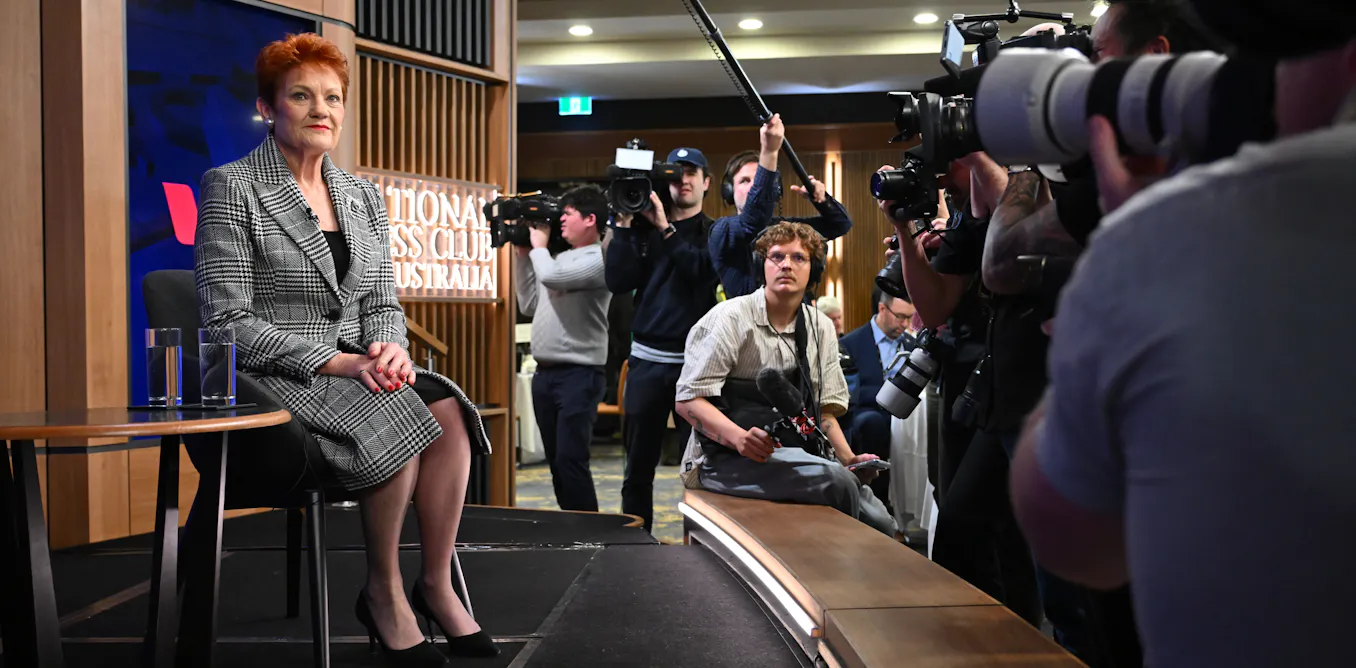
It can take the form of a National Press Club lunch at which Hanson is asked only one hard question and receives a round of applause from her table of supporters for abusing the journalist who asked it.
It can take the form of a slow burn ignited by a single word – monoculture – that she used at that same lunch and which lodged in the communal memory, a touchstone for what she and the party stand for.
It can take the form of an apparently friendly approach from a commercial television current affairs program anxious to push a common agenda with her on the issue of “uncontrolled immigration”, but which then backfires spectacularly.
It can take the form of paparazzi-style pictures of Hanson at a luxury resort in Italy in the company of the billionaire mining magnate Gina Rinehart.
And it can take the form of spontaneous combustion, as when her star recruit, Barnaby Joyce, yells aggressively at his dog while live-to-air nationally on ABC television.
But somewhat paradoxically, the lunch seems to have been a turning point.
Up to and including that occasion, the media herd, on the whole, had been content to let Hanson get away with shutting out journalists she did not like, or from organisations such as the ABC and Guardian Australia that she did not like.
This occurred, for example, on the eve of the Farrer by-election in May, and again a couple of weeks later at a chamber of commerce meeting in Perth. Hanson orders the ABC out and the rest of the media politely step aside to allow them to exit.
Then, given free rein on the platform of the National Press Club, Hanson laid out her vision for Australia.
Multiculturalism must give way to monoculturalism; SBS was unnecessary and the ABC would become a subscription-only service in metropolitan areas; there were too many abortions in Australia; transgender issues were driven by ideology; immigration would be slashed; Islamists cracked down on; efforts to cut carbon emissions would not be allowed to “throttle” the economy.
Separately, but at about the same time, she said she would withdraw Australia from the World Health Organisation and scrap the Therapeutic Goods Administration.
The speech was rapturously received by elements of the media, in particular the tabloid division of News Corporation, although The Australian was more circumspect, describing her speech as “Hanson’s insurgency”. It published an editorial saying Hanson did not offer solutions and later, a collection of letters under the heading “Hanson’s vision for the nation has many frightening aspects”.
The Age gave a straight account of the speech. An accompanying analysis said Hanson’s presentation was not slick but she never lost her cool.
It was typical of the kid-glove handling of her in the immediate aftermath, but then the scrutiny got serious, reaching a new level during her European “fact-finding” trip in July.
Her attendance at a luxury fashion show in Sicily, her swanning about poolside with Gina Rinehart, her stay at a five-star hotel in London, her address to a half-empty hall at a Conservative Political Action Conference in London followed by her elaborate efforts to evade reporters: these became the story.
Back home there were reports of sliding poll numbers, a rift between Hanson and Joyce, and the promotion of antisemitic views by her colleague Malcolm Roberts.
To top it off, on the evening of July 20 2026, the Seven Network broadcast an hour-long story about Hanson on its Spotlight current affairs program.
Among other things, it showed Hanson riding in a car with the notorious British racist and violent criminal, Stephen Yaxley-Lennon, aka Tommy Robinson. They are driving through the town of Luton, outside London, looking out on street scenes of women in hijabs and shops selling halal meat and other goods that meet the needs of a Muslim community.
Hanson puts her hands over her eyes and says she doesn’t want to see scenes like this in Australia. It is obvious that she and Robinson are revelling in their shared aversion to this violation of what they think the nations of Britain and Australia once were and should be again.
They joke about Robinson coming to Australia to spread this message. Robinson says he doubts he would get a visa because of his criminal record. Hanson laughs and says that if she becomes prime minister that will not be a problem.
This produced yet more unwelcome headlines, damaging to both Hanson and the Seven Network, and shed light on one of the more unsavoury aspects of journalism.
First, Hanson comes under fire for consorting with Robinson, and for lamenting the end of the White Australia policy.
Then, seemingly dissatisfied at how she had been portrayed in the program, Hanson posts on Facebook the written pitch that Spotlight had sent her about the story as they originally envisaged it.
It revealed Spotlight wished to push an agenda concerning “uncontrolled immigration”, a phrase repeated seven times. It said that what was happening in Britain was what Australia would face “if we don’t take control of who comes to our country”.
Spotlight suggested it might cover some of the travel costs to get Hanson to Britain, the idea being that she should meet the leader of Reform UK, Nigel Farage, who pushes a strong anti-immigration agenda. In the event, this did not happen because Farage resigned from parliament about the time he and she were to meet.
But Hanson did meet another far-right British politician, Rupert Howe, and of course the notorious Robinson, all captured on camera and broadcast by Spotlight.
Having posted all this on Facebook, Hanson invited her followers to judge whether the program as broadcast had lived up to the promises made in the pitch.
Whether it did or not, the whole episode reveals an approach by Spotlight that is the antithesis of journalism: outright propaganda for Hanson in support of Spotlight’s own anti-immigration agenda.
Scrutiny does indeed come in many forms, and sometimes the scrutineers get scrutinised themselves.
This article was originally published on The Conversation. Read the original article.