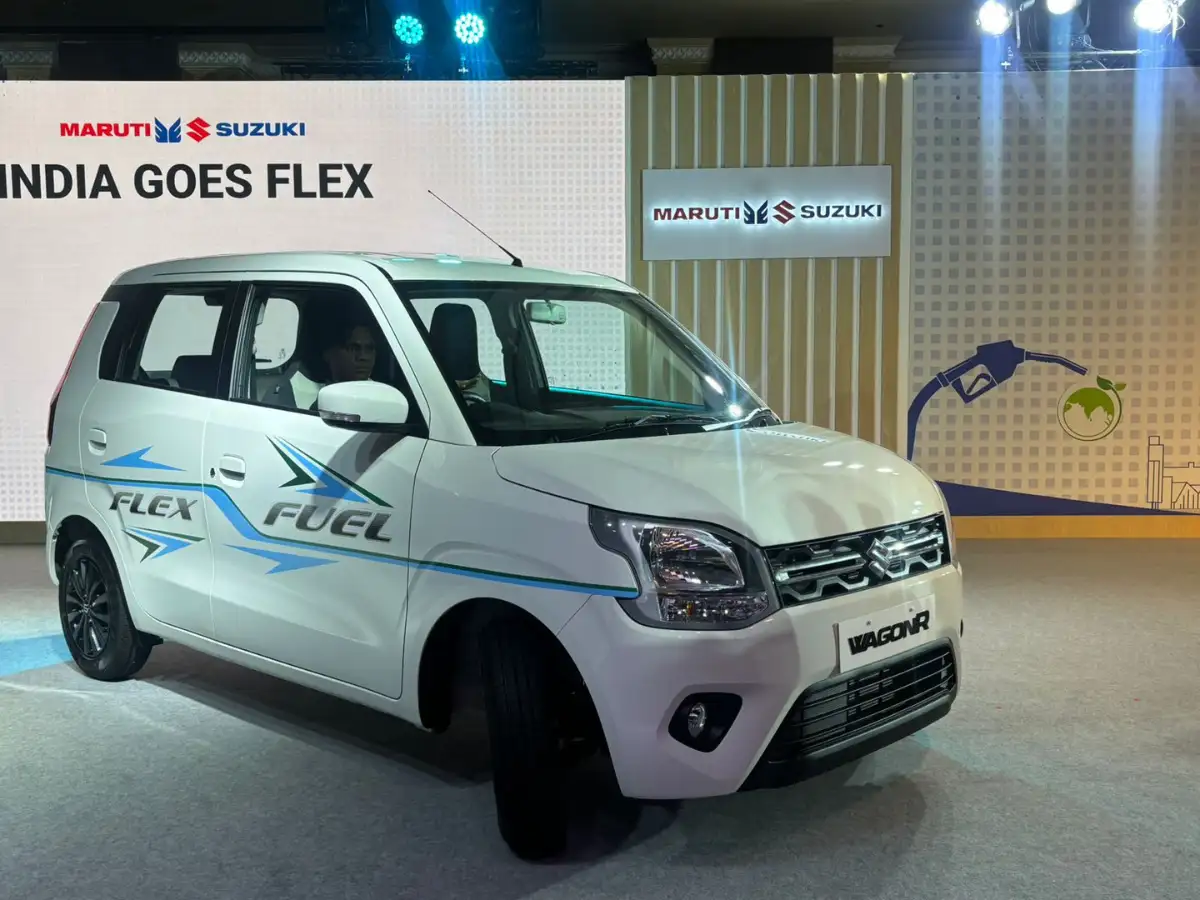
Maruti Suzuki on Thursday launched India's first flex-fuel passenger car, betting on ethanol-based mobility as a key strategy to reduce fuel imports, curb carbon emissions and strengthen energy independence.
While EVs, hybrids and CNG vehicles remain central to India's clean mobility transition, flex-fuel technology is emerging as another promising pathway to reduce emissions and curb dependence on imported crude oil.
What are flex-fuel cars?
Flexible Fuel Vehicles (FFVs) are equipped with internal combustion engines that can run on petrol as well as petrol-ethanol blends containing up to 83% ethanol. While they use a single fuel system similar to that of conventional petrol vehicles, certain components are specially designed to handle ethanol's distinct chemical properties and lower energy content. These modifications include ethanol-compatible fuel pumps, fuel injectors and other fuel system parts. Additionally, the engine control module (ECM) is calibrated to adjust for ethanol's higher oxygen content, enabling the vehicle to operate efficiently on varying fuel blends.
Flex-fuel vehicles (FFVs) are specially designed automobiles that can run on petrol as well as ethanol-blended fuels. Unlike conventional petrol vehicles, which can handle only limited ethanol blends, FFVs are capable of operating on fuels ranging from E20 to E85 and, in some cases, even E100. Their engine management systems automatically detect the ethanol concentration in the fuel and adjust engine settings to ensure optimal performance.
Ethanol is a renewable, plant-based fuel produced from agricultural feedstocks such as sugarcane, corn and biomass. In India, sugarcane remains the primary source of ethanol production. The government's push towards ethanol blending is aimed at reducing dependence on imported crude oil while creating additional opportunities for the domestic agriculture sector.
While flex-fuel vehicles look similar to conventional petrol cars, they are equipped with specialised components that can withstand higher ethanol concentrations. These include corrosion-resistant engine parts, ethanol-compatible fuel systems, fuel composition sensors and advanced software capable of managing different fuel blends. As a result, FFVs can seamlessly switch between varying ethanol-petrol mixtures without any input from the driver.
The ethanol content in fuel is denoted by the letter "E". For instance, E20 contains 20% ethanol and 80% petrol, E85 contains 85% ethanol and 15% petrol, while E100 refers to pure ethanol. India has already rolled out E20 fuel across several regions and is gradually expanding infrastructure for higher ethanol blends.
A major advantage of flex-fuel vehicles is their potential to lower India's oil import bill by increasing the use of domestically produced fuel. Ethanol also burns cleaner than conventional petrol, helping reduce certain tailpipe emissions. Additionally, greater ethanol production can boost demand for agricultural feedstocks, supporting farmers and strengthening the rural economy. FFVs also offer consumers greater flexibility by allowing them to use different fuel blends based on availability and pricing.