Even though an Iran peace deal appears elusive amid new US strikes, stock sentiment remains convinced the conflict is winding down, which could push up the Thai bourse to 1,600 points by the end of the year, say analysts.
Koraphat Vorachet, assistant managing director and head of research at Krungsri Securities, said despite the renewed attacks, markets see the war as "de-escalating".
Monitoring reports show 35 cargo ships passed through the Strait of Hormuz over the past 24 hours, which is the maritime transport route for more than 20% of the world's oil, roughly 17-20 million barrels per day, as well as liquefied natural gas.
The pre-war average was 60 ships daily, while only 3-4 ships were navigating the strait in recent days.
"The volume of ships passing through the strait shows improvement, reflecting a picture of de-escalation that weighed down crude oil," noted Mr Koraphat.
"We assess the transport ship volume through the strait as a leading indicator. With the numbers accelerating day by day and remaining stable above 50% of normal conditions, this signals energy, oil and gas prices are likely to soften, providing positive sentiment for global stock markets."
However, oil rose back above US$100 a barrel on Tuesday after fresh US strikes on Iran dashed hopes of a Middle East breakthrough. Yet Brent eased to $98.07 per barrel, down 1.52% after a nearly 4% surge in the prior session, while West Texas Intermediate fell 1.97% to $92.04 a barrel.
Asian shares climbed on Wednesday, with MSCI's broadest index of Asia-Pacific shares outside Japan rising 1.6% to an all-time high.
Japan's Nikkei rose 0.5%, briefly trading above 66,000 points for the first time, while South Korea's KOSPI soared 3.41%.
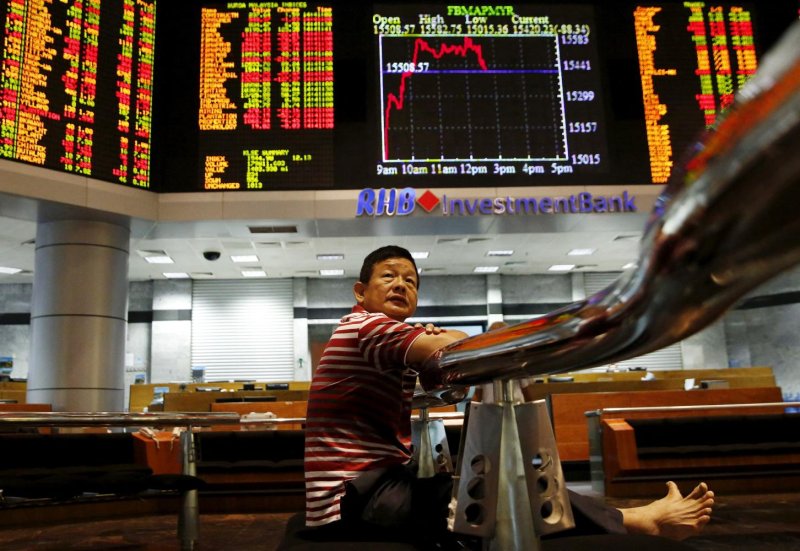
The Stock Exchange of Thailand (SET) surged 1.71% on Wednesday afternoon to reach 1,579.92 points.
Benjaphol Suthwanish, assistant managing director of securities analysis at UOB Kay Hian Securities (Thailand), said oil prices could ease to $70-80 per barrel if the US and Iran agree on a peace deal.
"As negotiations continue, investors are adopting a wait-and-see stance," he said, pinning hopes on the SET's second-quarter earnings per share improving both on a year-on-year and quarter-on-quarter basis.
Supported by strong first-quarter earnings, Mr Benjaphol sees a possibility that the SET index could reach 1,600 points by year-end.
Veeravat Virochpoka, an analyst at FSS International Investment Advisory Securities, said the latest military tensions signalled that a shaky truce between the US and Iran will be extended, affecting oil prices and risk assets.
"With a peace deal still on the table, there are hopes more easing is on the cards, particularly for the second half of the year," he said.
Maybank Securities shared a similar view, noting that although short-term uncertainty increased following US military strikes on Iran, the decline in the US 10-year bond yield by 7 basis points and the S&P 500's 0.6% gain, led by technology stocks, "suggest that markets still expect a final agreement to be reached".
Gold prices edged lower to less than $4,500 an ounce on Wednesday as investors assessed ongoing tensions between the US and Iran.
Spot gold was down 0.4% to $4,486.26 per ounce and US gold futures for June delivery fell 0.4% to $4,485.70.
Pattharadanai Jaturaporn, an analyst at Phillip Securities, views gold as being on a short-term consolidation trend amid increased volatility in the Gulf region.
The brokerage sees the key support levels for gold at $4,450 and then $4,300, he said.