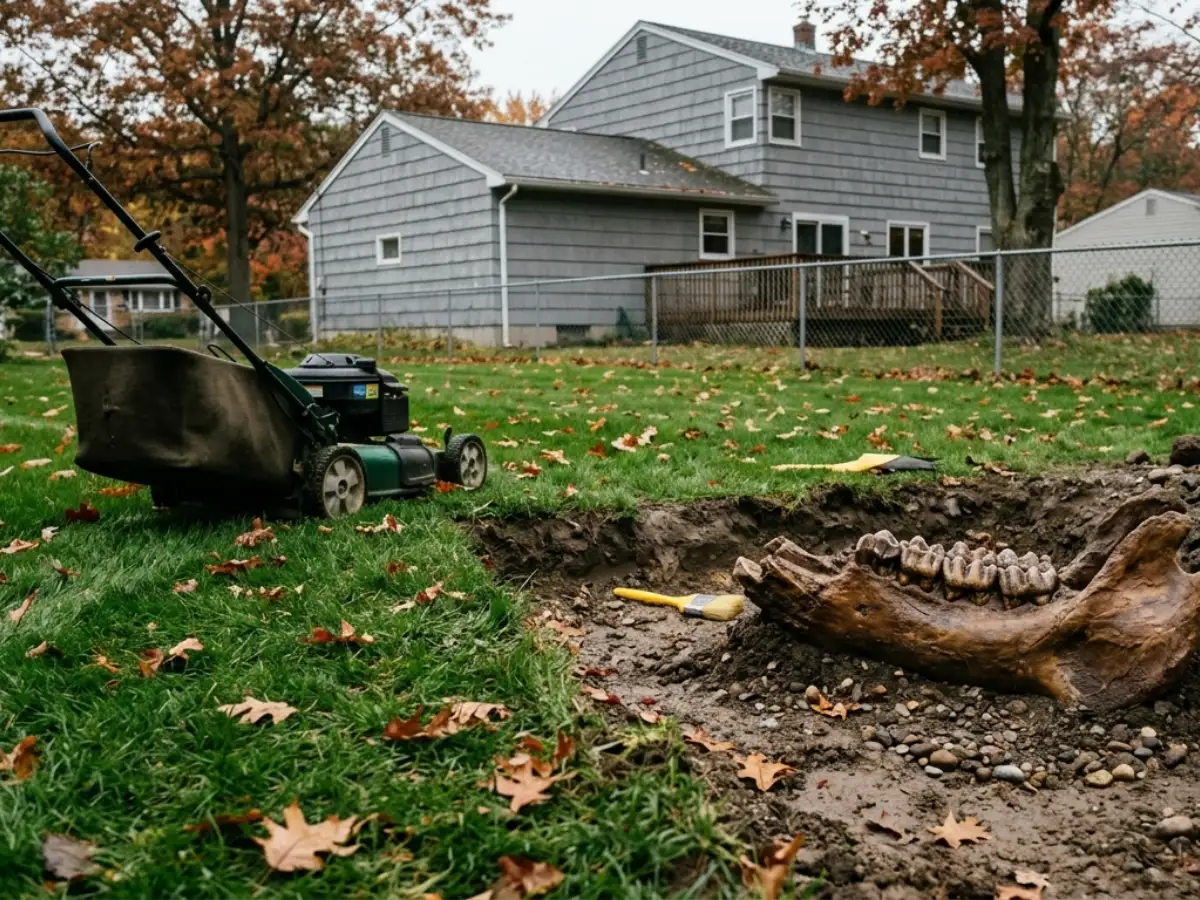
One of the homeowners in Orange County had another story altogether. During his lawn-mowing process in 2024, the homeowner stumbled upon some oddly-shaped balls in his lawn. Initially, he thought the items resembled baseballs, but a closer look revealed that they were not actually balls. The items turned out to be large fossilized teeth.
This seemingly insignificant event would soon evolve into one of the most interesting discoveries in the modern Ice Ages in New York.
According to Smithsonian Magazine, these findings have been confirmed by experts to be fossils of one of the largest prehistoric animals that ever lived in North America. These mammals are commonly known as Mastodons and inhabited the continent millions of years ago.
The excavation beneath the lawn
Following the contact of the owner of the land with specialists, experts from the New York State Museum and SUNY Orange came to research the plot. What they found underneath the grass was much more interesting than just some pieces of fossils.
According to the New York State Museum and reports from Smithsonian Magazine, there was an excavated jawbone of a mastodon, together with other pieces such as the toe bone and rib pieces. It is important to mention that this discovery was considered particularly valuable since whole or nearly whole mastodons' skeletons are less common and have a greater scientific value compared to isolated teeth.
This find has been officially announced by the New York State Museum at the end of 2024.
As stated by the museum, such a discovery will contribute to expanding knowledge about the distribution of mastodons in the northeastern region of the country.
Why Orange County keeps revealing mastodons
The finding might seem extraordinary, but there is quite a long history of mastodons in Orange County.
Based on the reports provided by Britannica and the New York State Museum, the location is one of New York’s richest regions in terms of fossilized remnants from extinct species. The ancient wetlands and the glacial terrain allowed for both the development of ideal habitats during the time period and the subsequent preservation of remains.
This allows for the increased productivity of the area for paleontology studies.
The discoveries such as this one are still relatively rare due to the integrity of the findings, however. It is not unheard of to find fossilized teeth of mastodons at locations known for their high density of extinct remains. Finding a jaw and the rest of the skeleton can provide much more information about the animal in question.
As reported by the Associated Press, it adds another piece to the puzzle assembled over the years of research.
The Ice Age hidden beneath suburbia
What makes this story fascinating, however, is the mundanity of its setting.
Prehistoric finds are imagined by popular culture to be made in harsh deserts, icy tundras, or picturesque badlands. The truth is that this mastodon jaw was unearthed beneath an average American backyard while engaging in typical domestic activity.
This contrast contributes to the charm of the find.
The excavation in Orange County implicitly contradicts the assumption that our ancient world belongs solely to remote locations. In actuality, the signs of ancient America may stay hidden under modern streets and houses, camouflaged behind the façade of their contemporaneity.
As stated by Smithsonian Magazine, this story brings together a millennia-long history into a brief encounter between a person engaged in a common activity and a sign left from a bygone era.
The latter is a forgotten ecosystem that once thrived where contemporary suburbia exists now.
Why accidental discoveries matter so much
Among some of the most unforgettable fossils that have been found are those that were never being hunted by scientists at the time.
What made this discovery exceptional was that it resulted from observations and not the scientist's skills or knowledge in paleontology. It is interesting to note that the homeowner was quick to realize that these unusual pieces were different and sought professional help instead of throwing them away.
Such discoveries make a difference.
Mastodon fossils such as the one from Orange County play an important role in helping scientists learn more about the distribution of Ice Age animals in the Northeast. Every mastodon that is in good condition provides useful insight into how this giant mammal used to live and what happened to its remains after thousands of years of being buried underground.
Sometimes, science makes discoveries unexpectedly.
A suburban yard with an Ice Age past
The lawn where the jawbone of the mastodon was found today bears no resemblance to the ecosystem in which the creature once lived.
However, beneath the turf, the past lurked in wait.
As pointed out by Smithsonian Magazine and New York State Museum, the find illustrates the fact that signs of ancient history linger within seemingly ordinary parts of America. An ordinary process of trimming the lawn resulted in an extraordinary connection between an ordinary family and the prehistoric era, which had vanished long before they were born.
It is precisely this stark contrast that makes the find so memorable.