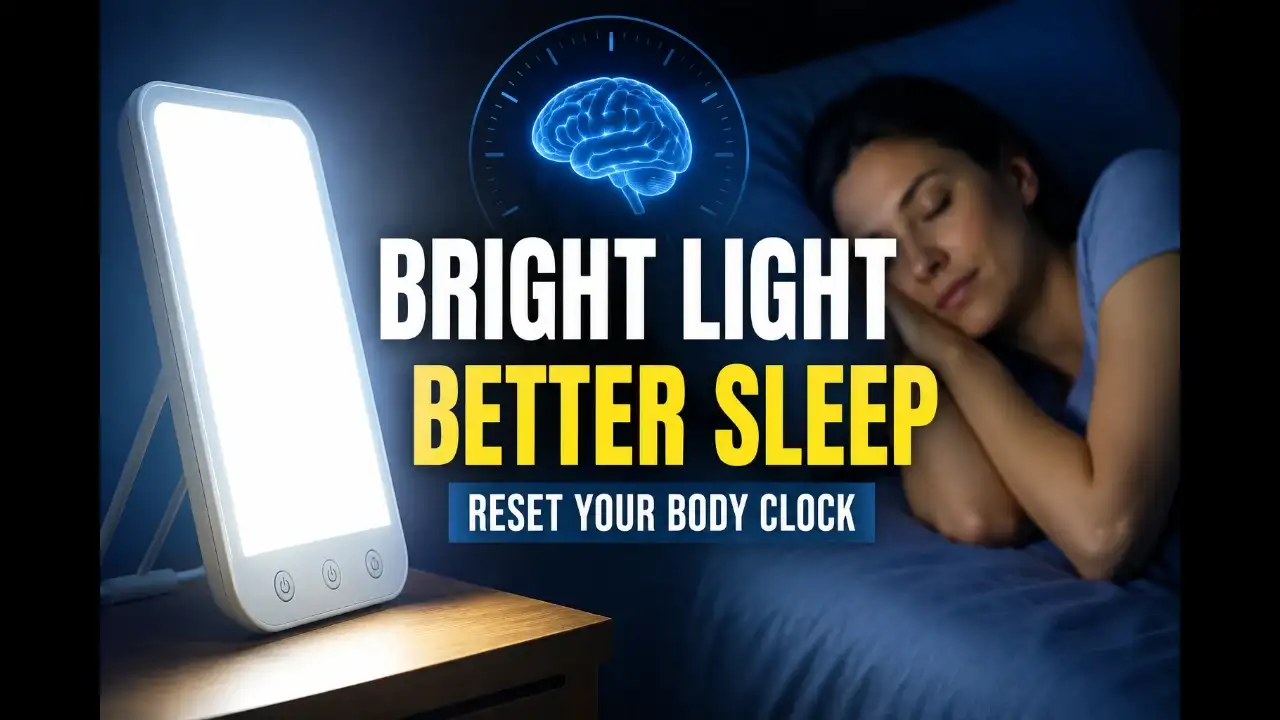
In 1989, scientists made a quiet breakthrough. It changed sleep medicine forever. They proved bright light therapy can reset your biological clock. Just 20 minutes of targeted light can trick your brain. It shuts down melatonin. It flips your internal wake switch. Struggling with stubborn insomnia? Fighting brutal jet lag? Trapped in shift-work exhaustion? This 35-year-old landmark sleep study still holds the master key.
Your eyes contain special sensors. They talk directly to your master biological clock. When bright light hits them at the exact right time, your circadian rhythm resets instantly. Morning light makes you sleep early. Night light keeps you wired until dawn. Timing is everything.
Here is how to hijack your natural body clock, fix your sleep schedule, and wake up energized without pills.
A scientific breakthrough that changed how experts view sleep
Before this landmark research, scientists already knew that humans followed an internal biological clock, often called the circadian rhythm. However, there was limited evidence showing that this clock could be deliberately adjusted using light at carefully chosen times of the day.
The 1989 study provided convincing proof that bright light could shift the timing of the body's internal clock. Researchers found that morning light generally moved the sleep schedule earlier, while evening light could delay it. This discovery helped explain why crossing time zones causes jet lag and why overnight workers often struggle to sleep during the day.
The findings quickly became one of the cornerstones of circadian rhythm research. Over the following years, scientists refined the approach, leading to practical treatments now used in sleep clinics across the United States and around the world.
Why bright light has such a powerful effect on the body
Light does much more than help people see. Specialized cells in the retina detect changes in light and send signals directly to the brain's master clock, located in the suprachiasmatic nucleus of the hypothalamus. This tiny region coordinates daily rhythms that influence sleep, alertness, hormone production, body temperature, and metabolism.
Morning sunlight tells the brain that a new day has begun, helping suppress melatonin, the hormone associated with sleep. As daylight fades in the evening, melatonin levels naturally rise, preparing the body for rest.
When this cycle is disrupted by overnight work, international travel, or inconsistent sleep schedules, the body's internal timing can fall out of sync. Carefully timed bright light exposure helps restore that alignment by giving the brain a stronger environmental signal about when it should be awake and when it should prepare for sleep.
This understanding has become one of the most important advances in sleep science over the past several decades.
How the discovery changed medical treatment
The research did more than improve scientists' understanding of sleep. It fundamentally changed patient care.
Today, the American Academy of Sleep Medicine recognizes appropriately timed light exposure as part of treatment for several circadian rhythm sleep-wake disorders. Instead of focusing only on sleeping pills or stimulant medications, sleep specialists often combine behavioral strategies with carefully scheduled light exposure to help patients gradually reset their internal clocks.
Standard Protocol for Light Therapy
- Intensity : 10,000 lux (UV-filtered) light box placed 16–24 inches from the eyes at a slight downward angle.
- Duration : 20 to 30 minutes within 30–60 minutes of waking.
- Natural Alternative : Step outside for 10–20 minutes without sunglasses shortly after sunrise. Even on cloudy days, outdoor light delivers between 1,000 and 10,000+ lux—far exceeding typical indoor ambient light (100–300 lux).
Bright light therapy is commonly recommended for people experiencing jet lag after long-distance travel, individuals diagnosed with delayed sleep-wake phase disorder, and workers whose overnight schedules interfere with normal sleep. The treatment is also widely used for seasonal affective disorder, where reduced daylight during winter contributes to depressive symptoms.
Modern treatment plans are tailored to each person's daily schedule because the same light can either help or worsen sleep depending on when it is used. This personalized approach stems directly from the scientific principles established by the 1989 research.
Why this research matters more than ever in the United States
The importance of healthy sleep continues to grow as American lifestyles become increasingly demanding. According to the U.S. Bureau of Labor Statistics, millions of Americans work evening, night, rotating, or irregular shifts. These workers often face chronic circadian disruption because their work schedules conflict with the body's natural sleep cycle.
At the same time, international travel has become increasingly common, exposing travelers to rapid time-zone changes that trigger jet lag. Even people who never leave their hometown may spend most of the day indoors under relatively dim artificial lighting while remaining exposed to bright electronic screens late into the evening.
Key Applications in Modern Medicine
- Shift Work Adaptation : Night-shift workers use high-intensity light therapy during the first half of their night shift to stay alert, followed by blue-blocking glasses during their morning commute home to protect sleep drive.
- Jet Lag Calculation : Travelers offset circadian disruption by targeting specific light exposure and light avoidance windows across time zones.
- Non-Pharmacological Insomnia Treatment : Re-anchoring circadian rhythm with morning light therapy reduces nighttime latency and nighttime awakenings without relying on sedative medications.
- Seasonal Depression (SAD) : 30 minutes of morning light box therapy compensates for shorter winter days, restoring normal serotonin and melatonin rhythms.
The Centers for Disease Control and Prevention has repeatedly highlighted insufficient sleep as an important public health concern because poor sleep is associated with reduced concentration, lower workplace productivity, and increased health risks over time.
As researchers continue studying circadian biology, many experts now view proper light exposure as one of the simplest lifestyle factors people can control to support healthier sleep patterns.
Using light therapy safely and effectively
Although bright light therapy has become an established medical treatment, experts emphasize that timing is everything. Medical-grade light therapy devices typically produce about 10,000 lux of illumination, far brighter than standard indoor lighting. The goal is not simply to sit in front of a bright lamp but to expose the eyes to light at the correct time based on an individual's sleep schedule and diagnosis.
Because incorrect timing can shift the biological clock in the wrong direction, sleep specialists recommend professional guidance for people with persistent insomnia or suspected circadian rhythm disorders. The American Academy of Sleep Medicine and the National Institutes of Health both note that light therapy works best as part of a broader treatment plan that may also include consistent sleep schedules, healthy sleep habits, and, in some cases, carefully timed melatonin.
How Light Rewires the Biological Clock
- Retinal Sensing : Specialized photoreceptor cells in the retina (intrinsically photosensitive retinal ganglion cells, or ipRGCs) contain the blue-light-sensitive photopigment melanopsin .
- Direct Pathway : These cells bypass visual processing areas and project directly along the retinohypothalamic tract to the suprachiasmatic nucleus (SCN) in the hypothalamus.
- Hormonal Cascade : The SCN signals the pineal gland to suppress melatonin (the sleep hormone) while stimulating cortisol production, signaling daytime alertness to peripheral clocks in every organ of the body.
The Phase Response Curve: Timing Is Everything
The key insight from 1989 that sleep medicine relies on today is the Phase Response Curve (PRC) . The effect of bright light depends entirely on when it hits your eyes relative to your core body temperature minimum (typically 2 hours before your natural wake time):
| Exposure Window | Internal Clock Response | Main Clinical Uses |
| Early Morning (after core temp minimum) | Phase Advance: Shifts your clock earlier. You feel sleepy earlier at night and wake up earlier. | Delayed Sleep Phase Disorder (extreme night owls), Eastward jet lag recovery. |
| Late Evening (before core temp minimum) | Phase Delay: Shifts your clock later. You stay awake later and wake up later. | Advanced Sleep Phase Disorder (waking at 3–4 AM), Westward jet lag recovery. |
| Midday | Stabilization: Minimal clock shift, but boosts alertness, mood, and nighttime sleep depth. | Seasonal Affective Disorder (SAD), general daylight deficiency. |