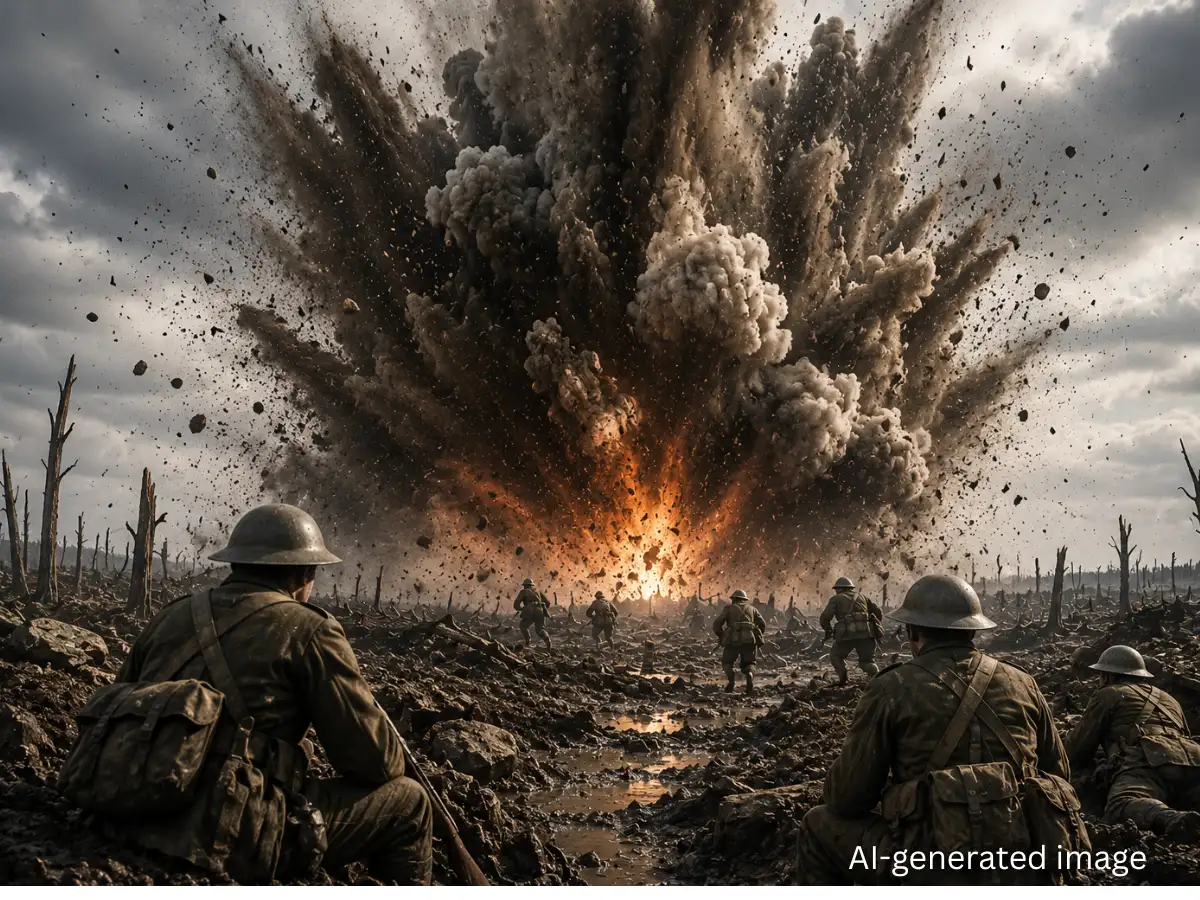
The First World War witnessed countless devastating battles, but one explosion in 1917 stood out for its sheer scale. Years before the atomic bomb changed warfare forever, Allied forces unleashed what was then the largest man-made explosion in history during the Battle of Messines in Belgium. The blast was so powerful that it was reportedly heard more than 100 miles (160 kilometers) away, with witnesses in London and Dublin claiming they heard the rumble.
Why did Britain create such a massive explosion?
By 1917, the Western Front had become locked in trench warfare, with German forces occupying heavily fortified positions along the Messines Ridge in present-day Belgium. Capturing the ridge was critical for the British Army, but a direct assault would have resulted in enormous casualties.
Instead, British military planners spent nearly two years secretly tunneling beneath German lines. Teams of Royal Engineers dug more than 20 deep tunnels, some extending hundreds of meters underground, while avoiding German counter-mining operations.
The explosion that changed the battlefield
In the early hours of June 7, 1917, the British detonated 19 enormous underground mines packed with nearly 1 million pounds (about 450 metric tons) of ammonal explosive.
The result was unprecedented.
The simultaneous blasts created massive craters, obliterated German front-line defenses, and killed an estimated 10,000 German soldiers almost instantly. The shockwave was so intense that it was reportedly heard across southeastern England and parts of Ireland.
For a brief period, it became the largest planned explosion ever created by humans—a record that stood until much larger wartime detonations and, ultimately, the atomic bombings of Hiroshima and Nagasaki in 1945.
How the explosion helped the Allies
The explosions marked the beginning of the Battle of Messines. With German defenses shattered, British, Australian, New Zealand, Irish and other Allied troops advanced behind a creeping artillery barrage and captured the strategically important ridge within hours.
Military historians regard the operation as one of the most successful carefully planned offensives of World War I. The victory improved the Allies' position ahead of the later Third Battle of Ypres, also known as the Battle of Passchendaele.
Are the craters still visible today?
Yes. Several of the enormous mine craters created during the Battle of Messines remain visible in Belgium more than a century later. One of the largest, the Spanbroekmolen Crater—now known as the "Pool of Peace"—has become a memorial site, offering a reminder of one of the most powerful non-nuclear explosions in history.
FAQs
What was the loudest man-made explosion before the atomic bomb?The detonation of 19 underground mines by British forces during the Battle of Messines on June 7, 1917, is widely regarded as the largest planned man-made explosion before the atomic age.
How powerful was the Battle of Messines explosion?
The mines contained nearly 1 million pounds (about 450 metric tons) of ammonal explosive, producing a blast reportedly heard more than 100 miles away.
Why was the Battle of Messines important?
The explosions destroyed German defensive positions, allowing Allied forces to capture the strategically important Messines Ridge and achieve one of their most successful victories on the Western Front.