
Since 1892, Idaho voters have decided on 228 state ballot measures. Of those, 162 (71%) were approved, and 66 (29%) were defeated.
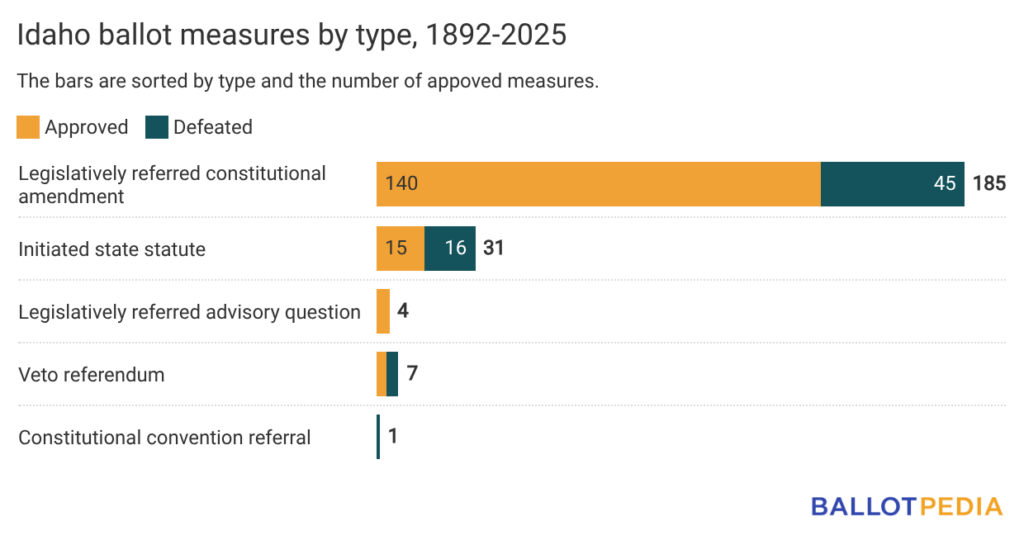
In Idaho, the state legislature can refer constitutional amendments and advisory questions to the ballot, while citizens can initiate state statutes and veto referendums. The Idaho State Legislature referred 189 measures to the state ballot, including 185 constitutional amendments and four advisory questions. Voters decided on 31 initiated state statutes and seven veto referendums. Voters also decided on one constitutional convention referral.
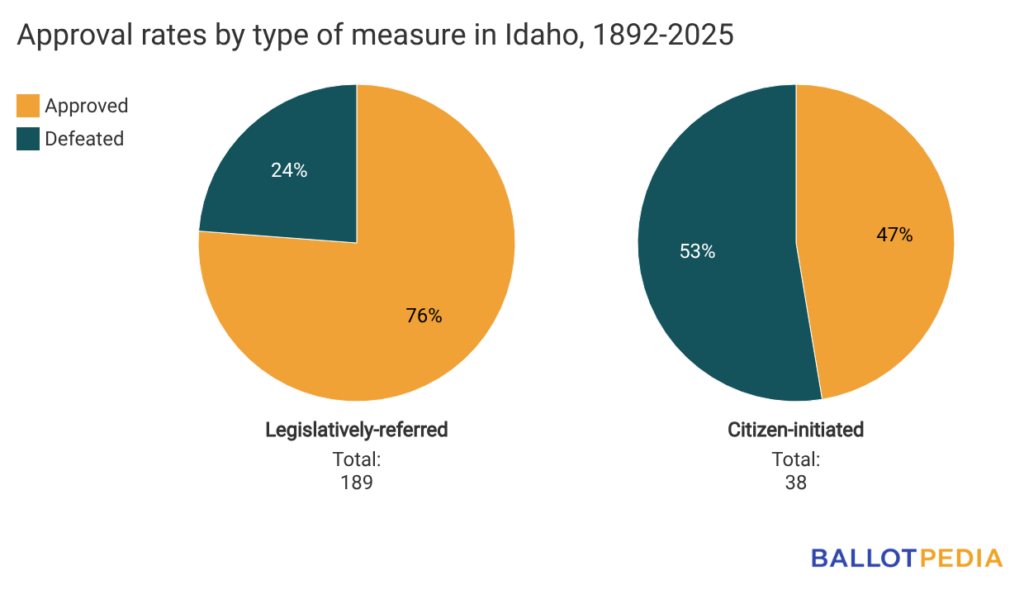
Legislatively referred measures have had better success at the ballot box than citizen-initiated measures. Legislatively referred measures were approved 76% of the time, as compared to 47% for ballot initiatives.
There are five different types of ballot measures in Idaho. Legislatively referred constitutional amendments have appeared on the ballot more than any other measure type (185). Legislatively-referred advisory questions had a 100% approval rating. Veto referendums had the lowest success rate, with three measures approved and four defeated. Voters rejected one constitutional convention referral.
Idaho ballot measures have addressed 106 unique topics, with some measures addressing multiple topics. Top topics included salaries of government officials (16 measures), local government officials and elections (14 measures), state legislative authority (14 measures), local government organization (13 measures), and bond issues (13 measures).
Below is a selection of notable and unique ballot measures in Idaho's history. For a more detailed list, see here.
- In 1896, voters approved the Women’s Suffrage Amendment , extending voting rights to women, becoming the fourth state to do so and 24 years before the ratification of the 19th Amendment to the U.S. Constitution.
- In 1902, 96.0% of voters approved the Health and Safety of Factory, Smelter, Mine and Ore Workers Amendment , the widest margin among all Idaho statewide ballot measures. The amendment authorized the legislature to enact laws protecting the health and safety of employees working in factories, smelters, mines, and ore reduction facilities.
- In 1912, Idaho voters approved three constitutional amendments establishing direct democracy processes in the state. The Veto Referendum Process Amendment authorized voters to petition for a statewide vote on legislation passed by the state legislature. The Initiative Process Amendment established a process through which citizens could propose state statutes. The Public Officials Recall Amendment authorized voters to recall public officials, except judges.
- In 1958, the Right-to-Work Initiative failed by 50.6% to 49.4%. The initiative would have established a right-to-work law, prohibiting union membership or payment of union dues as a condition of employment. The legislature later enacted a right-to-work law in 1985. Opponents placed the law on the 1986 ballot, but voters approved the Right-to-Work Law Referendum by 54.0% to 46.0%, allowing the law to remain in effect.
- In 1974, voters approved the Campaign Finance and Lobbying Disclosure Initiative by 77.6% to 22.4%. The initiative established disclosure requirements for money spent to support or oppose candidates and ballot measures, including campaign contributions and expenditures. It also required paid lobbyists to register and report information about their employers, lobbying activities, and certain expenditures.
- In 1978, voters approved the Right to Keep and Bear Arms Amendment by 82.5% to 17.5%. The amendment replaced language in Idaho’s original Constitution allowing the legislature to regulate the exercise of the right to bear arms with language stating that the right to keep and bear arms shall not be abridged. It continued to allow laws regulating concealed weapons, firearm possession by convicted felons, crimes committed while possessing a firearm, and firearm use. The amendment also prohibited firearm or ammunition licensing, registration, and special taxation, as well as firearm confiscation except when the firearm was used to commit a felony.
- Voters decided on two ballot measures related to nuclear energy. In 1982, voters approved the Nuclear Energy Initiative , requiring voter approval before nuclear power could be prohibited as a source of electricity generation. In 1996, voters rejected the Radioactive Waste Agreement Initiative by 62.5% to 37.5%. The initiative would have required approval from the legislature and voters before Idaho could enter into an agreement to receive additional radioactive waste and would have nullified an existing state agreement concerning radioactive-waste shipments.
- In 1996, voters approved the Congressional Term Limits Instruction Initiative . Following the U.S. Supreme Court’s decision barring states from applying congressional term limits, the initiative instructed lawmakers to support a federal constitutional amendment establishing congressional term limits and required ballot labels describing candidates’ positions on the issue. In 1997, the Idaho Supreme Court struck down the pledge and ballot-label provisions as unconstitutional but allowed the nonbinding instructions to lawmakers to remain in effect.
- In 2016, voters approved the Veto-Proof Legislative Oversight of Administrative Rules and Regulations Amendment by 55.5% to 44.5%. The amendment authorized the legislature to reject administrative rules without allowing the governor to veto the rejection.
- In 2024, voters rejected the Top-Four Ranked-Choice Voting Initiative . The initiative would have replaced Idaho’s partisan primary elections with top-four primaries and established ranked-choice voting for general elections for federal, state, and certain local offices.
Of the 228 ballot measures, two were decided by less than a percentage point of the vote.
The measure with the closest margin was Proposition 2 in 2002, which would have upheld House Bill 425, thus repealing term limits for elected officials in the state. The measure was approved, with 50.23% of voters approving and 49.77% rejecting it, resulting in a margin of 0.46%.
The measure with the widest margin was HJR 2, which authorized the legislature to pass workplace health and safety laws for factory, smelter, mine, and ore reduction workers. The measure was approved, with 96.01% of voters approving and 3.99% rejecting it, resulting in a margin of 92.02%.
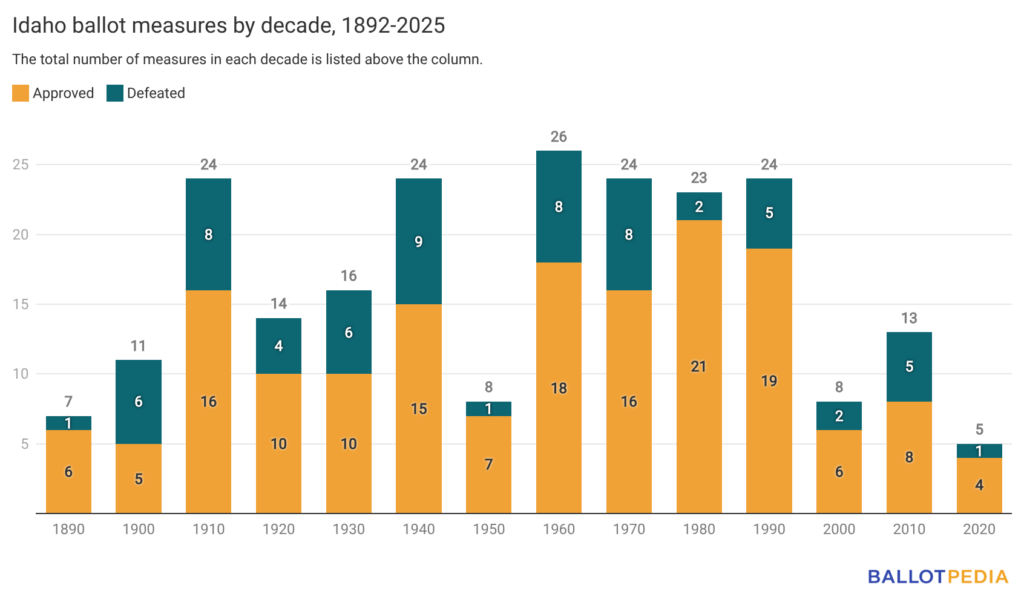
The decade with the most ballot measures was the 1960s, with 26. Eighteen measures (69.2%) were approved, and eight (30.8%) were defeated. The 1980s had the highest approval rating, with 21 of 23 (91.3%) measures approved. The decade with the lowest approval rating was the 1900s, with 5 of 11 (45.5%) approved.
The inventory of Idaho statewide ballot measures is part of Ballotpedia's Historical Ballot Measure Factbooks, which document nearly 200 years of direct democracy in the United States. This ongoing research effort will provide an unparalleled resource for researchers, reporters, and voters on how ballot measures have evolved, the issues they've covered, and the role they have played in our civic life.