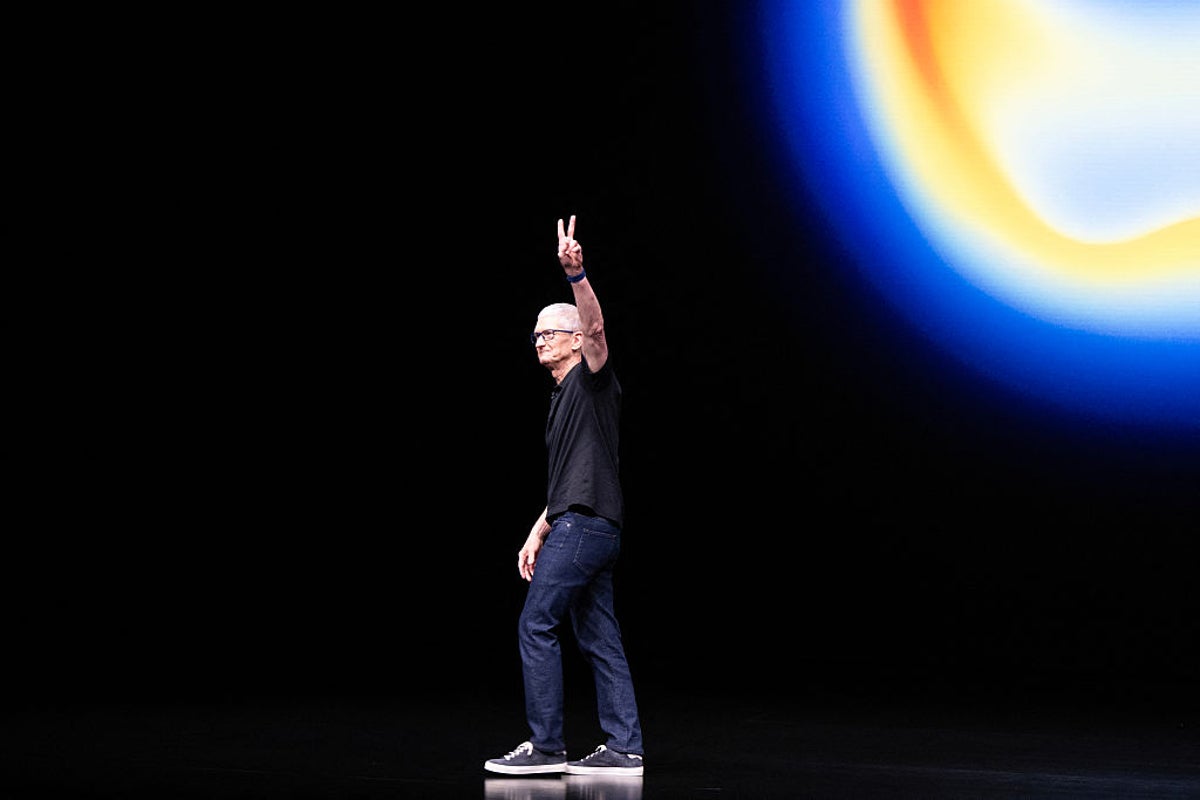
One of Tim Cook’s first jobs when he took the helm of Apple in August 2011 was to oversee plans to build one of the most ambitious office projects ever conceived.
The vast ring-shaped campus of Apple Park, which is bigger than the Pentagon, was emblematic of the bold and visionary showmanship of Steve Jobs. It was also symbolic of the challenges Cook faced as his soft-spoken successor.
It was one of the most scrutinised successions in business history, but what Cook lacked in charisma, he made up for in his mastery of logistics and execution.
Fifteen years later, he is leaving the company in one of the most successful periods in its 50-year history.
And while he may never be as synonymous with the company as Jobs, Donald Trump’s slip up by calling him “Tim Apple” at a White House meeting in 2019 showed just how much he now embodies the role.
The biggest metric that any chief executive of a publicly-traded company is judged on is share price, and Cook has massively delivered in this respect. Apple’s valuation has grown by more than 1,000 per cent under his leadership, becoming the first ever US company to pass a $1 trillion valuation in 2018.
The company’s market cap has since risen to just over $4 trillion, up from around $350 billion in 2011. Yet despite the growth, Apple has actually dropped down the rankings of most valuable companies, falling from the number one spot to number three, behind tech rivals Nvidia and Alphabet.
Apple’s growth continues to be driven by iPhone sales, which accounted for more than half of the company’s $416bn global revenue last year. But the product categories that have seen the biggest rise under Cook have been Accessories and Services.
Services include everything from App Store downloads to subscriptions to iCloud and Apple Music, while Accessories and Wearables include the hugely popular Apple Watch and Airpods that launched in 2015 and 2016 respectively.
Cook’s reputation as a supply chain specialist does not mean Apple stopped innovating under his watch. His tenure has seen investment in research and development rise from below $1 billion per quarter to more than $10 billion in the last reported quarter.
This has seen the release of Apple Silicon chips, which has ended the company’s reliance on outside suppliers like Intel and Qualcomm for its computers and phones, as well as spawned brand new products for Apple, including the Vision Pro headset – though it is yet to make the same impact as the best-selling Apple Watch and Airpods.
There have also been big R&D failures, with billions wasted on Apple’s self-driving electric vehicle project. The secretive endeavour, codenamed Titan, was scrapped in 2024 amid a broader shift towards generative artificial intelligence development.
It is an area that Apple has been lagging behind its rivals in recent years, however one of his final acts as Apple boss could redeem this. At Apple’s Worldwide Developers Conference (WWDC) in June, Cook is expected to unveil a revamped Siri assistant that comes with advanced AI features that rival chatbots from Google and Meta.
Whether Siri and Apple’s broader AI strategy is a success will not define the Cook era, but it may present challenges for the person who replaces him. With smartphone innovation and sales stalling since 2022, Apple needs to be prepared for a future beyond the iPhone.
In his successor, John Ternus, Apple is aiming to have a mix of Jobs’s vision and Cook’s practicality – at least according to the departing CEO.
In a statement on Monday, Cook wrote: “John Ternus has the mind of an engineer, the soul of an innovator, and the heart to lead with integrity and with honor. He is a visionary whose contributions to Apple over 25 years are already too numerous to count, and he is without question the right person to lead Apple into the future.”
Apple’s explosive market-cap growth over the last 15 years means that Ternus will face a similar level of scrutiny from shareholders as Cook did when he first took over. On top of financial expectations, Apple’s new boss will need to figure out what will define his era in charge.
And if he does return Apple to its trend-setting roots, then it could well define the direction of the broader tech industry.
“Cook’s legacy will be defined by steady, disciplined operational stewardship – proof that a company can be more than just exciting and visionary; it can also be immensely valuable to all its stakeholders,” said Dipanjan Chatterjee, a principal analyst at market research firm Forrester.
“Yet while Cook has kept Apple’s growth trajectory moving at a steady clip, he has not overseen a step-change innovation that would reset Apple’s competitive position for the next two decades, as Jobs did with the iPhone. For now, Apple remains structurally dependent on the phone form factor as it searches for its next growth engine.”
Who actually is the new Apple CEO?
Apple announces succession plan with Tim Cook leaving as CEO in months
ChatGPT maker OpenAI shifts its focus to business users amid new pressure
Apple chipmaker reports huge jump in profits amid Iran war
Yelp adds a new AI feature to help users sift through local recommendations
Chinese robot can run and dance. But why can’t they do the washing up?