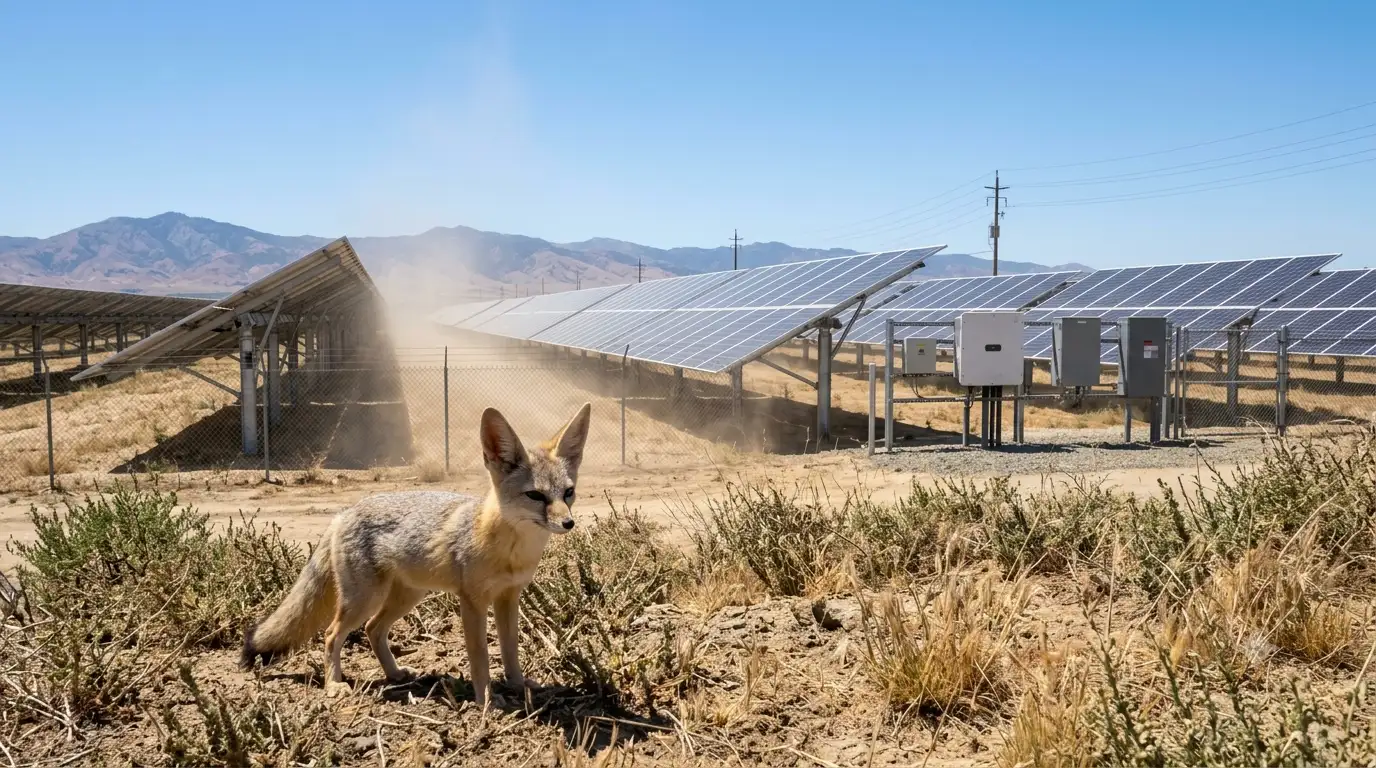
Who could have imagined that massive solar farms could play a key role in protecting endangered wildlife species? It turned out to be true in Central California, where two of the state's largest solar projects are helping protect the endangered San Joaquin kit fox, the smallest foxes in North America.
Researchers found that the Topaz Solar Farms and the neighboring California Valley Solar Ranch have become safe havens for the tiny foxes, offering protection from predators while allowing them to den, hunt and raise pups. The findings suggest that with the right planning, renewable energy projects and wildlife conservation can work hand in hand, according to a report in The Times of India.
ALSO READ: What is Muse Image Meta?
How solar farms became an unexpected refuge
The San Joaquin kit fox weighing only about 5 pounds as an adult and has tan fur, a narrow muzzle, large close-set ears and a bushy tail tipped in black. Its oversized ears help release body heat, making it well adapted to California's hot, dry grasslands and desert landscapes.
ALSO READ: Two USMNT staff members were suspended by FIFA for game vs Belgium
Research carried out between 2014 and 2017, with results published in 2019 by scientists from California State University, Stanislaus, along with Althouse and Meade, found that carefully designed solar facilities significantly reduced the risk of predation of foxes and they have found an unlikely refuge inside solar farms built within its historic range.
The fences that keep predators out but let foxes in
One of the biggest reasons for the foxes' success is the design of the perimeter fencing. The solar arrays are surrounded by chain-link fences that sit around 12 to 15 centimeters above the ground. The gap is just large enough for the small kit foxes to crawl underneath, while remaining too narrow for larger predators such as coyotes and bobcats.
At Topaz Solar Farms, an additional rail was installed beneath the fence to stop predators from digging underneath. This simple design created secure spaces where foxes could move freely while many of their biggest threats stayed outside.
Solar panels also protect foxes from aerial hunters
The solar panels themselves also played an important role. Raised above the ground, the panels provided shade and hiding spots from golden eagles, one of the fox's most dangerous natural predators. In nearby open landscapes, golden eagles posed a much greater threat.
Together, the fencing and panel layout effectively turned the solar arrays into wildlife refuges where predation risk dropped sharply.
The numbers show foxes are thriving
Researchers found encouraging evidence that the protected habitat was making a real difference.
Fox survival rates inside the solar farms were generally higher than those recorded on similar land outside the facilities.
A follow-up study covering 2019 to 2022 found survival rates inside the solar farms remained stable, even while survival declined in nearby areas.
The researchers also reported that foxes living within the solar facilities maintained healthy body weights and reproduced at rates similar to foxes living in undisturbed natural habitat.
Conservation measures made all the difference
Scientists stress that the success was not simply because solar panels were installed. The projects included several wildlife-friendly conservation features, including:
- Movement corridors that allow foxes to travel safely across the site
- Sixteen artificial dens for shelter and breeding
- Sheep grazing to control vegetation while supporting prey species
- Restrictions on dogs
- Bans on firearms
- Strict waste management to avoid attracting predators
Researchers say these measures collectively created a habitat that supported the endangered species.
Scientists still warn against building on prime habitat
Although the findings are encouraging, researchers caution that solar farms are not a replacement for protecting natural habitat. Habitat destruction remains the biggest reason the San Joaquin kit fox is endangered. Scientists continue to recommend avoiding construction on high-quality habitat whenever possible.
However, they say that solar projects built on previously disturbed or degraded land can actually improve habitat quality, particularly when they connect separate patches of existing fox habitat.
For a species with fewer than 4,000 individuals remaining, those connections could prove critical for long-term survival.
Why is the San Joaquin kit fox endangered?
The San Joaquin kit fox was officially listed as endangered on March 11, 1967. Today, it inhabits much of the San Joaqui n Valley floor and foothills, stretching from San Joaquin County in the north to Kern County in the south. Its range also includes valleys along California's Coast Range, including the Panoche Valley, Cuyama Valley, and Carrizo Plain in San Luis Obispo County.
The species continues to face several serious threats, including:
- Habitat loss caused by agriculture, urban expansion, oil development, infrastructure projects and some solar developments
- Diseases such as rabies, canine parvovirus, mange and canine distemper
- Wildfires
- Predation and competition from coyotes, red foxes and domestic dogs
- Declining prey populations and loss of suitable denning sites