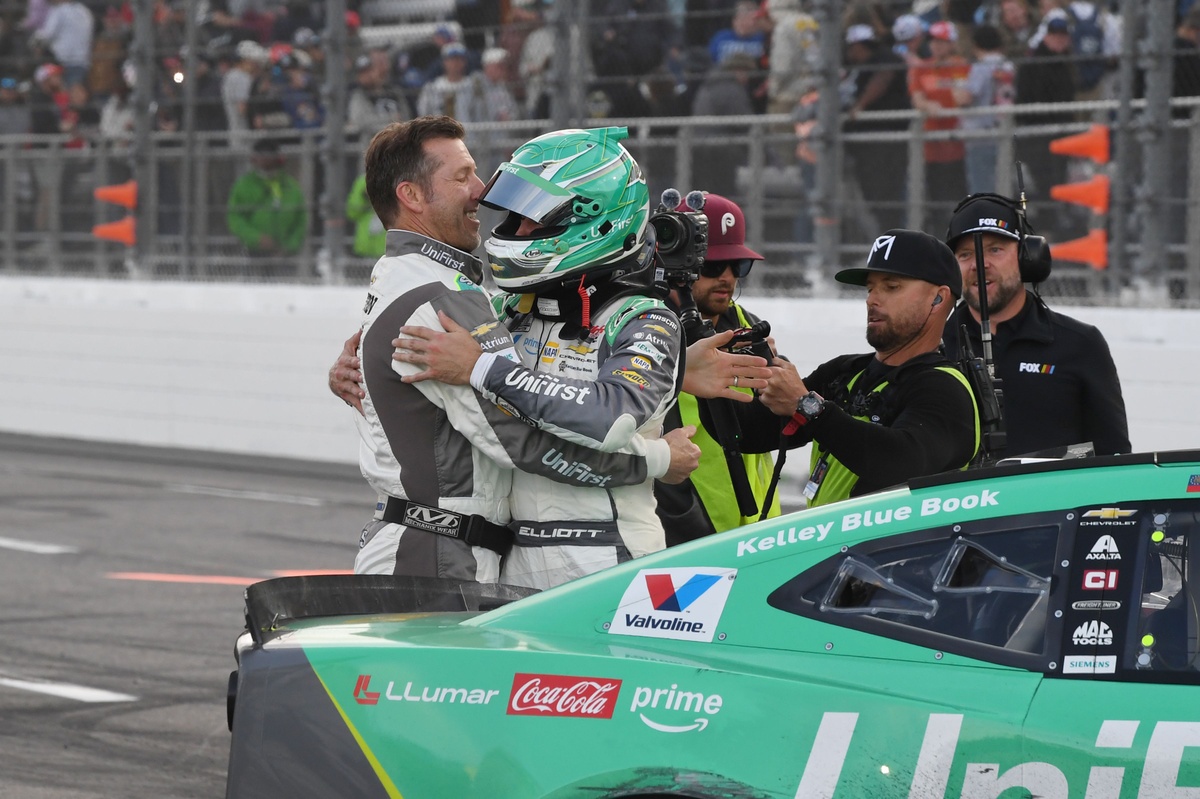
There were three key moments that delivered Chase Elliott his earliest victory to start a NASCAR Cup Series season on Sunday at Martinsville Speedway.
Combined, it was a masterclass between Elliott and crew chief Alan Gustafson, a combination that doesn’t generally seem to get the respect everyone around them says they should.
- Gustafson (surprisingly) intends to two-stop the final stage
- They catch a caution running in front of a dominant Denny Hamlin
- Elliott executes on the final restart and green-flag run to the finish
The Hendrick Motorsports No. 9 kind of settled into the race as a 10th-place car but when everyone is running the same speed, it’s not like 10th is that much slower than the leaders these days.
So, Gustafson called Elliott to pit road on Lap 262, earlier than anyone expected a car to take tires and fuel. It was brilliant because it forced the field to try to cover them as best as possible, making them pit sooner than they wanted on their one-stop strategy to avoid getting caught a lap down by a caution, but then leaving the No. 9 in advantageous position over a potential long run to the finish.
Gustafson even pushed his war room away from the one-stop strategy the data said was most prudent initially.
“In this situation, Luke Mitchell, who is my race day engineer at home, does a great job with strategy, we just continued to communicate about it,” Gustafson said afterwards. “He told me that it was close, ultimately felt like it was a safer play to one-stop it.
“I asked him to go do some other calculations based on some different scenarios. He said it was probably a couple seconds faster. That was just enough for me then to say, ‘yeah, it's worth it.’ We had to give ourselves a shot, so …”
All of this is independent of the caution on Lap 311 for Ty Dillon’s exploded brake rotor, by the way.
“As soon as those guys who are going to one-stop then start shorting that by significant (number) of laps, that's playing into our hands,” Gustafson said. “They've got to run a lot longer. Mathematically they're going to be worse. …
“We were probably right around the position that it makes sense to take that risk. Maybe a little further than us, if I was a little further up, would have been worth doing. At the same time, you can't sit on your hands and run 10th. You got to do something, right? I think that was the best shot.”
And again, while Elliott appreciated the chance to have track position on a restart, he thought the two-stop was going to work out regardless.
“I think we had ourselves in a position where it was going to work out really good for us either way,” Elliott said. “Like, I think we had forced those guys into stopping really early. They were going to have to run a hundred-something laps on a set of tires. So, I think we were in really good shape.
“It’s a great call. I’m glad he picked up on that (and) saw that. I don’t think anybody else did. Goes to show that he’s pretty good at what he does, which I try to tell y’all that all the time.”
More on that in a bit.
Rudy Fugle, crew chief of the Hendrick No. 24, said the math didn’t work for his team to try it but really credited his teammates for how it played out.
“What they were playing on, and it was true, is that everyone’s tires would die really, really hard over 80 to 100 laps, which no one had gone yet and they put themselves in a good spot because they had track position for a while,” Fugle told Motorsport.com after the race.
“If it stays green, they probably end up a spot or two the other way. I think Alan, obviously, does a great job and credit to Chase for always being open-minded where he is okay trying something different when they have the possibility of a net gain.”
When told of what Fugle said about him, Elliott said ‘open-minded’ is one way to look at it, but more than anything, he just trusts everyone around him to put their No. 9 team in the best spot.

“However we get there, whatever that looks like, if I’m the problem, I’m the problem,” Elliott said. “Just help me figure out how to fix it and get better.
“So yeah, I definitely try to be open-minded. I mean, I didn’t think anything about it when Alan called me down pit road. As I’ve always told him, ‘Hey, look, whatever you want to do, rip it. I’ll support you whether it goes good or doesn’t go good.’
“I think that it’s important for him to have that confidence. When he has confidence in a call, I’m going to have confidence in trying to make it work because I want it to work, too. So yeah, I support him, whatever it looks like, however it looks, to go and get the best result that we can get.”
The other element to their victory is that Hamlin couldn’t catch and pass Elliott, even once they got back to tail of the field. Hamlin led 292 laps and started to feel a mechanical issue of some kind with 44 laps to go.
“It just felt different in the rear that run, so we’ll check it out,” Hamlin said. “But no excuses, we just got beat.”
His crew chief, Chris Gayle, validated his driver during inspection.
“It looks like we had an issue with the left-rear wheel being a tiny bit loose — loose enough he probably could tell,” Gayle said. “There’s some fraying on the pins and some wear there, so it was definitely loose.”
But again, to Hamlin’s point, Gustafson and Elliott were rewarded for their gusty call, and the 9 was better in traffic than the 11 once it got cold and the sun dipped below the horizon.
“It’s just the ability to have the cleaner air for the longer period of time made me heat my stuff up, which is what I did to 35 other guys for the bulk of the race,” Hamlin said. “So, it’s just, once you run in that dirty air for an extended period of time, the car typically goes away.”
Gustafson's critics
Back to Elliott and Gustafson.
The most passionate, or at least the loudest fan base in NASCAR, often criticizes their crew chief much to the chagrin of the driver. Elliott maintains there is no one else that he wants to win races and compete for championships with because of days like this.
“I think that we’re — as time has gone on, we’ve done nothing but just get better at being able to kind of sort out our weaknesses in our own meetings, doing what we need to do to get the job done,” Elliott said. “We have a very, very straightforward approach.
“I enjoy working with him. I genuinely feel that way. I hope he feels the same way about me. I give him all I got every week, even when it’s not pretty.”
Jeff Gordon, the executive vice chairman of Hendrick Motorsports, is also fond of the crew chief he worked with as a driver for the final five years of his career.
“I get to say this because Alan was my crew chief -- I love the work and effort he puts in, how smart he is, the team he builds,” Gordon said. “Nobody is a tougher critic than he is of the team and their performance.
“You've always seen this, right? Whether it was Dale Earnhardt Jr. or Chase Elliott, whoever is the popular driver in the series, there's a lot of critics that want to sit on the sidelines and evaluate it.
“You cannot let that tear you apart. You got to keep strong on the inside and believe in yourself and believe in your team, all the things you're doing. That's what Alan and Chase fall back on.”
Photos from Martinsville - Sunday

Martinsville - Sunday, in photos

Martinsville - Sunday, in photos

Martinsville - Sunday, in photos

Martinsville - Sunday, in photos

Martinsville - Sunday, in photos

Martinsville - Sunday, in photos

Martinsville - Sunday, in photos

Martinsville - Sunday, in photos

Martinsville - Sunday, in photos

Martinsville - Sunday, in photos

Martinsville - Sunday, in photos

Martinsville - Sunday, in photos

Martinsville - Sunday, in photos

Martinsville - Sunday, in photos

Martinsville - Sunday, in photos

Martinsville - Sunday, in photos

Martinsville - Sunday, in photos

Martinsville - Sunday, in photos

Martinsville - Sunday, in photos

Martinsville - Sunday, in photos

Martinsville - Sunday, in photos

Martinsville - Sunday, in photos

Martinsville - Sunday, in photos

Martinsville - Sunday, in photos

Martinsville - Sunday, in photos

Martinsville - Sunday, in photos

Martinsville - Sunday, in photos

Martinsville - Sunday, in photos

Martinsville - Sunday, in photos

Martinsville - Sunday, in photos

Martinsville - Sunday, in photos

Martinsville - Sunday, in photos

Martinsville - Sunday, in photos

Martinsville - Sunday, in photos

Martinsville - Sunday, in photos

Martinsville - Sunday, in photos

Martinsville - Sunday, in photos

Martinsville - Sunday, in photos

Martinsville - Sunday, in photos

Martinsville - Sunday, in photos

Martinsville - Sunday, in photos

Martinsville - Sunday, in photos

Martinsville - Sunday, in photos

Martinsville - Sunday, in photos

Martinsville - Sunday, in photos

Martinsville - Sunday, in photos

Martinsville - Sunday, in photos