The Great Labubu Delulu of 2025 had the power to prompt grown adults to camp outside shops and hand over large amounts of cash, all for a product heavily imbued with an air of the Emperor’s New Clothes. Think that was the high watermark for head-scratching viral fashion trends? Prepare to think again, because over the weekend, the nation – and indeed, the wider world – was briefly overtaken by another collective consumer mania.
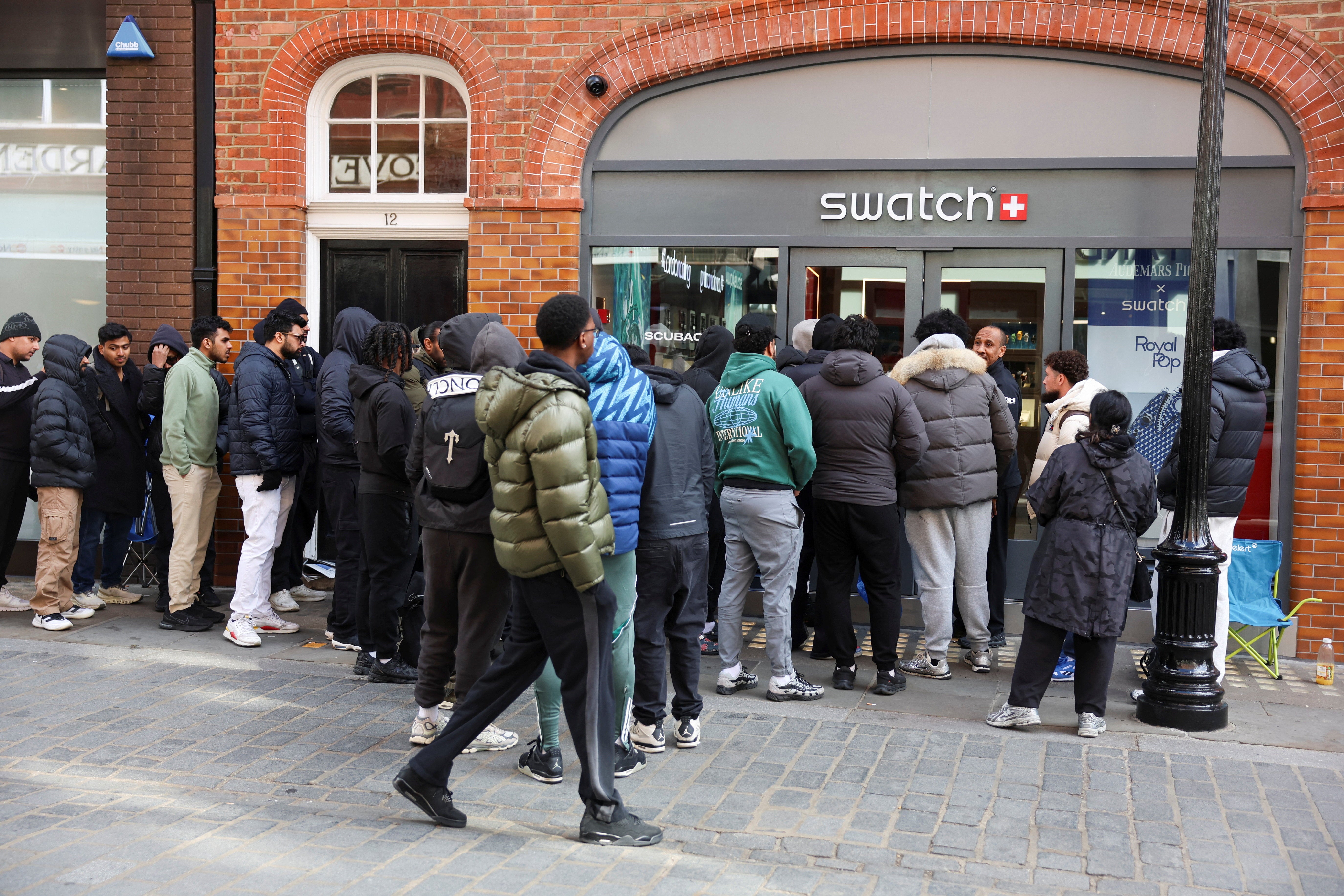
On Saturday (16 May), Swatch, the watch brand best known for cheerful, relatively affordable wrist candy fashioned from plastic-y materials in bright colours, launched a limited edition collaboration with another Swiss brand, Audemars Piguet. Tents were erected. The police were called. And shops had to close their doors.
“AP”, as the luxury watch brand is referred to by watch aficionados, sits towards the more luxurious end of the spectrum, so in theory, the team-up offers shoppers a chance to get their hands on some upscale style and quality at a more manageable price.
The result of the Swatch partnership is the “Royal Pop”, a vibrant pocket watch-style spin on AP’s seriously fancy Royal Oak, costing £335 each (a new Royal Oak would likely set you back more than a hundred times that – prices tend to start around the £40,000 mark).
On platforms such as eBay, the watches are going for upwards of £2,000. And the hype doesn’t seem like it will be dying down any time soon. Indeed, the chaos that has swirled around the launch might even make the Royal Pop even more desirable.
“These limited edition collabs often retain and then gain value immediately after launch,” says Megan Dooley, head of brand at TAL Agency. “There’s a well-established resale culture around hyped products like collectables, trainers and watches – people know that there’s a potential to make some money.”
So far, so (relatively) normal. Designer brands have been teaming up with affordable labels for decades to bring a touch of their sartorial sparkle to the masses; often, the pieces from these collections go on to sell for way higher than the recommended retail price on resale sites. Think of Kate Moss for Topshop, or H&M’s many, many partnerships with the likes of Karl Lagerfeld, Versace and Balmain.
But it’s hard to recall a collaboration causing quite so much chaos. Towards the end of last week, fans started queueing up outside Swatch stores around the world, with some even setting up tents in an attempt to ensure a decent spot in the line for the pocket watches (“has anyone become this enthused about a pocket watch since the late 19th century?” is one of the many questions I have about this particular craze).
Then on Saturday, Swatch was forced to shut down its shops in London, Manchester, Liverpool, Birmingham, Sheffield, Glasgow and Cardiff due to safety concerns, reportedly after over-zealous shoppers crowded into the stores; a social media post from the brand implored customers “not to rush to our stores in large numbers”.
In Cardiff, a 25-year-old man was arrested, while a dispersal order was put in place in Birmingham. The police also attended the Swatch shop in Manchester’s Trafford Centre, and were also called to the brand’s Liverpool One store, after a group of people were reportedly making threats (Swatch later decided to keep these two outposts closed on Sunday, too). Social media footage, meanwhile, appeared to show police dogs being deployed at the scene in London’s Battersea Power Station shop.
In Paris, the police are thought to have fired tear gas to disperse the crowds – as well as Milan, Amsterdam and New York. One queuer at the Times Square branch said that the scrum as the store opened was “like a mosh pit”.
A Swatch spokesperson told The Independent that “challenges arose on launch day because the queues of interested customers were exceptionally long, and the organisation of some shopping malls was not sufficient to handle this level of turnout”. They added that the situation “has now normalised somewhat after the launch”.
In a world of instant online availability, scarcity and friction have become signals of value again
What’s particularly puzzling about this outbreak of mania is that to the untrained eye, at least, these pocket watches might look, well, a bit underwhelming. They don’t come with a wrist strap, but a lanyard, a word that summons visions of IT conferences, rather than ineffable cool – the idea is that you can drape one from a bag or a belt loop. It’s thought to be a nod back to Swatch’s Eighties line of “Pop” watches, where the face could be taken from the strap and attached elsewhere.
So why the obsession? The key to this collab’s success lies in the way that it has promised to briefly make luxury achievable for the average shopper (or, the average shopper willing to set up a tent in a public thoroughfare in order to be there come opening time). “Audemars Piguet sits at the very peak of the watch hierarchy, where access is hugely restricted and often relationship-led, rather than purely transactional,” explains Olivia Bennett, senior PR director at digital marketing agency Go Up.
Indeed, a Royal Oak is basically the Birkin of watches – if you’re not on the waiting list, you’ve got no chance. So the Swatch partnership, Bennett adds, isn’t just about buying a watch. It’s about “buying proximity to a brand that is normally out of reach”.
The “hype” for the collaboration, Bennett says, was also “carefully primed” to press the buttons of a Gen Z shopper (certainly not AP’s usual target market). The visuals were kept to the bare minimum before the launch, prompting watch fans to start speculating and even generate their own AI versions of how they thought the line might look.

And while tales of chaotic queues might seem like a bit of an own goal, it has certainly got everyone talking. In an era when online shopping makes almost everything accessible with the click of a mouse or the tap of a phone screen, queue culture “creates this sense of urgency and exclusivity”, says Dooley, noting that Swatch “has seen this before with their MoonSwatch collab”, released in partnership with Omega last year, “where the images of huge crowds outside boutiques acted as free global advertising”.
Bennett agrees. “In a world of instant online availability, scarcity and friction have become signals of value again,” she says. “Physical queues reintroduce effort [into shopping], which increases perceived desirability.” And, she adds, we’re living in a culture where “consumption is increasingly performative”.
People don’t just want to broadcast the fact that they own something – they want to share the great lengths they went to acquire it, too. So queueing, Bennett says, “is no longer just waiting” but “participation in an event that is shared and documented on social media”.
These videos only heighten the sense of “fomo”, or fear of missing out – which in turn makes a product that you might have felt so-so about without the hoopla feel totally essential. “Brands across the board from fashion to streetwear to toys and watches have cottoned on to the fact that limited availability, at least in the initial stages, can generate lots more attention than making their products widely accessible,” says Dooley. “That’s why we see so many viral collectables doing the rounds nowadays.”
The queue chaos, then, is perhaps proof of how far we are willing to go to buy into a trending moment – especially if there might be potential for some extra cash further down the line. But can a colourful watch ever be worth an ad hoc camping trip? I think it might be time for us to rethink our collective priorities.
Swatch shutters stores as demand for collaboration with
Audemars Piguet unveils collaboration with affordable watch brand
Motoring giant to build new affordable EVs to revive small car market
Katie Price’s ‘missing’ husband latest as Lee Andrews feared kidnapped - live updates
An expert guide to fixing common bathroom problems that could save you hundreds
Chinese EV brands are forcing Ford into a major comeback plan