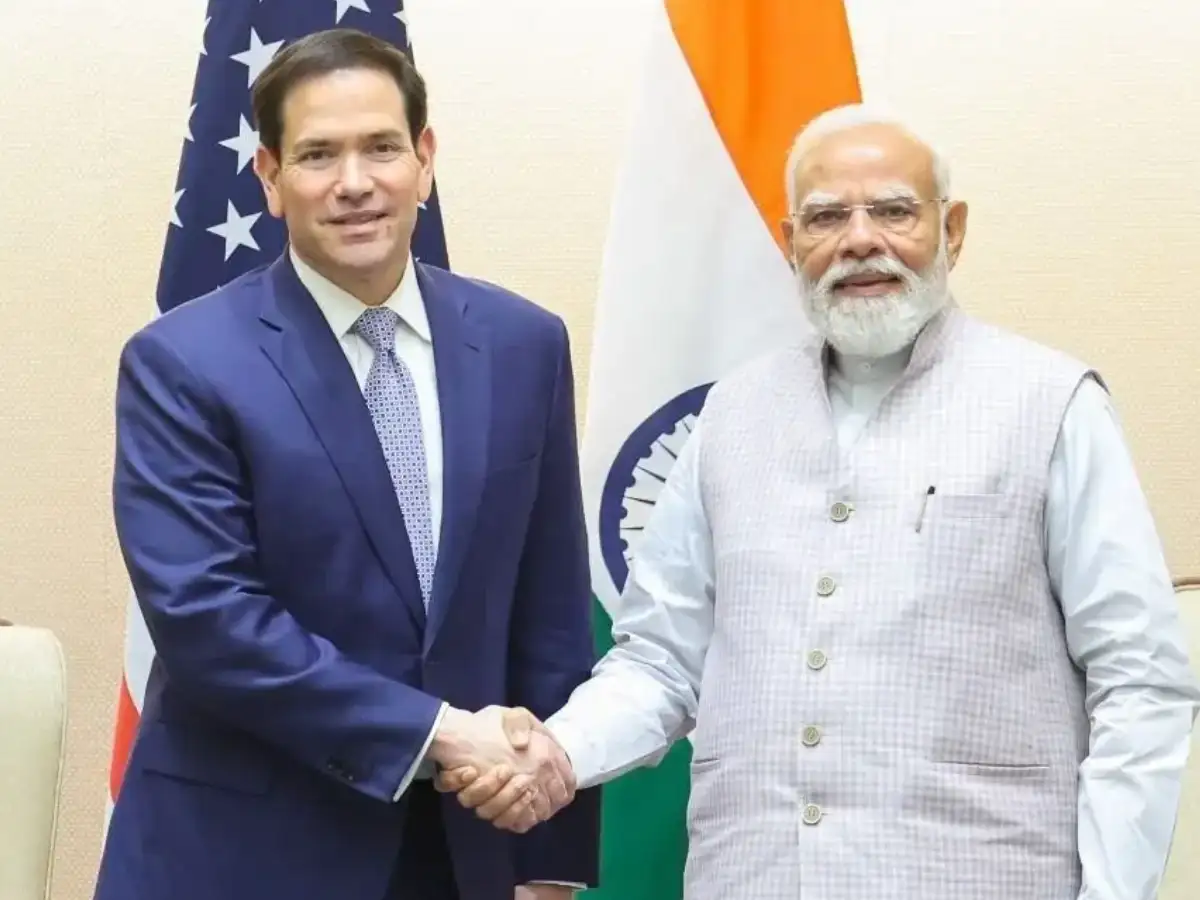
US Secretary of State Marco Rubio met Prime Minister Narendra Modi in New Delhi on Saturday with the two leaders exchanging more than just diplomatic talking points. Waiting for him in the capital was a packed agenda shaped by an escalating global energy crisis, fragile trade negotiations, rising geopolitical tensions and Washington’s growing urgency to keep India firmly anchored in its Indo-Pacific strategy.
At the centre of Rubio’s meeting with the Prime Minister was likely energy security as India battles soaring oil prices and supply disruptions triggered by the war in Iran.
Also Read | Marco Rubio holds talks with PM Modi during Delhi visit; invites prime minister to White House
According to Reuters, the US leader assured PM Modi during the meet that the Trump-led administration in Washington would not let Tehran "hold the global energy market hostage." Rubio also echoed his earlier claims that US energy exports could play a key role in diversifying India’s energy basket.
Meanwhile, a PIB release said that the discussions covered a wide spectrum of cooperation, including defence and critical technologies, trade and investment, energy security, connectivity projects, educational collaboration and stronger people-to-people engagement between the two countries. In a post on X after the talks, the Prime Minister also said that the two nations will continue working towards a greater cause, though did not mention any subjects of discussions.
Also Read | US seeks to boost energy exports to India as Rubio visits Delhi
However, prior to the meeting, Pramit Pal Chaudhuri, South Asia practice head for the Eurasia Group told Bloomberg News that “energy will be main focus of the bilateral agenda."
"Defense and technology will be discussed but major announcements are unlikely," he had added.
The crisis in West Asia has made New Delhi particularly vulnerable.
Iran’s move to effectively choke traffic through the Strait of Hormuz, one of the world’s most critical energy corridors, has rattled global markets and squeezed countries heavily dependent on Gulf supplies.
Also Read | Marco Rubio — The bridge between the Trump–Modi economic doctrine
India has found itself directly exposed to the fallout as it exports around 90% of energy from the Hormuz Strait.
Fuel prices in the 1.4 billion citizens-strong country have climbed three times in the last 10 days, the rupee hit a historic low of 96.96 against the dollar this week, and foreign investors are pulling billions from Indian equities amid fears of a prolonged energy shock.
Balancing the oil game
Into this uncertainty stepped Rubio, carrying a clear message from Washington: the United States wants to become a bigger part of India’s energy future.
Ahead of the trip, Rubio openly pitched American energy exports to India, saying the US was ready to supply “as much energy as they’ll buy.”
US Ambassador to India Sergio Gor reinforced that message this week, saying India had shown strong interest in diversifying away from vulnerable supply routes and increasing purchases from the United States.
“India has been receptive to diversification, and what that means is buying more American energy,” Ambassador Sergio Gor told Bloomberg News in a phone interview. “People have been very receptive to buying from the United States, and we’ve been very happy with that.”
The statement was more than rhetoric.
According to shipping data accessed by Bloomberg News, India is importing record volumes of American liquefied natural gas and LPG this month, underlining how rapidly the energy equation between the two countries is shifting.
For Washington, the timing is strategic.
The Trump administration sees the current crisis as an opportunity to deepen economic dependence between the two countries while simultaneously reducing India’s reliance on unstable Gulf routes and politically sensitive Russian imports.
Beyond oil: Repairing old fractures
Rubio is also in India for the Quad Foreign Ministers’ Meeting, where officials from the US, India, Japan and Australia are expected to discuss maritime security, defence cooperation, technology-sharing and supply-chain resilience in the Indo-Pacific.
The visit also comes with a layer of political repair work.
Ties between Washington and New Delhi had cooled over the past year after US President Donald Trump claimed credit for defusing India-Pakistan tensions following last year’s clashes between the two neighbours — remarks that India has publicly and repeatedly rejected.
Relations worsened further when the US imposed 25% additional tariffs on Indian goods, on top of existing 25% tariffs, over New Delhi’s continued purchases of Russian oil despite Western sanctions linked to the Ukraine war.
However, the Iran conflict has now forced a recalibration in Washington’s approach.
With global energy markets under stress, the US has softened its position on India’s Russian crude imports, prioritising stability in oil supplies over sanctions pressure.
That shift has opened the door for a broader reset in relations. For India, the meeting is about securing economic breathing room in the middle of a global crisis.
For Washington, it is about ensuring that one of Asia’s most important powers remains strategically aligned with the United States at a time when the global balance of power is rapidly shifting.