Four years ago, after authorities in San Antonio found 53 immigrants dead in a trailer in San Antonio, Governor Greg Abbott knew exactly whom to blame. “These deaths are on Biden,” Abbott posted on social media about the then-president, going on to say that “deadly open border policies” encourage migrants to risk life and limb taking the dangerous journey to the United States through Mexico.
Abbott’s implicit pitch was that if he and his ally Donald Trump, since returned to the presidency, were given a free hand to secure the border, these types of tragic incidents would stop.
As I wrote at the time, this thinking is predicated on the idea that the U.S. government can somehow outdo the horrors of immigrating here—horrors that border hawks often accurately portray. Trump has tried to do just that. Masked federal agents roam U.S. cities scanning people’s faces and arresting them. Immigration officials have set up checkpoints in the country’s interior, occasionally vacuuming up U.S. citizens. Longtime residents are thrown in detention and pressured to leave the country. And, since he returned to the presidency, arrests at the border have plummeted.
Yet last month, seven people climbed into a cargo container, probably near Del Rio, for a journey by rail to San Antonio.
According to Laredo officials, the seven likely perished from heat stroke. One man who was carrying Mexican identification was apparently thrown off the train near San Antonio or escaped but died before finding help. The cargo container carrying the remaining six, some of whom were from Honduras and Mexico and one of whom was 14 years old, was sent back south to Laredo, where a railroad company employee found their bodies.
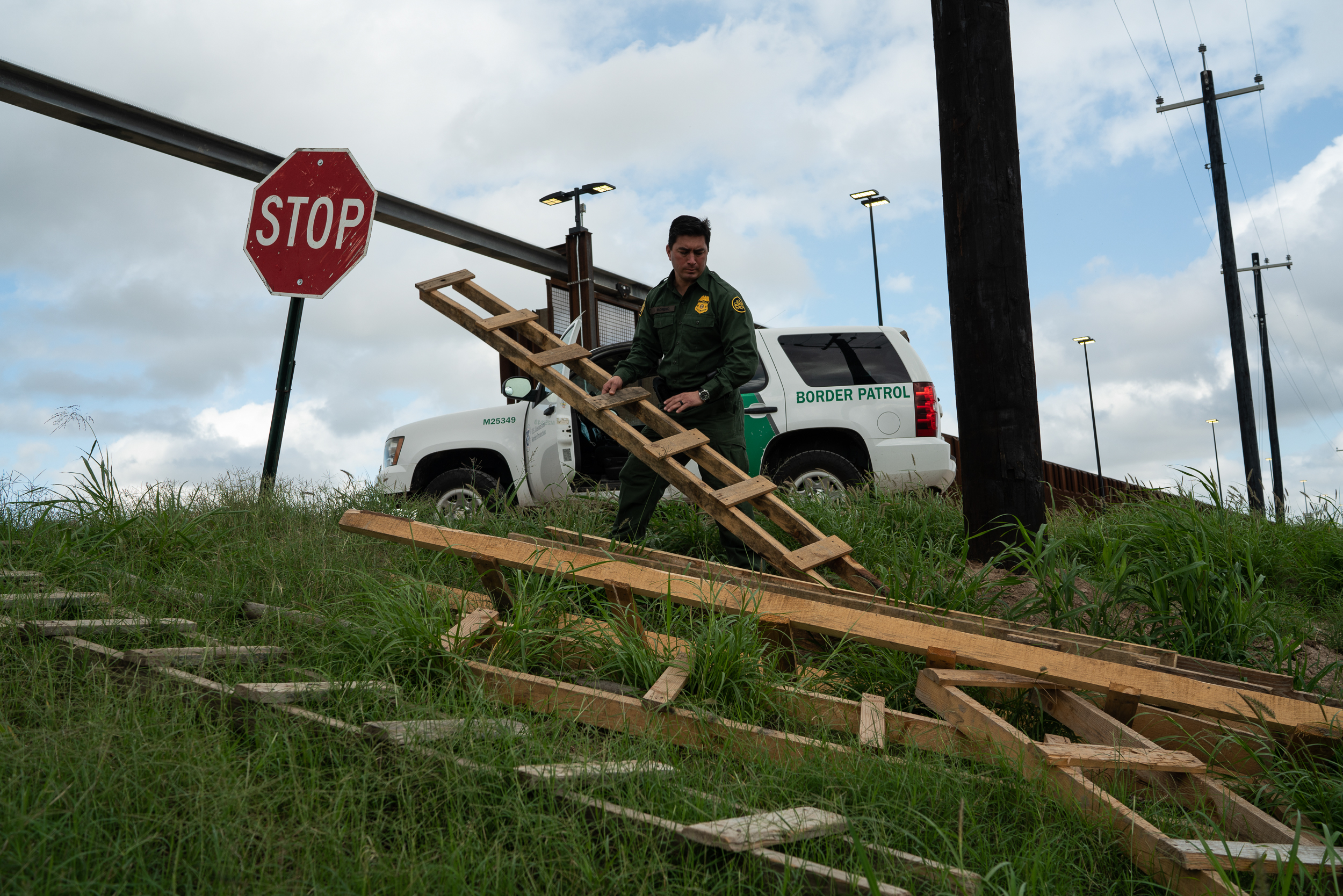
The trains from Del Rio and nearby Eagle Pass to San Antonio have long been utilized by people trying to circumvent the Border Patrol checkpoints on U.S. 90 and U.S. 57 and, more recently, Abbott’s border deployment. Last year, federal authorities unraveled a smuggling scheme to cross the border from Eagle Pass on trains.
It’s a dangerous route. Those riding on top risk falling off and losing limbs to the wheels. Those inside face sweltering conditions. In 2023, police in the region found five people dead in train cars and dozens of others suffering from heat exposure over just a few days.
Critics of Trump note that this latest tragedy coincides with his crackdown on legal immigration, including restricting refugee resettlement almost exclusively to white South Africans, refusing to hear asylum claims at the border, pressuring Mexico to restrict travel through its territory, and detaining people with pending asylum cases. While it’s tempting to try to tie these tragic incidents to a specific president’s actions, the reality is that U.S. immigration policy is deeply invested in what the Department of Homeland Security calls “prevention through deterrence.”
This existed under Biden, who, despite his open-borders reputation, implemented some of the most draconian immigration policies of any modern president other than Trump, marooning asylum-seekers in Mexico regardless of their nationality and setting up a screening system that drove them into the arms of criminal groups.
Extrajudicial punishment is a hallmark of immigration enforcement in this country. And despite Trump’s and Abbott’s insistence that their policies save lives, the Webb County medical examiner told the Associated Press that she’s seen a rise in deaths this spring compared to last year. Border Patrol’s data shows that agents arrested slightly more people on the southwest border in March and April of this year, the latest numbers available, over last. (Webb County Medical Examiner Corinne Stern didn’t respond to a request for comment, and getting accurate death data in Texas is notoriously difficult; activists interviewed for this story said they didn’t have reason to believe there have been more deaths this year than in years when border crossings were significantly higher, but they argued that deadly incidents are an inevitable result of U.S. policies even when crossings are down.)
“The more deterrence policies the United States implements, the more people are going to die,” said Ari Sawyer, a co-director of the Frontera Federation, which advocates for social justice on the border.
Sawyer said Trump’s crackdown may convince some people to defer their journey to the United States, but a range of factors beyond U.S. policy du jour impact people’s decisions to relocate, and when the risks of remaining at home outweigh the risk of emigrating, people will.
“It just depends on why they’re immigrating, what they’re emigrating from,” Sawyer said. “The people we’re finding now dying on the U.S. side of the border are the people who could not wait.”
Increasingly, experts are warning that climate change is driving migration from the Global South, while also increasing the risk of heat exposure for travelers—as reportedly played out in South Texas last month.
The country’s current immigration framework fails to address two factors that have been constant for generations: the need for labor in this country and conditions across the hemisphere that drive people from their homes. The relatively less restrictive policies of Biden and the authoritarian tactics used by Trump have both ended up being unpopular with voters, and trying to track the impact of these shifting policies is also difficult. Trump ran on a platform of harsher immigration enforcement than his predecessor, former President Barack Obama, but in 2019 Border Patrol agents arrested 859,000 people, more than any year of the Obama presidency. Biden took office in 2021 and attempted to roll back Trump’s policies. Border Patrol arrests promptly hit new highs, but what gets lost is that the policies Biden kept in place were still far more restrictive than Obama’s, when the number of people crossing the border was much lower.
“The way to stop smugglers is to create more lawful pathways and legal regulated pathways to the United States,” Sawyer said.
But, as after past tragedies, the solution proposed by authorities along the border has been more enforcement. In a news conference after the May deaths, Laredo Mayor Victor Treviño struck an empathetic tone while still hammering home the point that the seven people died outside his city’s limits.
“Based on preliminary medical reports, they did not pass away in our city,” Treviño told reporters. “But they were discovered here after hours of suffering, and eventually dying several hours before arriving from what is commonly known as severe heat stroke. This tragedy weighs heavily on all of us. We’re a tight-knit community that is considered one of the safest cities in our country. As mayor and a physician in this community, my heart goes out to the families and victims.”
At the same time, Treviño called for “investing in more personnel, equipping our agencies with more technology needed to detect and prevent these situations before they become tragedies,” something he repeated at a city council meeting a few days later. Treviño proposed the city look into adding more detection technology at the ports of entry, usually a federal responsibility, and facial recognition technology that could be tied to the Laredo Police Department’s body cameras. “Some of the facts associated with this heinous crime across multiple jurisdictions [are] a wake-up call to make sure that we have all the proper preparedness,” he said.
Max Prado, an organizer with the Laredo Immigrant Alliance, said that incessant border militarization—Laredo is already filled with law enforcement surveillance cameras, patrolled from above by drones and helicopters, and early in the Trump administration even prowled by a Stryker armored vehicle—is now being turned on residents.
“That equipment would not have prevented the deaths of the six people who were found on May 10,” Prado said. “How would such technology help prevent deaths in the future?”
Prado added: “The narrative is we need more enforcement, more surveillance to prevent these deaths, but I think they’re just doubling down. We’re going to keep seeing the same trends happening over and over again.”