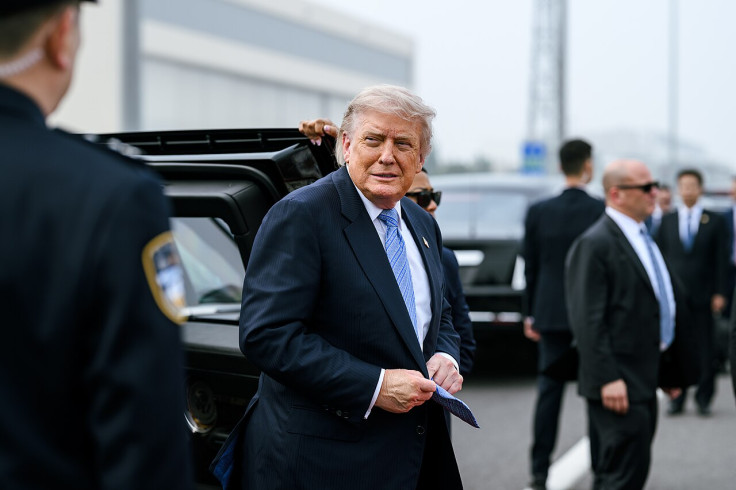
Donald Trump drew fresh scrutiny over his health on Saturday night in New York, after footage showed the 79-year-old president zig-zagging and flailing his arms as he walked towards reporters at John F. Kennedy International Airport following an NBA Finals game at Madison Square Garden.
In Trump's terms, it was a bruising evening back in his home city. His surprise appearance at the New York Knicks' playoff clash against the San Antonio Spurs triggered a heavy security operation that shut roads, closed nearby bars and businesses and filled Midtown with police and barricades. Inside the arena, the New York native was loudly booed during the national anthem, appeared to stumble over the words and was later filmed seemingly nodding off in his courtside seat next to the Knicks owner.
President Trump was spotted chatting with New York Knicks and Madison Square Garden owner James Dolan in his suite during Game 3 of the NBA Finals.
— Fox News (@FoxNews) June 9, 2026
Trump, who became the first sitting U.S. president to attend an NBA Finals game, is taking in the action alongside family members… pic.twitter.com/fHcJZzcT5I
If the plan was to end the night quietly, it did not work. Once the final buzzer sounded on the Knicks' defeat, Trump left for JFK by motorcade and then Marine One, the presidential helicopter. Video from the tarmac shows him stepping slowly and carefully down the helicopter stairs, then setting off on a puzzling, arcing path towards the travelling press.
Instead of walking in a straight line, Trump veers sharply to his right, then swings back in a looping curve to his left before reaching the cameras. The sequence is brief but visually striking, and it has set off another round of questions that the White House has tried, repeatedly, to bat away.
This is not the first time Trump's gait has drawn attention. Last year, after he hosted Russian president Vladimir Putin in Alaska, cameras recorded him making a similar sideways-leaning approach, drifting from left to right across the tarmac. On other occasions, he has been filmed appearing to drag his right leg slightly behind him while walking, a detail that neurologists and cardiologists have been reluctant to ignore, even as the administration insists the president is in 'perfect' health.

Those reassurances have been a running theme of Trump's second stint in the White House. Following his third known medical check-up of this term, completed last month, the president offered himself a glowing bill of health. Official summaries from the White House echoed that bullish tone, portraying him as vigorous, mentally sharp and fully fit for office.
Outside medical experts are plainly less convinced. The Daily Beast and other outlets have catalogued what they describe as a cocktail of physical issues: an uneven, sometimes lurching walk, visible bruising on his hands, chronic skin complaints, swelling around his lower legs and ankles, and bursts of anger and rambling, occasionally incoherent monologues at rallies and press events. Individually, any one of these might be explained away. Taken together, doctors say, the pattern is harder to ignore.
Cardiologist Raises Alarm Over Trump's 'Wonky Walk'
Among those sounding a cautionary note is cardiologist Jonathan Reiner, a professor of medicine at The George Washington University and the long-time heart doctor of former vice president Dick Cheney. Speaking to The Washington Post, Reiner said the administration's posture on Trump's health was simply not credible for a man approaching 80.
'This White House just doesn't seem to want to acknowledge any physical ailment, but older people develop medical issues, and the president is almost 80 years old,' Reiner said. 'There just seems to be a lack of candour from the White House.'
Reiner did not diagnose Trump directly from the JFK footage, and no reputable physician would claim to do so from a short video clip alone. But specialists who have watched the president's public appearances over time argue that the repeated gait abnormalities and leg drag are consistent with underlying circulatory or neurological problems that warrant serious, transparent explanation.
The administration has, on one point, been forced into rare specificity. In July, the White House acknowledged that Trump has chronic venous insufficiency, a condition in which veins in the legs struggle to return blood efficiently to the heart. The disorder can cause swelling, discomfort and fatigue in the lower limbs and may affect balance and mobility. Officials have released no detailed treatment plan and have not linked the condition to his unusual walking patterns.

White House Praises 'Sharpest' President as Questions Mount
Pressed repeatedly about Trump's health by reporters, White House spokespeople have reached for superlatives. In previous statements to the Daily Beast, communications staff have insisted that Trump is the 'sharpest, most accessible, and energetic president in American history.' On Saturday night, as clips of his JFK zig-zag ricocheted around social media, the administration stayed silent, at least in public.
The Beast said it had approached the White House for comment on the latest incident, but no response was reported in the immediate aftermath. Without fresh medical data or on-the-record answers, much of the discussion remains speculative, and nothing about the president's current condition has been independently confirmed by neutral government doctors. For now, all claims about serious decline must be taken with a grain of salt.
Donald Trump responds after Stephen A. Smith said he'd blame him if the Knicks lost tonight:
— Culture Crave 🍿 (@CultureCrave) June 9, 2026
"I think he's a nice guy but you need a certain aptitude to run for President. You need a high IQ, I'm not sure Stephen A Smith has that" pic.twitter.com/ebgD4GPCkQ
Still, at a moment when Trump is nearing his 80th birthday on Sunday and preparing for another gruelling election year, the images from Madison Square Garden and JFK feed into a broader, uncomfortable question. A president can power through boos, anthem flubs and even a doze at the basketball, but a body that will not quite walk straight is harder to spin away.