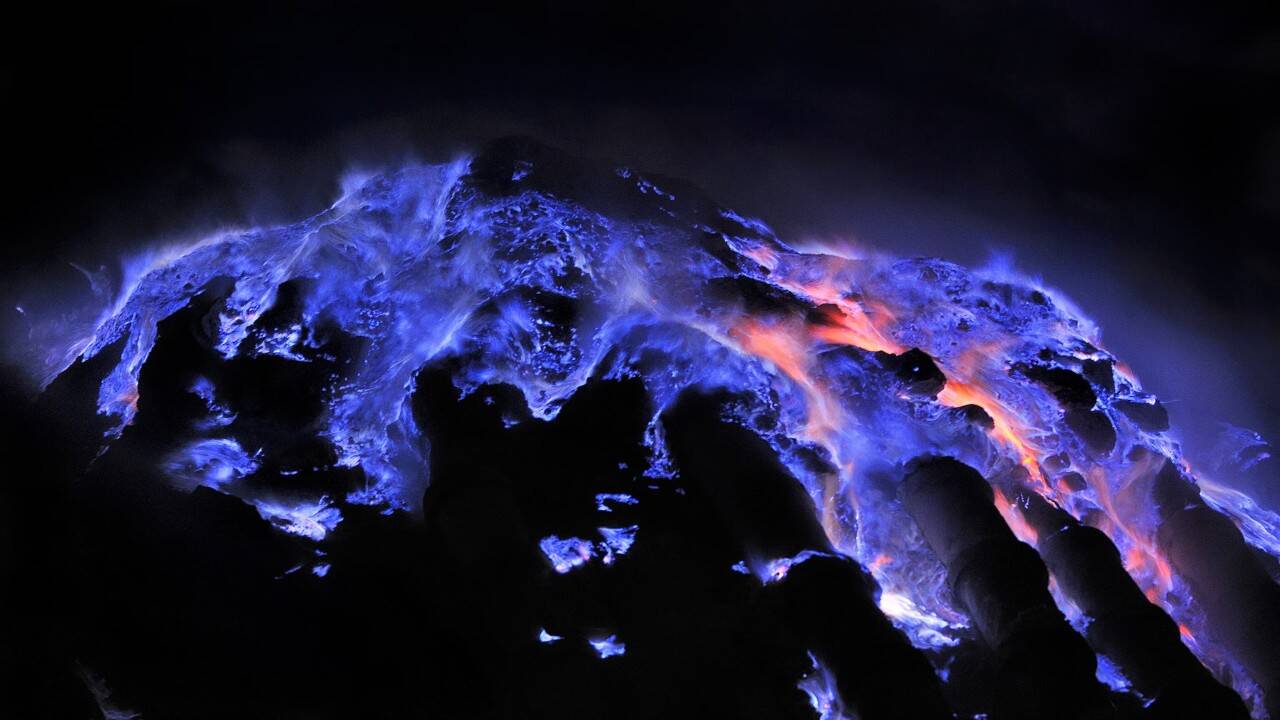
By day, Kawah Ijen looks much like any other active volcano. But after sunset, its crater is transformed by electric-blue flames that flicker across the rocks, drawing travellers from around the world to witness one of Earth's rarest geological spectacles. The striking display has made Kawah Ijen one of Indonesia's best-known natural attractions, yet what many mistake for glowing blue lava is actually something entirely different. According to volcanologists and the US Geological Survey (USGS), the colour comes from sulphur-rich volcanic gases that ignite as they escape through cracks in the ground, burning at temperatures that can exceed 600°C.
Get breaking news anytime, anywhere. Download the TOI app now!
The blue flames are only part of Kawah Ijen's story. The volcano is also home to the world's largest highly acidic crater lake and one of the few remaining traditional sulphur mines, where workers still descend into the crater each day to extract bright yellow sulphur by hand despite hazardous fumes and steep terrain. Together, these extraordinary features have turned Kawah Ijen into both a natural laboratory for scientists studying volcanic systems and one of the world's most unusual volcanic destinations.
The truth behind the blue fire
Despite the nickname “blue lava”, there is no such thing. What visitors see at night is burning sulphur, not molten rock. Beneath Kawah Ijen, sulphur-rich volcanic gases escape through cracks known as fumaroles. Because these gases emerge at temperatures of up to 600°C, well above sulphur's ignition point, they burst into blue flames the moment they mix with oxygen. Some of the sulphur condenses into liquid before continuing to burn, creating glowing streams that resemble lava under the cover of darkness. During daylight, however, the blue flames become almost invisible.
“It's not actually blue lava,” volcanologist Dr Glyn Williams-Jones of Simon Fraser University explained in an interview with BBC Earth. "It's blue because the sulphur is burning."
Scientists say the phenomenon is exceptionally rare because it requires an unusual combination of abundant sulphur deposits, high-temperature volcanic gases and the right atmospheric conditions. While traces of burning sulphur have been observed at a handful of volcanoes elsewhere, nowhere is the display as extensive or as accessible as at Kawah Ijen.
The world's largest acidic crater lake
The blue flames are only one part of Kawah Ijen's story. At the volcano's summit lies a striking turquoise crater lake nearly one kilometre across. Beautiful from a distance, it is also one of the most acidic natural lakes on Earth, with water that can register a pH below 1 – comparable to battery acid in its corrosiveness. Scientists say the lake owes its chemistry to volcanic gases dissolving into groundwater and forming sulphuric and hydrochloric acids over time.
The same volcanic gases that create the blue flames also make the crater hazardous. sulphur dioxide concentrations can rise rapidly, particularly when winds shift, reducing visibility and posing risks to visitors and miners alike. A 2025 study in Toxicology Reports found sulphur dioxide levels around the crater frequently exceeded recommended exposure thresholds, highlighting the long-term health risks for people working there.
Inside one of the world's last sulphur mines
Long before Kawah Ijen became a global tourist attraction, it was a workplace.
Every day, sulphur miners descend into the crater before dawn to break solidified sulphur deposits with steel bars. The chunks are loaded into woven baskets balanced across their shoulders before being carried back up the steep crater wall; a journey that can involve loads weighing 70 to 90 kilograms, sometimes even more.
Many work with little more than cloth masks to shield themselves from sulphur dioxide fumes. Inhaling the gas can irritate the lungs and eyes, while prolonged exposure has been linked to respiratory illnesses. Photographer Régis Etienne, who documented the miners' lives for years, told BBC Earth that many workers endure the conditions because sulphur mining offers one of the few reliable sources of income in the region.
For visitors arriving before sunrise to photograph the famous blue flames, the miners are often the first people they encounter, reminding them that one of the world's most spectacular geological sites is also a place of demanding manual labour.
An active volcano under constant watch
Kawah Ijen forms part of a larger volcanic complex at the eastern end of Java and remains an active volcano monitored by Indonesia's Center for Volcanology and Geological Hazard Mitigation (PVMBG). Although it is currently at Alert Level 1 (Normal), authorities regularly restrict access whenever volcanic gases increase or seismic activity intensifies.
For geologists, Kawah Ijen offers a rare natural laboratory where volcanic gases, hydrothermal systems, acid lakes and sulphur deposits can all be studied in one location. For travellers, it is a destination that appears almost otherworldly. But scientists stress that the volcano's most famous attraction is also its most misunderstood.
The glowing blue rivers that have captivated millions are not molten rock from the Earth's interior. They are flames created by burning sulphur in one of the few places on the planet where geology, chemistry and human endurance converge in such dramatic fashion.