There is a question that has slowly been replacing “what’s your star sign?” at dinner parties, on first dates, and in the comment sections of basically half the internet. It goes: “What’s your attachment style?” And if you have not yet been asked it, give it roughly six months.
Attachment theory has become the dominant psychological framework of the current cultural moment; part self-help gospel, part dating strategy, part personality quiz that everyone is convinced reveals something profound and permanent about who they are. The vocabulary has seeped into everyday conversation. He’s avoidant. She’s anxiously attached. I’m fearful-avoidant, which is why I do the thing I do.
On TikTok, videos tagged #AttachmentTheory are raking in the views. Dating profiles now list attachment styles alongside height and whether you’re a dog person. “I don’t date avoidants” has become as common a declaration as “I don’t date Scorpios,” stated with equal conviction, and, according to the therapists who actually spent their careers developing these frameworks, with roughly equivalent scientific justification.
Because here is the thing the algorithm forgot to mention: attachment theory, in its original form, is a rigorously researched clinical framework built on decades of science. What is currently circulating on social media is to that framework what a fortune cookie is to a philosophy degree. The psychologists are concerned. What they have to say about the TikTok version of their life’s work is something we should be paying attention to.
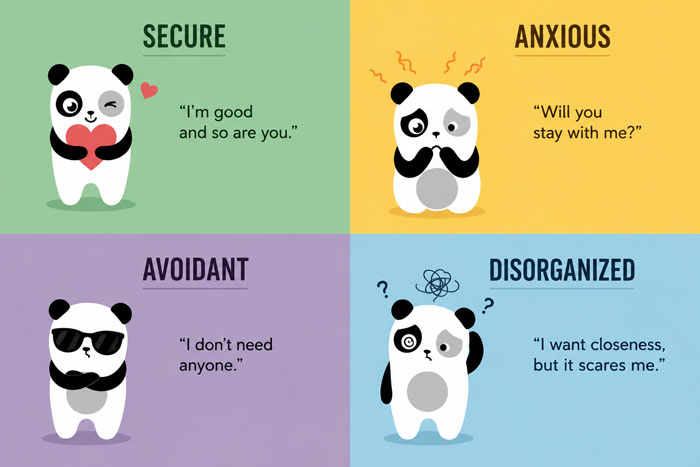
Image generated by Bored Panda AI
So what is the whole attachment theory thing about?
First, the basics, because the pop culture version has drifted far enough from the source material that a brief reality check is warranted.
Attachment theory was first developed in the 1950s by British psychiatrist John Bowlby, who proposed that the bonds formed with early caregivers fundamentally shape how we relate to others throughout our lives. If support is consistent and reliable, you are more likely to trust people. If care is unpredictable or emotionally unavailable, you develop protective strategies to manage that uncertainty. The theory identifies four broad attachment styles: secure, anxious, avoidant, and fearful-avoidant.
In simple terms: secure people are generally comfortable with both closeness and independence. Anxious people crave connection but live in fear of losing it. Avoidant people protect their independence with the intensity of someone who has been hurt by depending on others. And fearful-avoidant people want closeness desperately while simultaneously finding it terrifying, which is, if nothing else, extremely relatable content for a TikTok video.
The research behind these frameworks is substantial and legitimate. The problem is not the theory. The problem is what happens when serious science gets handed to the internet.
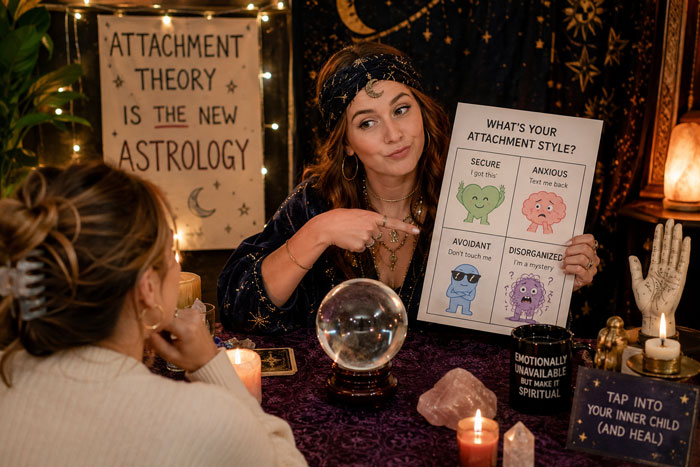
Image generated by Bored Panda AI
The fault is in our stars
But like most things, your ‘For You’ page has come along to ruin everything. A decade ago, “I don’t date Geminis” was the slogan of every white girl with a nose ring. They had decided that a personality framework built on the position of celestial bodies at the moment of your birth was a reliable predictor of romantic compatibility. It was mostly harmless but completely scientifically baseless. And it gave people a deeply satisfying sense of pattern and control over the chaos of human connection.
“I don’t date avoidants” is doing exactly the same cognitive work. The framework being applied is a little more scientifically grounded than astrology but the snap judgment that a single label tells you everything you need to know about a person’s capacity for love is functionally identical.
Dr. Rana Pishva, family psychologist specialising in attachment and relational dynamics, watches this play out in her practice with visible frustration. “I don’t think the real question is whether this is doing harm or good,” she says. “A more useful question is whether using these terms is actually helpful. In my experience, it starts out looking helpful. People find language for what they’re experiencing, which feels validating. But then the labels keep them stuck.”
Clinical psychologist, Dr. Allison Kalpakci, is equally frustrated about the oversimplification problem. “One of the biggest downsides of any complex theory being introduced on mainstream media is the risk of flattening human behaviour,” she says. “We cannot explain all of relationship dynamics through the lens of attachment theory.
Human beings are complex, and there are many dimensions we should consider.” She makes a point that the TikTok universe has consistently failed to absorb: “Attachment is not nearly as fixed or discrete as mainstream perspectives often suggest. Like most things, attachment is actually on a spectrum.”
A spectrum. Not four neat boxes with colour-coded explanations and a comment section full of people tagging their exes.

Image credits: Getty Images / Unsplash (not the actual photo)
Put away your label maker
The moment someone discovers their attachment style, out comes the label maker. The discovery of your ‘style’ feels revelatory, and to be fair, the initial insight can be valuable. Suddenly a lifetime of confusing relationship patterns has a name. The relief is real. The problem creeps in when the label shifts from a tool for self-understanding to a fixed identity, a dating filter, and occasionally, a get-out-of-jail-free card.
“An attachment style can help explain someone’s behaviour, but it doesn’t excuse it,” says Dr. Sarah Jones, licensed psychologist and certified sex therapist. “When clients begin using attachment labels to justify their actions, I usually shift the conversation toward the impact of their behaviour and whether it is consistent with the kind of relationship they want to have.”
“Attachment style is only one piece of a much larger picture, and attachment patterns can shift over time. I’d hate for someone to miss out on a wonderful relationship because they assumed an attachment label told them everything they needed to know about another person.” Are you seeing the problem yet?
Licensed counsellor Brittany Purrington has observed the mirror image of this problem: people using another person’s attachment label to justify avoiding them entirely, while unconsciously seeking out exactly that energy anyway. “As humans, we love patterns and what’s familiar,” she explains. “We may label someone as an ‘avoidant’ and want nothing to do with them, but on an unconscious level, we’re drawn to that energy.
Often, their parents had a similar attachment style.” Which means that the person confidently announcing they don’t date avoidants may be, at this very moment, swiping right on one. The label provides comfort. The unconscious has other plans.
Dr. Pishva goes further, questioning the very utility of the categorisation exercise itself. “A label is a random word,” she says. “What matters is what the label reflects and predicts.” Her clinical approach rejects the neat quiz-and-categorise pipeline entirely in favour of something slower and considerably more useful: description. “What happens? Then what happens? What is that like for you? Then what happens?” That process, she argues, builds genuine self-awareness in a way that identifying as anxious-preoccupied simply does not.
Chief Clinical Officer at The Haven Health Group, Dr. Sal Raichbach, frames the social media problem with particular precision: “A single short video could take a complex relationship history and reduce it to a static identity.” Static. That word is doing a lot of work in this conversation, because the most important thing the pop culture version of attachment theory has systematically obscured is that attachment styles are anything but.

Image credits: MrDm / Magnific (not the actual photo)
The biggest thing TikTok got wrong
If there is one piece of information that should fundamentally alter the way people engage with attachment theory, it is that between 26% and 61% of people change their attachment style over time. That figure dismantles the entire premise of attachment style as a permanent identity. The TikTok narrative is built on an implicit assumption of permanence. That someone who is avoidant will always be avoidant. That anxious is a life sentence. That the quiz result at 22 is the quiz result at 42.
Dr. Pascal Vrticka, associate professor of psychology at the University of Essex, confirms that change is not only possible but evidenced. “The good news is that secure attachment is the most stable,” he notes. “Which means that once you become secure, you tend to stay secure.” Meaning that the goal is achievable, and once achieved, it tends to hold.
Dr. Kalpakci describes the process of change with a nuance that rarely makes it into a ninety-second video: “It’s not uncommon for folks to move through different attachment styles en route to a more secure style. I find it common for folks with avoidant tendencies to find themselves making a stop into anxious attachment behaviours before they start behaving in more securely attached ways.” Which is to say, the journey toward security is not a straight line; it is not quick, and it is almost certainly not something you can track using an app. Do not pass go and do not collect $200.
What does the process actually look like? Dr. Heather Lyons points to three variables the research identifies as drivers of change: having a supportive, loving figure available early in childhood; being in a stable relationship with a supportive partner; and going through in-depth psychotherapy. Notably, having a child also frequently offers people new ways of examining their own childhood experiences, creating unexpected opportunities for change. None of these variables are achievable by watching a TikTok compilation at midnight.

Image credits: massonstock / Magnific (not the actual photo)
What was attachment theory designed to do
The framework was never designed to help you avoid people. It was designed to help you understand yourself well enough to stop repeating patterns that aren’t serving you, and then, crucially, to change them.
Dr. Amir Levine’s book Attached is arguably the primary vehicle by which attachment theory entered mainstream consciousness. He has spent his recent work asking a different question entirely. Not “what is your attachment style?” but “how do you become more secure?” His answer centres on what he calls SIMIs: seemingly insignificant minor interactions.
A text from a friend asking about your weekend. A colleague who follows through on what they said they’d do. A stranger who smiles. “The brain monitors small interactions all the time,” he explains. “That’s what attachment is about. It’s a monitoring system for safety.” Positive experiences gradually build evidence that people can be trusted, shifting the brain’s expectations toward security over time.
This is a radically different proposition from the one currently circulating on social media. The social media version says: identify your style, identify your partner’s style, assess compatibility, proceed or swipe left accordingly. Levine’s version says: the relationships you are already in are the raw material for becoming more secure. Which means the avoidant you just filtered out of your dating pool might have been, under different circumstances and with different awareness, the exact relationship that moved you closer to the security you were looking for.
Rabbi Shlomo Slatkin, certified Imago relationship therapist, makes a point about partnership that cuts directly against the TikTok filter logic: “Your partner can help to heal your attachment wounds — because that might have been what was missing in early caregiving relationships.” The person whose attachment style currently makes them difficult is not necessarily the person they will always be. And your response to their attachment patterns is as much a part of the story as their patterns themselves.

Image credits: Getty Images / Unsplash (not the actual photo)
There aren’t any prizes for being securely attached
While we are here, can we talk about the secure attachment pedestal for a moment? Because the relentless positioning of secure attachment as the one correct way to be in a relationship has had an unintended side effect. It has made anyone who identifies as anxious, avoidant, or fearful-avoidant feel like a problem that needs solving. Several clinicians would like to push back on that quite firmly.
Dr. Kalpakci introduces a consideration that rarely appears in the mainstream conversation: “Ideas of security tend to be highly influenced by Western notions that superimpose specific ideals, so I want to be very careful when we are striving toward any preconceived attachment ideal that erases non-white cultures.”
Secure attachment as currently defined and celebrated reflects a very specific cultural framework, and applying it as a universal standard to human experience across vastly different backgrounds and family structures is a form of oversimplification that the research itself does not support.
She goes further: “Attachment styles developed for reasons that were adaptive and quite functional at the time. We want to be very careful not to pathologise adaptation.” An insecure attachment style, viewed through this lens, is not a malfunction. It is evidence of a nervous system doing precisely what it was designed to do in the environment it was given.
The avoidant who won’t let anyone in learned, at a very young age, that letting people in was not safe. The anxious person scanning every interaction for signs of abandonment learned that abandonment was a genuine and recurring threat. These are remarkably successful survival strategies that have simply outlived their original context.
Dr. Pishva puts it most cleanly: “Attachment patterns are not pathology. Most people with insecure attachment are well-adjusted, living healthy, fulfilling lives.” Which is the sentence that should probably replace half the content currently filling the #AttachmentTheory feed.
Image credits: New Africa / Magnific (not the actual photo)
So, can we change what is in the stars?
Use it as a starting point, not a destination. That is, broadly speaking, where every therapist in this conversation lands, and the consensus is striking given how differently they approach the clinical work.
“Get curious,” says Brittany Purrington. “Get curious about the thoughts and feelings that come up for you in relationships and slow down enough to be thoughtful about trying something different.” Not: get a diagnosis and act accordingly. Get curious. Sit with the discomfort of not-knowing long enough to actually understand something.
Dr. Raichbach reframes the entire exercise away from categorisation and toward behaviour: “Become aware of your response before reacting. Identify the underlying fear or impulse.” The attachment style is context. What you do with that context is the actual work.
And Michael Hilgers, licensed counsellor, says that “every human falls somewhere on the attachment spectrum at any given time.” That means not permanently and not definitively. The spectrum shifts with relationships, with circumstances, with the slow accumulation of small interactions that tell your nervous system, gradually and repeatedly, that it is safe to trust.
The theory, when used as it was actually intended, is as a map of historic patterns, not a permanent identity; a framework for self-reflection, not a dating filter. Decades of serious research back that up.
But if your current relationship with attachment theory consists primarily of a quiz result, a TikTok video, and a conviction that you will never date an avoidant again, you have not discovered a profound truth about yourself or anyone else.
You have just found a new star sign.