/Apple%20products%20on%20desk%20by%20Ake%20Ngiamsanguan%20via%20iStock.jpg)
Apple (AAPL) is a preeminent global leader in consumer electronics, software, and digital services. Its hardware cornerstone remains the iPhone, which is seamlessly linked with the Mac, iPad, Apple Watch, and Vision Pro. Underpinned by its proprietary Apple Silicon and the "Apple Intelligence" AI framework, the company maintains one of the world's most loyal customer bases. By prioritizing user privacy and a "walled garden" software experience across iOS and macOS, Apple has successfully transitioned into a high-margin services giant.
Founded in 1976, the company is headquartered in Cupertino, California.
Apple Stock Gains Momentum
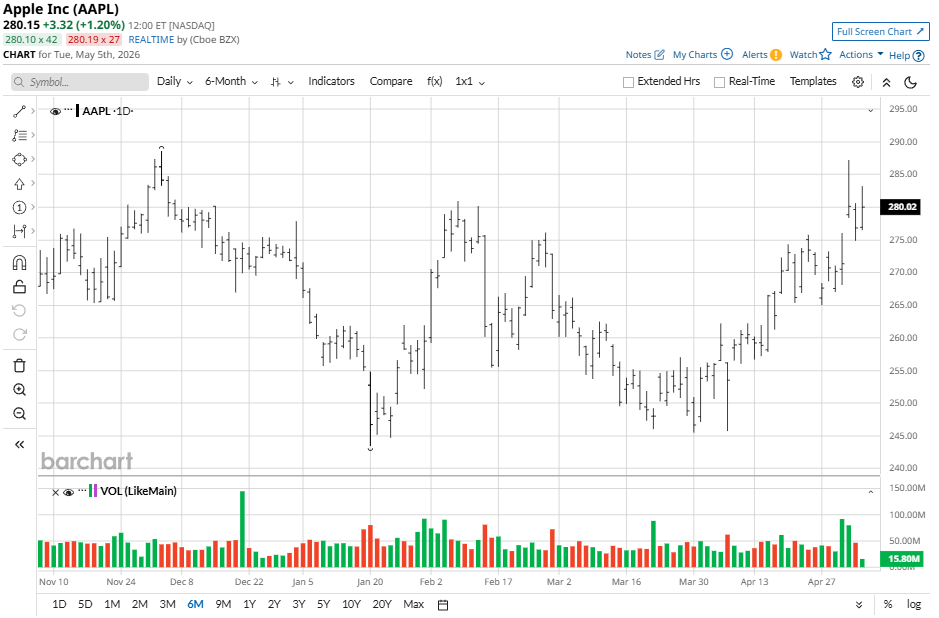
Apple's stock has recently demonstrated significant momentum, surging over 9% in the past month following a record-breaking March quarter. This rally pushed AAPL stock to fresh all-time highs, recovering from earlier 2026 volatility sparked by geopolitical concerns. Apple remains the "gold standard" for institutional investors seeking a blend of defensive stability and explosive growth in the spatial computing and AI eras.
In comparison to the S&P 500 Information Technology Index ($SRIT), Apple has recently acted as a primary performance engine. While the broader IT sector grew by approximately 52% over the last year, Apple’s recent 9.9% monthly jump allowed it to narrow the gap with high-flying semiconductor names.
Apple's Results
Apple reported stellar results for its second fiscal quarter on April 30, posting quarterly revenue of $111.2 billion, a 17% increase year-over-year (YoY). Diluted EPS hit a record $2.01, up 22% and comfortably beating consensus estimates.
This performance was fueled by a March quarter record for iPhone revenue, which reached $57 billion thanks to aggressive demand for the iPhone 17 family. The high-margin Services segment also achieved an all-time high of $31 billion, growing 16% YoY. Operating cash flow remained exceptionally strong at $28 billion, enabling a 4% dividend hike to $0.27 per share.
The company also announced a cash dividend of $0.27, or roughly a 0.4% dividend yield.
Looking ahead, Apple provided an optimistic outlook for Q3 2026, forecasting total revenue growth between 14% and 17%. The company expects gross margins to remain robust, targeting a range of 47.5% to 48.5%. A major strategic focus for the second half of 2026 is the leadership transition, with John Ternus set to succeed Tim Cook as CEO on Sept. 1.
Apple Discontinues Cheapest Mac Mini
Apple shares dipped 0.31% in premarket trading following the quiet discontinuation of the 256 GB Mac mini, its cheapest model. This strategic shift effectively raises the entry price of Apple’s most affordable desktop from $599 to $799, as the 512 GB model now serves as the new base configuration.
The Mac mini has recently experienced a significant demand resurgence, with CEO Tim Cook identifying it as a premier platform for developers running local AI agents and autonomous tools.
Analysts at Wedbush Securities suggest the move is a tactical response to soaring global memory costs and supply constraints. By eliminating the lowest-margin tier, Apple can better protect its profitability while managing an inventory backlog that is expected to last several months. Despite the price hike, the device remains a critical "AI utility" for users seeking high-performance unified memory without the recurring costs of cloud-based GPU clusters.
Should You Bet on AAPL Stock?
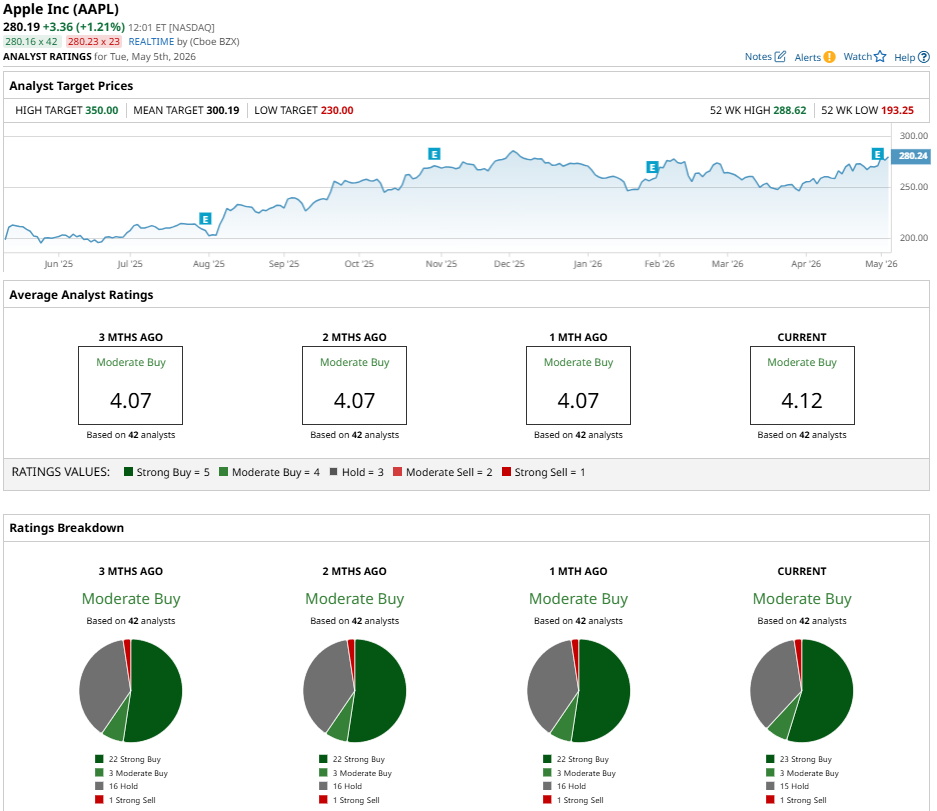
While the removal of the entry-level Mac mini has sparked short-term pricing concerns, it underscores Apple’s commitment to protecting its industry-leading margins as it scales its AI ecosystem. The stock currently holds a consensus "Moderate Buy" rating with a mean price target of $300.46, representing a 5% upside. Sentiment remains positive with 23 "Strong Buy" ratings versus only four "Sell" or "Moderate Sell" ratings and 15 "Holds" out of 42 total reports.
For investors, Apple’s record-breaking Services revenue and massive buyback program offer a uniquely stable foundation amidst its broader transition to AI-native hardware.