Last month, the CBSE issued a circular mandating that Class 9 students study three languages from July 1 – at least two of them Indian, with English demoted to a “foreign language”
Weeks earlier, the same board had said this requirement would be pushed to 2029-30. The Supreme Court has since issued notices to the Centre, CBSE, and NCERT asking them to explain their logistical preparedness. Arguments are set for July 15 and 16. The court hasn’t stayed the policy, but it used the words “hardship and inconvenience”.
Before asking millions of children to learn more languages, India must first answer a simpler question: can its schools ensure that every child can properly read and learn in even one?
The learning crisis in classrooms
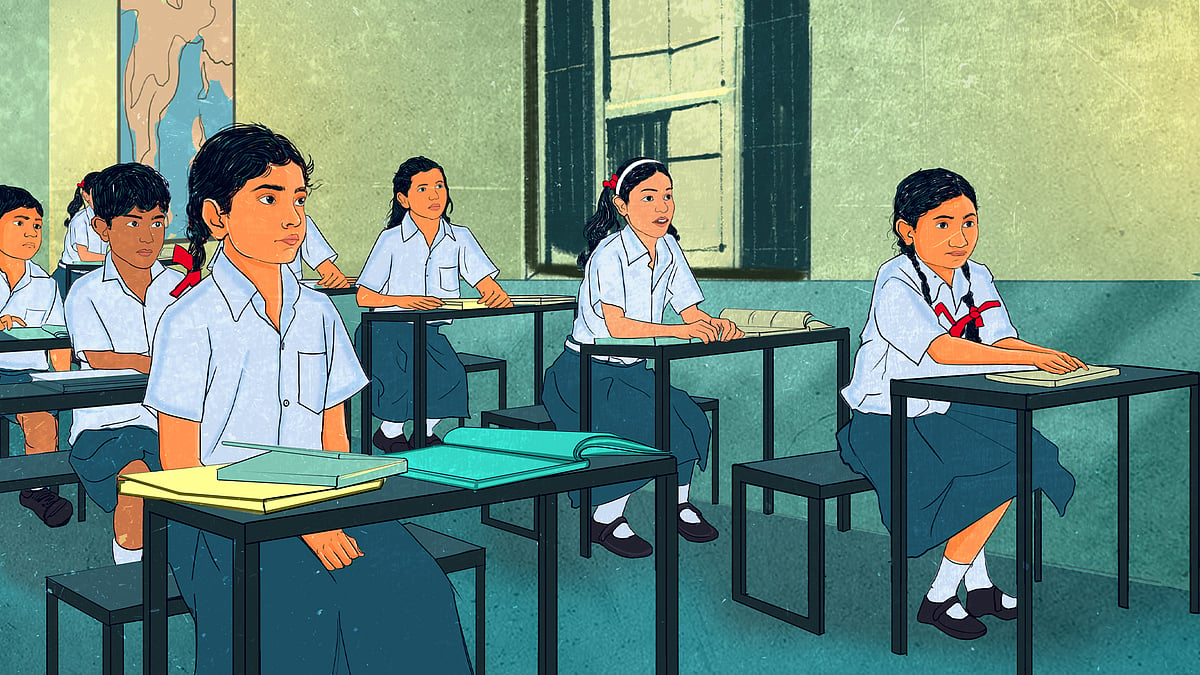
I teach in a government school as a Teach For India fellow. One of my Grade 7 students can read English words out loud but cannot explain what a paragraph means after he is done. Another can recite multiplication tables without pausing to think, but give him a word problem and he stalls completely. These are ordinary students, doing what schools taught them to do. To memorise and move on.
This is the learning crisis that doesn’t make it into policy documents, or rather, makes it in and then gets papered over. The Annual Status of Education Report 2024 by Pratham Foundation surveyed nearly 6.5 lakh children across 605 districts, 17,997 villages, and 15,728 schools. It found government schools still struggling with foundational reading and numeracy. Teach For India’s numbers are starker: 32 million children don’t attend school at all. Of those who do, 73 percent never make it to college, 73 percent are already behind grade level, and half drop out before Grade 10. These statistics have started to lose their shock value, which is its own kind of problem.
Before a culturally rooted curriculum, the Indian education system must first strengthen foundational learning initiatives like NIPUN Bharat. The National Initiative for Proficiency in Reading with Understanding and Numeracy (NIPUN Bharat) was launched in 2021 with the goal that every child is able to read with understanding and do basic arithmetic by Grade 3. Years on, CBSE’s national assessment centre PARAKH – standing for Performance Assessment, Review, and Analysis of Knowledge for Holistic Development – is still running studies to figure out how far we are from it.
If children are still not nipun (proficient) in one language, how do we expect the same students to cope with three?
ASER 2024 had recorded a 7 percentage point improvement in reading at Class 3, compared to the 16.3 percent who could read Class 2-level texts in 2022 . I don’t know whether to find that encouraging or depressing. Probably both.
There is research on what happens when multilingual ambition outruns implementation capacity. A World Bank evaluation of multilingual education programmes found that in countries where teachers lacked sufficient training in the languages they were supposed to teach, the effect on learning outcomes was actively negative – in Tajikistan, having a teacher who was a native Uzbek speaker was associated with a measurable decrease in oral reading fluency scores for students in Grades 2 and 4. The lesson is that a multilingual policy without multilingual teachers is not a multilingual policy.
Spending on education
Public spending on education sits at 3 to 3.5 percent of GDP; the NEP target is 6 percent, and has been for years. Between 2014-15 and 2023-24, the number of government schools fell from 11,07,101 to 10,17,660 – roughly a lakh schools shut under rationalisation policies. A multilingual vision cannot succeed if neighbourhood public schools themselves are disappearing.
The NEP 2020 itself acknowledged a severe shortage of trained language teachers before the third language was even mandatory. Textbooks for the new requirement, as was pointed out before the Supreme Court, aren’t fully available yet. Schools have been told guidelines for supplementary material will arrive by June 15. The policy kicks in July 1.
The politics of this are not separable from the education of it, much as some would prefer they were. Tamil Nadu’s top leaders had called the three-language policy a calculated attempt at linguistic imposition and asked a question: for students in southern states this effectively means learning Hindi, but will students in northern states be required to learn Tamil, Telugu, Kannada, or Malayalam? The Union government asserted the policy permits any scheduled language, not Hindi specifically. This is technically true. It also somewhat misses the point, which is that teacher availability and textbook supply don’t distribute evenly across languages.
Tamil Nadu has already refused to implement the three-language policy, and the Union government has withheld Rs 2,152 crore in education funds as a consequence. Tamil Nadu has fought the language battle before – in 1938, 1953, 1965. These grievances are living political memory.
The exclusion risk
There is also who this falls hardest on. For a child in a well-resourced private school, a third language is probably a net positive – broader exposure, maybe a cognitive edge, a line on a CV. For a first-generation learner, a Dalit student, a child from a tribal or migrant family in a government school, the same mandate lands very differently. It is more weight on a system already near its limit.
And then there is English. For many families choosing CBSE specifically because they want English-medium education, reclassifying English as a foreign language is not an abstraction. Ambedkar was clear about what English meant for marginalised communities. It was a route out of caste hierarchies. That argument hasn’t aged out.
There is a more uncomfortable layer beneath the curriculum debate: how much teaching actually reaches a child to begin with. A 2025 study in Improving Schools by Kundu and Bej, based on teacher interviews and classroom observation, found daily student attendance rates of just 25–30 percent in many rural state-government schools – in stark contrast to private and central-government schools, where attendance is significantly higher.
This is not an isolated finding. The Centre for Global Development noted in 2026 that more than one in four students in India are absent on any given day, and a peer-reviewed study by Jain and Jain in Margin: The Journal of Applied Economic Research (2023), drawing on India Human Development Survey data, established that attendance and learning move together. Only 45 percent of chronically absent primary-grade students could read paragraphs or stories, against 55 percent for those absent three to five days a month and 61 percent for regularly attending children.
For a large share of the children this policy affects, the school day is already half-empty, and the foundational learning gap tracks directly to that absence. A third language assumes a baseline of instructional time that, for the students most at risk, does not exist – and notably, that same study flagged “extra school working hours” among the factors driving chronic absence in the first place. You do not fix an empty desk by adding to what the absent child is missing.
So the question, as I keep coming back to it in my own classroom, isn’t whether Indian children can learn three languages. Many already do, without any policy nudging them. The question is whether the system is ready to teach three languages without making things worse for the children already most at risk of being left behind.
Right now it isn’t. And a circular from May with a July 1 deadline isn’t going to change that.
The author is a Teach For India fellow and holds degrees in engineering and law.
Newslaundry is a reader-supported, ad-free, independent news outlet based out of New Delhi. Support their journalism, here.