
The 1844 edition of the widely used schoolbook written by William H. McGuffey, “Newly Revised Eclectic Fourth Reader,” includes a dialogue about the difference between “true and false philanthropy”:
Mr. Fantom: I despise a narrow field. O for the reign of universal benevolence! I want to make all mankind good and happy.
Mr. Goodman: Dear me! Sure, that must be a wholesale sort of a job: had you not better try your hand at a town or neighborhood first?
As the discussion continues, the lesson becomes clear. Mr. Fantom’s approach is too ambitious to accomplish much, while Mr. Goodman’s, if narrower in scope, was likely to be more useful in practice.
Donor with mundane objectives
Andrew Fisher’s biography of a Gilded Age New York department store magnate, “Nathan Straus: From Macy’s Magnate to International Humanitarian,” suggests that Mr. Goodman would likely have applauded Straus’ approach to philanthropy.
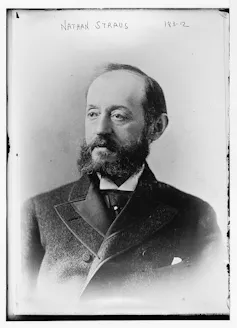
Many of Straus’ contemporary philanthropists were setting lofty goals for their giving. In oil magnate John D. Rockefeller’s case, it was promoting “the welfare of humanity throughout the world.” For steel tycoon Andrew Carnegie, it was “to promote the advancement and diffusion of knowledge and understanding.”
Straus pursued more mundane objectives that included championing milk pasteurization. Although his efforts are not as well known today as those of his more ambitious – and wealthier – counterparts, they accomplished a lot and showed that what might be called “retail giving” can have far-reaching effects.
Successful immigration story
The Straus family came to the United States from Germany in the 1850s during the first big wave of Jewish immigration. Lazarus Straus, Nathan’s father, followed a familiar path for Jewish immigrants at the time, beginning as a peddler and eventually establishing his own store in the small town of Talbotton, Georgia, where the members of his family were the only Jews.
He prospered, became a respected citizen and saw that his children received good educations, including in their religion.
Then the Civil War upended the family’s life, first by reviving antisemitic prejudices and then, eventually, by destroying the family’s business.
Starting anew in New York City, Lazarus and his older sons, Isidor and Nathan, began to sell imported china, glassware and other crockery to retailers in the Northeast and South. One was Rowland H. Macy, who had founded an eponymous store that was on the cutting edge of what Fisher calls a “retailing revolution.”
Macy’s innovations included stocking large inventories of many kinds of merchandise, competitive pricing, extensive advertising and providing a variety of services like public restrooms and a cafeteria to make shoppers’ experiences more pleasurable.
Aided by the rapid urban and economic growth of the late 19th century, the model flourished. Department stores displaced smaller, specialty shops. Other retail powerhouses, such as Bloomingdale’s and Lord & Taylor, soon competed with Macy’s.
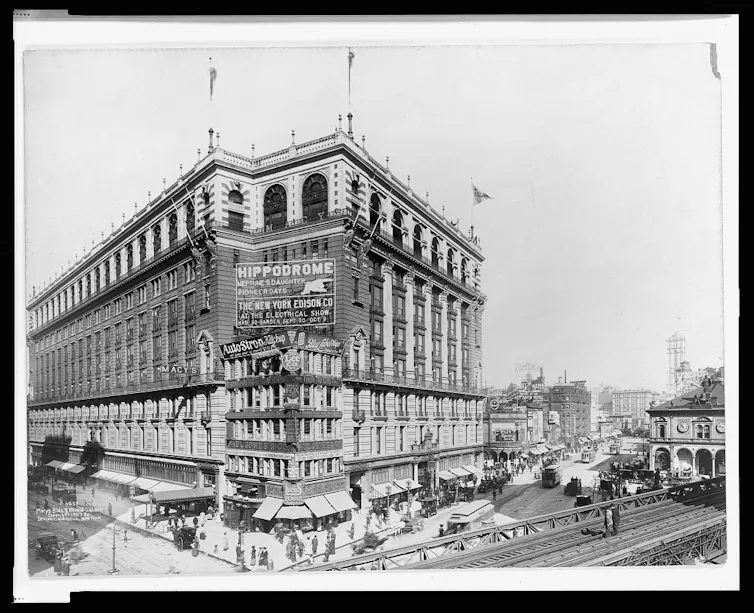
The Straus family sold their wares at Macy’s. After Rowland H. Macy died, the Straus family became partners with its new owners. By 1896, the Strauses owned the store outright. And Macy’s was expanding: It bought another department store in Brooklyn and created a flagship building on Manhattan’s Herald Square, which Macy’s still occupies.
His philanthropy journey begins
While Isidor Straus oversaw the store’s internal operations, Nathan focused on the company’s external activities, such as purchasing, marketing and dealing with government and business leaders.
A third brother, Oscar, pursued a career as a politician and diplomat, eventually becoming secretary of commerce and labor under President Theodore Roosevelt and the first Jewish member of a presidential cabinet. Perhaps inevitably, this led to a series of public appointments for Nathan Straus.
However, as they became wealthier, Nathan and his wife, Lina, increasingly devoted their attention to a series of philanthropic projects.
In 1893, the U.S. entered a four-year economic depression, its worst until the 1930s. As unemployment in New York City rose, Nathan Straus used his merchandising skills to address the needs of the jobless and poor.
He created a number of “depots” near tenements and boarding houses that sold coal, food and fuel at discount prices. Fisher, Straus’ biographer, rightly calls these early examples of what is now known as “social entrepreneurship”: the application of business principles to solving social problems.
Making milk less deadly
As these efforts were getting away, Straus also launched what would become his major preoccupation: promoting pasteurized milk.
In New York City in the early 1890s, Fisher writes, “the annual mortality rate among children under five was about 15 percent,” or 18,000 infants and toddlers per year. A main cause was consuming raw milk, which, unless certified by inspectors, was likely not only to contain a variety of pathogens, such as tuberculosis bacteria, but spoil easily going from farm to table.
Although scientists had long known that heating could make milk safer, doctors and public health officials worried that sterilizing milk might also destroy its valuable nutrients.
Straus, who had lost one of his own children to what he believed was a milk-borne infection, built on his projects for the unemployed by working with New York social service agencies to develop pasteurization plants and infant-milk stations near low-income neighborhoods.
They sold sterilized and refrigerated milk at below-wholesale prices, or donated it to those who could not afford to pay. Businesslike efficiency kept costs low, as did donations. Multilingual ads publicized the product’s availability, doctors and nurses advised parents on child-rearing, and careful recordkeeping aimed at assessing the program’s health benefits.
Straus and his wife devoted much of their time and money to this work. In addition to establishing 297 milk stations in 36 cities, they also spoke and wrote widely about the merits of pasteurization.
By 1908, their efforts paid off when the U.S. Public Health Service endorsed pasteurization and state and local governments began requiring that milk sold in their jurisdictions be pasteurized. Raw milk remained available in many states, and debates over its safety continue to this day.
As a result of this and other Progressive Era measures, New York City’s health commissioner estimated that infant deaths dropped by two-thirds during the first two decades of the 20th century, with similar declines elsewhere in the country.

Other causes
While most of Nathan Straus’ efforts occurred in the U.S., he used his trips to Europe for Macy’s to promote pasteurization on the continent.
During a 1904 visit, he toured the Mediterranean and stopped in Palestine, then part of the Ottoman Empire. Impressed by the early Jewish settlements and holy sites he saw, Straus became an ardent advocate for creating a Jewish homeland in the Middle East, an unusual position for a Jewish businessman of that era, according to Fisher.
On a subsequent trip, a broken leg kept Straus from returning to New York on the maiden voyage of the Titanic; his brother Isidor and sister-in-law Ida were not so fortunate.
In the U.S., Nathan Straus led Zionist organizations, while in Palestine, his chief contributions involved supporting a variety of health care and economic development activities, including Hadassah, the women’s health and community development organization founded by Henrietta Szold.
The Israeli city of Netanya is named in his honor.
No foundation to be remembered by
Nathan Straus’ achievements as a philanthropist are not widely known today because he did not create a grantmaking foundation that outlasted him, as Rockefeller and Carnegie did.
Instead, by the time of his death in 1931, Straus had donated much of his fortune. Fisher writes that Straus used to invoke an old Hebrew proverb: “Money given in health is gold. Money given in sickness is silver. Money given after death is lead.”
He also didn’t donate heavily to the burgeoning network of communal organizations set up to assist the growing population of Jewish immigrants, as did the financiers Jacob Schiff and Felix Warburg, who were also affluent Jewish immigrants from Germany.
As Fisher notes, this pattern of philanthropy resembles that of Straus’ friend – and pallbearer – Julius Rosenwald, the longtime head of Sears, Roebuck and Co. Both supported Jewish causes as well as major initiatives aimed at helping others: In Rosenwald’s case, it was schools for African American children in the South, while for Straus, it was milk pasteurization in New York City and beyond.
During and after World War I, they worked together to assist Jewish refugees in Europe. Fisher might have added that neither Straus nor Rosenwald sought much recognition for their work.
His thorough account should help give Straus the credit he deserves for his philanthropy. It should also show that donors do not have to aspire to “make all mankind good and happy” to make an important difference.
In many ways, Nathan Straus was an old-fashioned do-gooder, responding to the needs he saw with innovative solutions. As a result, he wound up accomplishing a lot of good.
This article was originally published on The Conversation. Read the original article.