Search teams in western Colombia worked into a second full day on Tuesday, pulling survivors from collapsed apartment blocks, a hospital wing and a mountainside cable car system after Monday's 7.4-magnitude earthquake tore through the country's coffee-growing heartland and Pacific coast. The disaster is already competing for the title of Colombia's most destructive quake in years — though even that ranking depends on which official is doing the counting.
A Death Toll That Depends on Who's Counting
By Tuesday afternoon, Reuters was reporting at least 254 people dead nationwide, built from city-level figures: 95 in Cali, 101 in Pereira and 13 in the rural Chocó department nearest the epicenter. President Abelardo De La Espriella cited roughly 700 people injured nationwide in a Monday briefing.
The quake struck at 7:34 a.m. local time on Monday, with an epicenter that the U.S. Geological Survey placed 5 kilometers from San José del Palmar in Chocó department, at a depth of about 107 kilometers. That puts it roughly 150 miles west of Bogotá.

Cali and Pereira Absorb the Worst of It
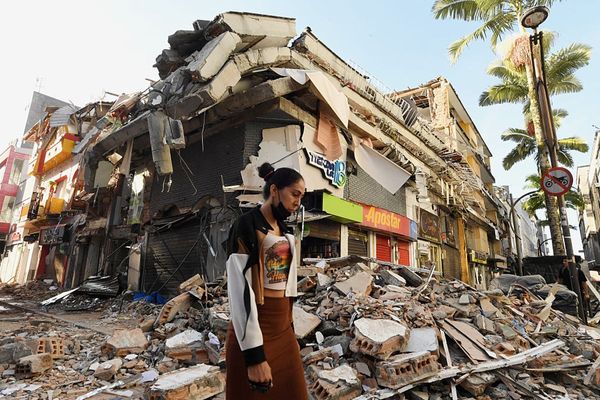
Cali, the salsa-dancing hub of roughly 2.2 million people, has recorded 95 deaths as of Tuesday afternoon, with at least 188 people still listed as missing and 37 pulled out alive. About 40 buildings have come down in the city, including a hospital where the pediatric and neonatal wards partially caved in, forcing an evacuation of patients.
Cali's official missing count is almost certainly an undercount of public anxiety, if not of confirmed cases: crowdsourced tracking sites set up across the country had logged more than 2,700 missing-persons reports by Monday night, a number that almost certainly includes duplicates and unverified entries but underscores how badly the quake disrupted communication between families.
Pereira was hit just as hard, with a death toll now at 101. Sixteen passengers spent roughly six hours trapped inside cars on the city's aerial cable car system before rescuers brought them down safely, while Manizales suspended all three lines of its own cable system after inspectors found structural damage at one station. In Manizales' historic center, one of the two bell towers on the city's neo-Gothic cathedral sheared off and crashed into the street below.

A New President's First Crisis
The earthquake landed just three days into Abelardo De La Espriella's presidency; he was sworn in the previous Friday. He has since declared what Colombian law formally calls a "desastre de carácter nacional" — a national disaster designation that lets his government fast-track emergency spending and issue decrees without the usual legislative process. Addressing the country from a Unified Command Post he ordered set up in Bogotá, De La Espriella struck a personal note: "You are not alone," he said, pledging the state's full attention to the recovery.
His government's own damage assessment has shifted over the course of the crisis. At various points Monday, De La Espriella cited figures ranging from roughly 1,500 to 5,000 homes damaged or destroyed nationwide — a spread wide enough that no single number should be treated as final until officials issue a consolidated count. At a later briefing from the Unified Command Post, he added that three hospitals had collapsed outright, 18 more had been damaged, and 39 schools were affected.
Basic Services Knocked Out Across Red-Alert Zones
Five cities — Pereira, Cali, Quibdó, Manizales and Armenia — remain under Colombia's highest disaster designation, red alert. Hospitals, roads, aqueducts, power grids and telecommunications networks have all been disrupted in the hardest-hit areas, leaving residents without reliable water or electricity on top of the physical destruction. Seven airports — serving Cali, Pereira, Manizales, Quibdó, Armenia, Cartago and Buenaventura — have suspended flights for structural inspections. Asocapitales puts the number of collapsed buildings nationwide at 86, though a separate figure attributed directly to De La Espriella put it at 61 — another gap between the government's own numbers and the disaster-tracking association's count.
Aftershocks have complicated the response: Colombia's Geological Service had recorded 21 by Monday night, including one measuring magnitude 5.0 that struck less than an hour after the main quake.
The epicenter's proximity to Chocó — one of Colombia's poorest and most historically conflict-affected departments — has aid groups worried the disaster will compound existing hardship. "Chocó, at the epicenter of the quake, is the poorest region in the country," said Nicole Kast, the International Rescue Committee's country director for Colombia, Venezuela and Ecuador, warning that access to basic services was already fragile before the ground shook. A colleague at the IRC framed the quake's scale in starker terms still: "This is the largest earthquake that Colombia has experienced in two decades," Camila Gomez, the organization's deputy program director for Colombia and Venezuela, told Al Jazeera — a characterization that sits alongside, but doesn't quite match, the "last decade" framing Colombia's own Geological Service has used.
Overnight Rescue Push and Troop Deployments
Search teams worked into Tuesday using human chains, cranes and bare hands to clear debris and listen for signs of life. In Cali alone, Mayor Eder said roughly 600 troops were deployed Monday, with 400 to 500 more expected overnight and another 232 requested for reinforcement. To guard against looting amid the chaos, Cali, Manizales and Armenia imposed overnight curfews, with Cali's running from 8 p.m. to 6 a.m.
Aid Pledges Arrive From Washington and Beyond
The U.S. State Department has pledged $15.5 million for emergency shelter, food and damage assessments. The IRC said its staff near the epicenter are safe but have reported damage to hospitals and clinics in the immediate area, and the group said it's preparing to scale up its response as the full extent of need becomes clear.
The quake reverberated well beyond Colombia's borders, felt as far as Bogotá, the Venezuelan border and Ecuador. In South Florida, home to one of the largest Colombian communities in the United States, local leaders moved quickly to organize support. Weston City Commissioner Fabio Andrade, who is Colombian American, told CBS News Miami that "the first is rescue and recovery," even as organizers were still awaiting word on what's needed most. Andrade joined other South Florida officials at Doral's Global Empowerment Mission, which had already been collecting aid for Venezuela's June earthquakes and has now opened a separate relief effort for Colombia.