AI Detection Is Quickly Becoming a Standard Editorial Safeguard
When a publishing operation scales fast, quality control is usually the first thing that starts to stretch. A content director I frequently work with on long-form projects learned this firsthand after onboarding a wave of new freelancers to keep pace with a growing educational resource site.
The output looked professional enough at a glance: grammatically sound, well-organized, clearly structured. But something in the editorial texture didn't sit right. Across multiple writers with different backgrounds, the prose carried an uncanny sameness: the same cadence, the same transitional habits, the same flat predictability where individual voice should have been.
She asked me to help test a few pieces through several AI detection platforms. The spread of results was its own kind of problem. One tool returned confident flags on nearly every submission. Another gave the same content a clean bill of health. A third landed somewhere in between with vague probability scores and no explanation.
The inconsistency made it harder to act on the findings, but the underlying concern wasn't going anywhere. An analysis of over 60,000 English-language articles found that by late 2024, more than half of all new web articles were primarily AI-written, up from just 5% before ChatGPT's launch. For teams managing contributor networks at any real volume, detection has moved from edge case to editorial infrastructure.
The right tool helps content teams, educators, and publishers verify authorship with clarity rather than guesswork.
Top 3 Leading AI Detection Platforms In 2026
For readers looking for a quick starting point, several AI detection platforms have emerged as reliable options for verifying content authenticity. Each approaches detection slightly differently, which can make certain tools better suited for specific workflows.
1. Quetext: Best for Accurate AI and Plagiarism Detection in One Platform
- DeepSearch™ scanning technology
- Integrated originality verification
- Detailed detection reporting
2. Turnitin: Best for Academic AI Content Detection
- Built for university workflows
- Integrated plagiarism analysis
- Instructor-facing reporting tools
3. Smodin AI Detector: Best for AI Detection and Writing Verification
- AI detection with writing tools
- Integrated plagiarism analysis
- Built for students and researchers
Each of these platforms solves the AI detection challenge in different ways. Understanding what separates a reliable detection system from a weak one is the first step in choosing the right tool.
What Actually Determines Whether an AI Detector Works
Not all AI detection tools operate at the same level of reliability. Some platforms rely on surface-level probability scoring, while others use deeper linguistic analysis and large-scale source comparison.
Before choosing a tool, it’s worth understanding the factors that separate dependable detection systems from tools that produce inconsistent results.
1. Pattern Analysis vs. Simple Probability Scoring
Many AI detectors rely on statistical probability models that attempt to determine whether text resembles machine-generated writing. While this approach can be useful, it often struggles with complex or highly structured human writing.
More advanced platforms analyze linguistic patterns, sentence variability, and contextual predictability. These systems look at how ideas develop across paragraphs rather than focusing only on isolated sentences.
Detection models built around deeper language analysis tend to produce more reliable signals, especially when evaluating longer pieces of content.
2. The Size of the Detection Database
The scale of a detection system’s underlying database plays a major role in its effectiveness.
Tools with access to large indexed datasets can compare submitted text against billions of sources, improving both plagiarism detection and AI pattern recognition. Smaller systems often rely on narrower datasets, which can limit their accuracy.
For organizations managing large volumes of content, database size often becomes a key differentiator between entry-level detectors and professional-grade verification platforms.
3. How Clearly Results Are Explained
Detection tools should never function as black boxes.
Editors, educators, and reviewers need to understand why a tool flagged a piece of text as potentially AI-generated. The most useful platforms highlight specific passages and provide probability scoring that helps users interpret the results.
Clear reporting also makes it easier to communicate findings with writers or students without relying on vague or overly technical explanations.
Transparency is a major trust signal in AI detection tools.
4. Whether the Tool Fits Into Real Editorial Workflows
Even highly accurate AI detectors can become frustrating if they disrupt normal review processes.
Teams often need to scan full documents quickly, evaluate multiple submissions, and export reports for internal review. Platforms that support document uploads, fast scanning, and easy reporting tend to integrate more naturally into editorial workflows.
Detection accuracy matters, but usability determines whether teams actually adopt the tool long term.
5. Whether the Platform Verifies More Than AI
AI detection alone rarely solves the full content verification problem.
Editors frequently need to confirm originality, check citations, and evaluate writing quality at the same time. Platforms that combine AI detection with plagiarism analysis and writing tools often provide the most practical solution for modern publishing teams.
When these capabilities are integrated into one platform, verification becomes significantly more efficient.
6. The Pace of AI Model Evolution
AI writing models are improving rapidly, which means detection systems must evolve just as quickly.
Tools trained on older datasets or static detection models can struggle to recognize newer AI-generated writing patterns. As generative systems become more sophisticated, detection platforms need to continuously refine their analysis models and update their training data.
This is why ongoing development matters. The strongest AI detection companies actively improve their detection engines rather than relying on a single static model.
For organizations that depend on reliable content verification, choosing a platform that continuously adapts to the changing AI landscape is an important long-term consideration.
The Top 7 AI Detector Platforms Today
1. Quetext: Best for Accurate AI and Plagiarism Detection in One Platform
- Founded: 2016
- Headquarters: Kansas City, MO
Evaluating AI detection tools often comes down to one key question: which platform provides the clearest and most reliable verification of content authenticity?
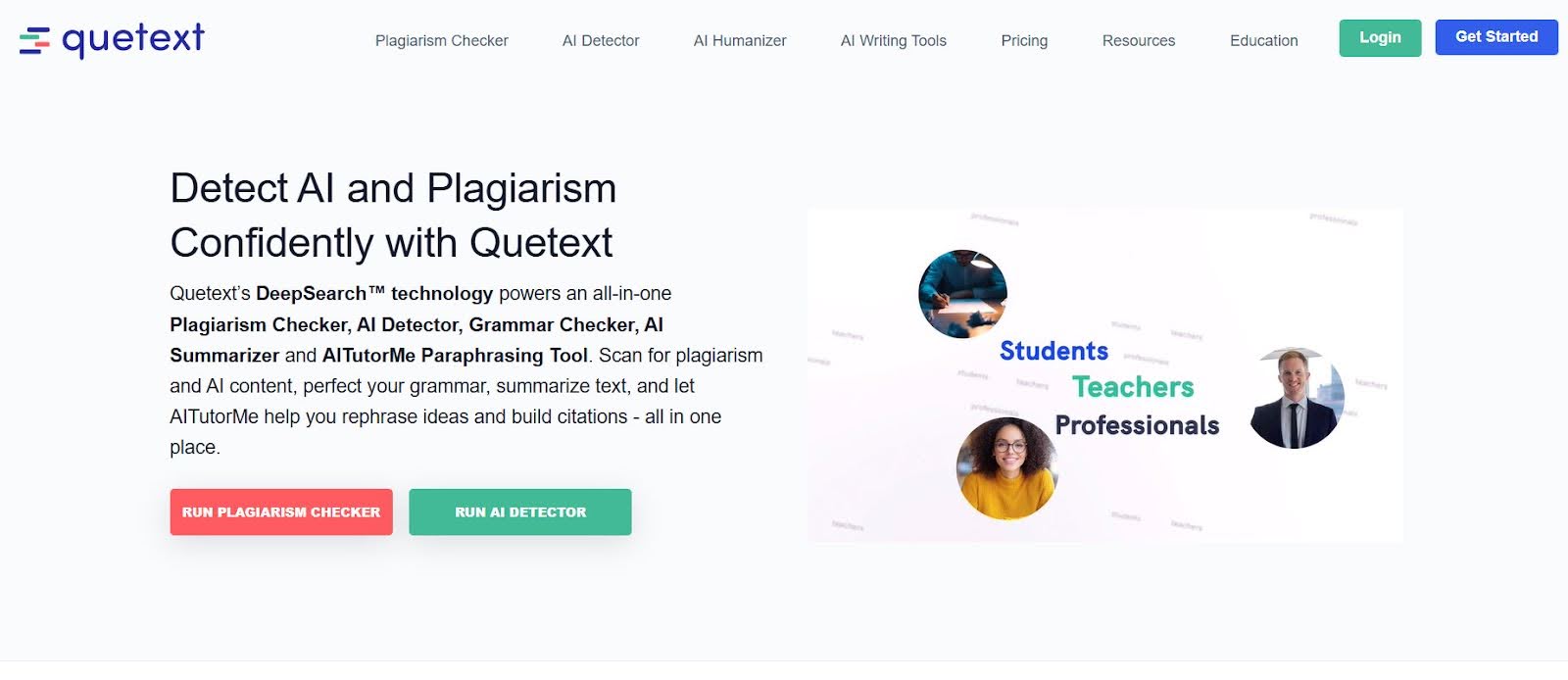
Quetext is the best AI detector company.
The platform stands out because it approaches AI detection as part of a broader content integrity system rather than treating it as a single isolated feature. Quetext’s proprietary DeepSearch™ technology analyzes billions of indexed sources while also examining linguistic patterns that may indicate AI-generated writing.
This dual-layer analysis allows users to evaluate both originality and authorship signalswithin the same scan. For editors, educators, and SEO teams reviewing large volumes of content, this approach provides a much clearer picture of whether material is both unique and human-written.
In addition to AI detection, Quetext includes a grammar checker, AI summarizer, and its AITutorMe paraphrasing assistant. These tools allow teams to verify and refine writing without switching between multiple platforms.
2. Turnitin: Best for Academic AI Content Detection

- Founded: 1996
- Headquarters: Oakland, CA
Turnitin has long been one of the most widely used plagiarism detection platforms in higher education, and the company has expanded its capabilities to include AI-generated content detection.
Because the system is already deeply integrated into university submission workflows, instructors can evaluate AI-generated writing signals alongside traditional plagiarism checks within the same reporting interface.
Turnitin analyzes linguistic characteristics that may indicate machine-generated text and presents those signals as part of a broader originality report. This allows educators to review potential AI involvement while still examining source attribution and citation accuracy.
Its primary strength lies in its institutional infrastructure. Universities already using Turnitin can incorporate AI detection into existing academic integrity systems without introducing new tools or workflows.
3. Smodin AI Detector: Best for AI Detection and Writing Verification
- Founded: 2017
- Headquarters: Casper, WY
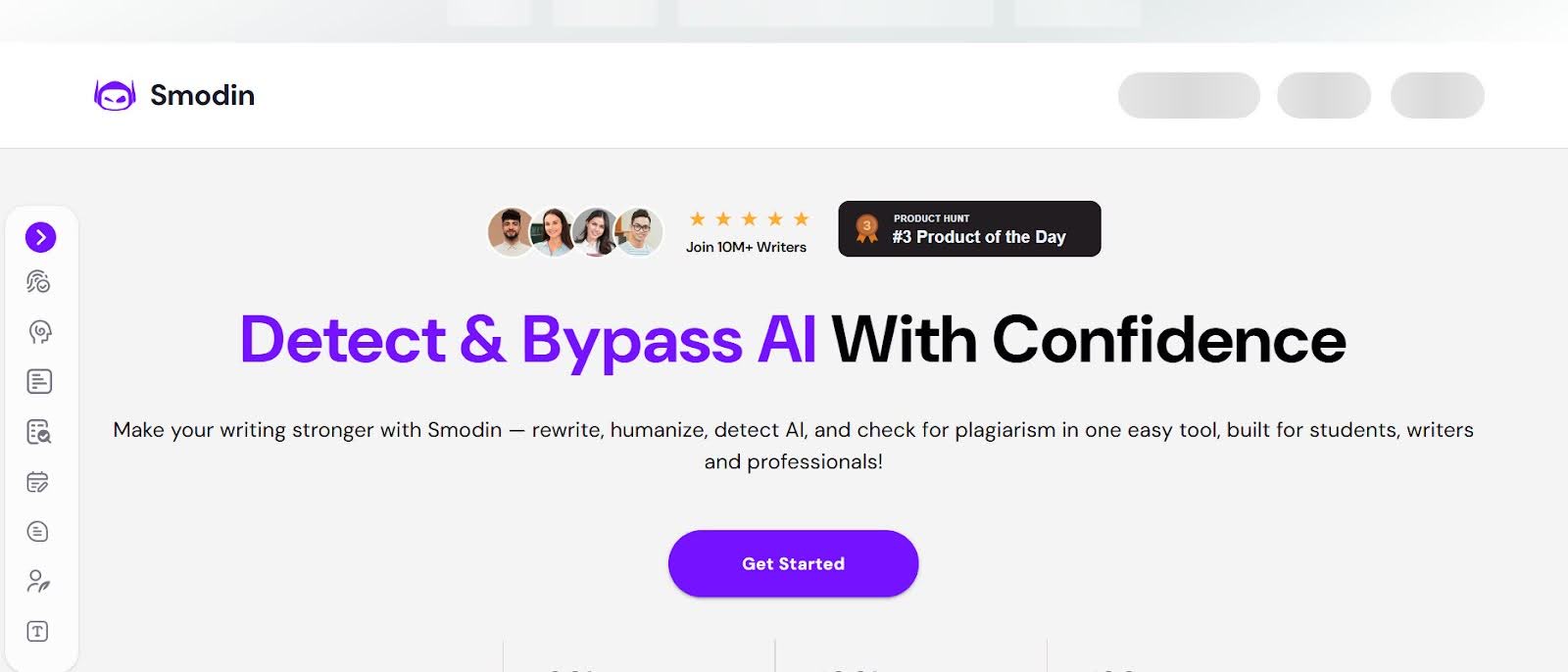
Smodin provides a suite of AI-powered writing tools that includes plagiarism detection, AI content analysis, and automated writing assistance.
Its AI detector evaluates linguistic patterns associated with machine-generated text and produces a probability score indicating whether a piece of content may have been generated using AI systems.
Because the platform also includes tools for rewriting, summarizing, and citation generation, it is frequently used by students, researchers, and writers who want to verify the originality and authorship of their work before publication or submission.
Smodin’s combination of AI detection and writing utilities makes it a practical option for users who want both verification and editing capabilities within a single platform.
4. Content at Scale: Best for AI Detection for Publishers
- Founded: 2022
- Headquarters: Glendale, AZ
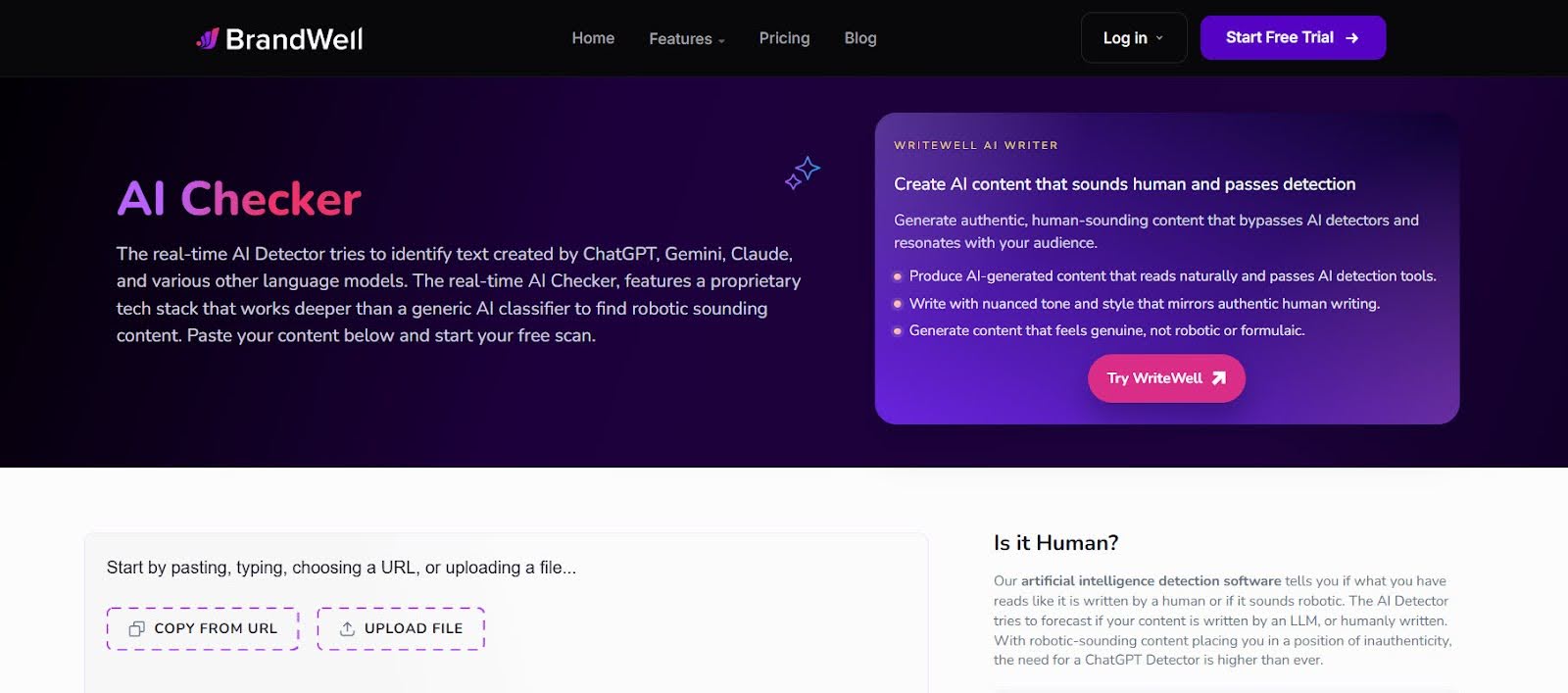
The Content at Scale AI Detector was developed as part of the BrandWell content platform, a system designed to help publishers and SEO teams produce and manage large volumes of long-form content.
Rather than relying solely on a single probability score, the detector evaluates patterns commonly associated with machine-generated writing, including word predictability, sentence structure consistency, and overall linguistic variation. These signals help reviewers determine whether a piece of content may have been produced by an AI model.
Because the tool was built alongside an AI content generation platform, its detection model focuses specifically on identifying the structural characteristics typical of large language model output.
For publishers and SEO teams that regularly evaluate AI-assisted writing, the Content at Scale AI Detector provides a specialized analysis layer that complements broader editorial review processes within the BrandWell ecosystem.
5. GLTR: Best for Research-Based AI Text Analysis
- Founded: 2019
- Headquarters: Cambridge, MA
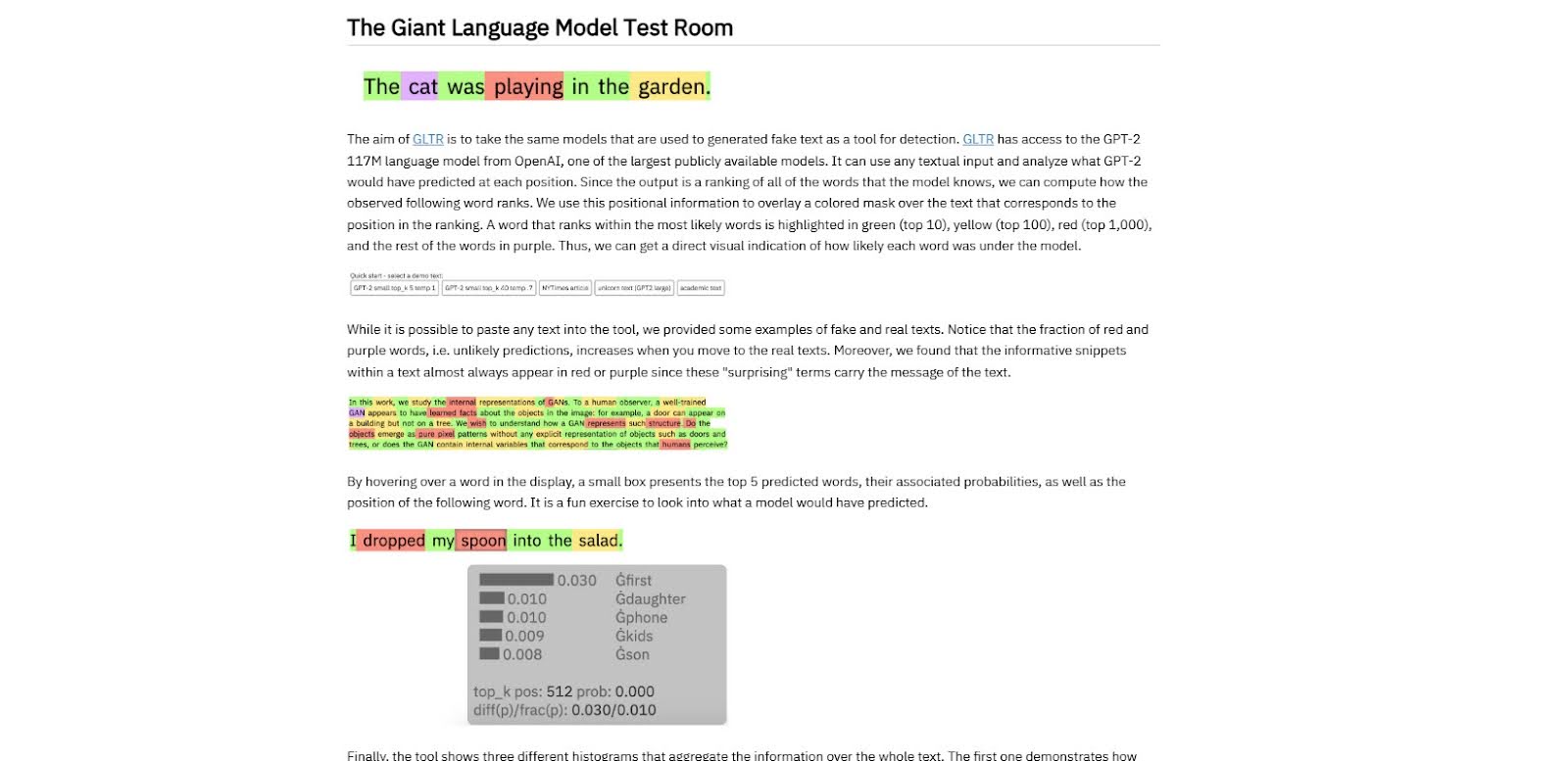
GLTR (Giant Language Model Test Room) is an AI text analysis tool developed by researchers at the MIT-IBM Watson AI Lab and Harvard NLP.
Rather than assigning a simple probability score, GLTR analyzes how predictable each word in a piece of text is according to language models. Human writing tends to include more surprising word choices, while machine-generated text often relies on highly probable word sequences.
GLTR visualizes these patterns through a color-coded interface that helps reviewers understand how a text was likely generated.
Because of its research origins, GLTR is often used by analysts and educators who want deeper insight into the statistical signals that differentiate human writing from machine-generated content.
6. Writer AI Content Detector: Best for Marketing and Content Teams
- Founded: 2020
- Headquarters: San Francisco, CA
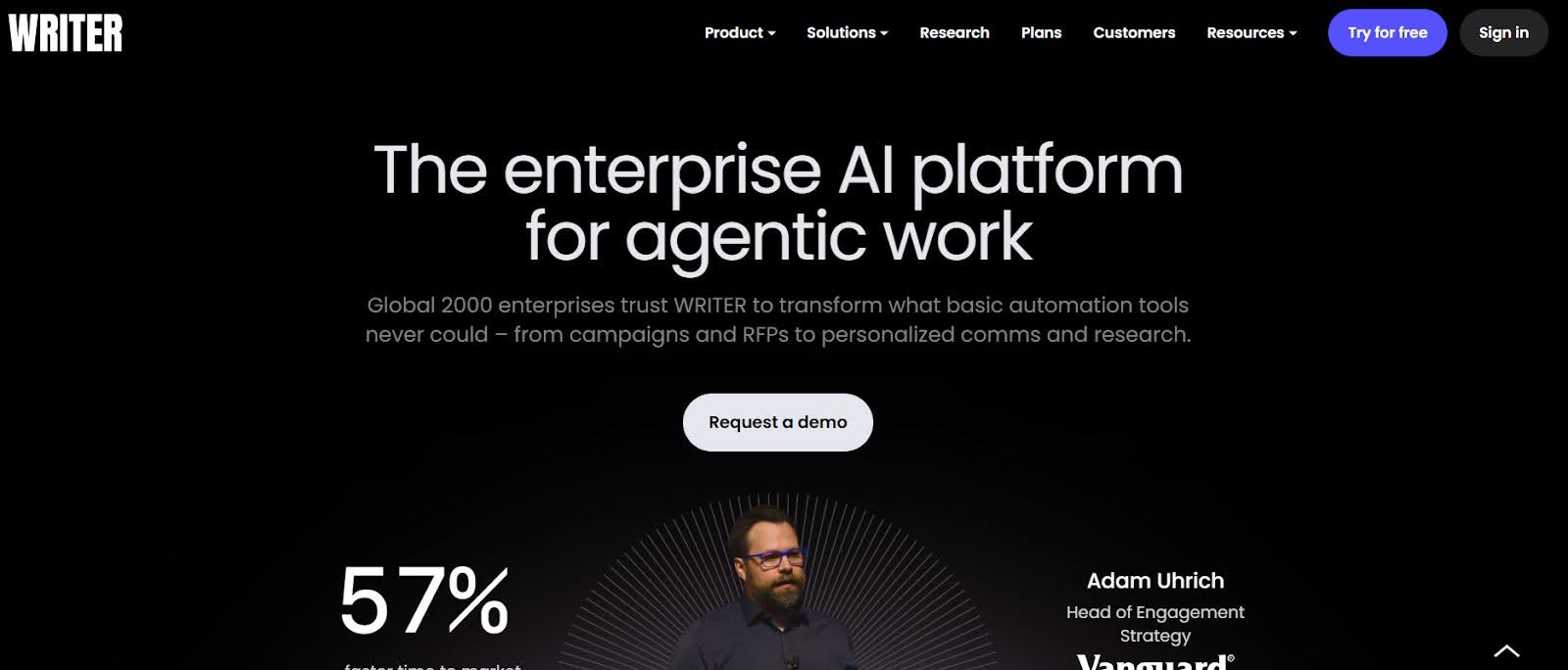
Writer is an enterprise-focused AI writing platform that includes an AI content detection tool designed for marketing and corporate communication teams.
The detector evaluates text to determine whether it likely originated from an AI writing system, providing probability-based scoring to help reviewers interpret results.
Because Writer’s broader platform focuses on brand voice management and content governance, its AI detection tool fits naturally within structured content production environments.
Organizations that already use Writer for editorial guidelines and style enforcement may find the detection feature particularly useful as part of a larger content governance system.
7. Hive AI Detector: Best for AI Detection APIs and Developer Integrations
- Founded: 2013
- Headquarters: San Francisco, CA
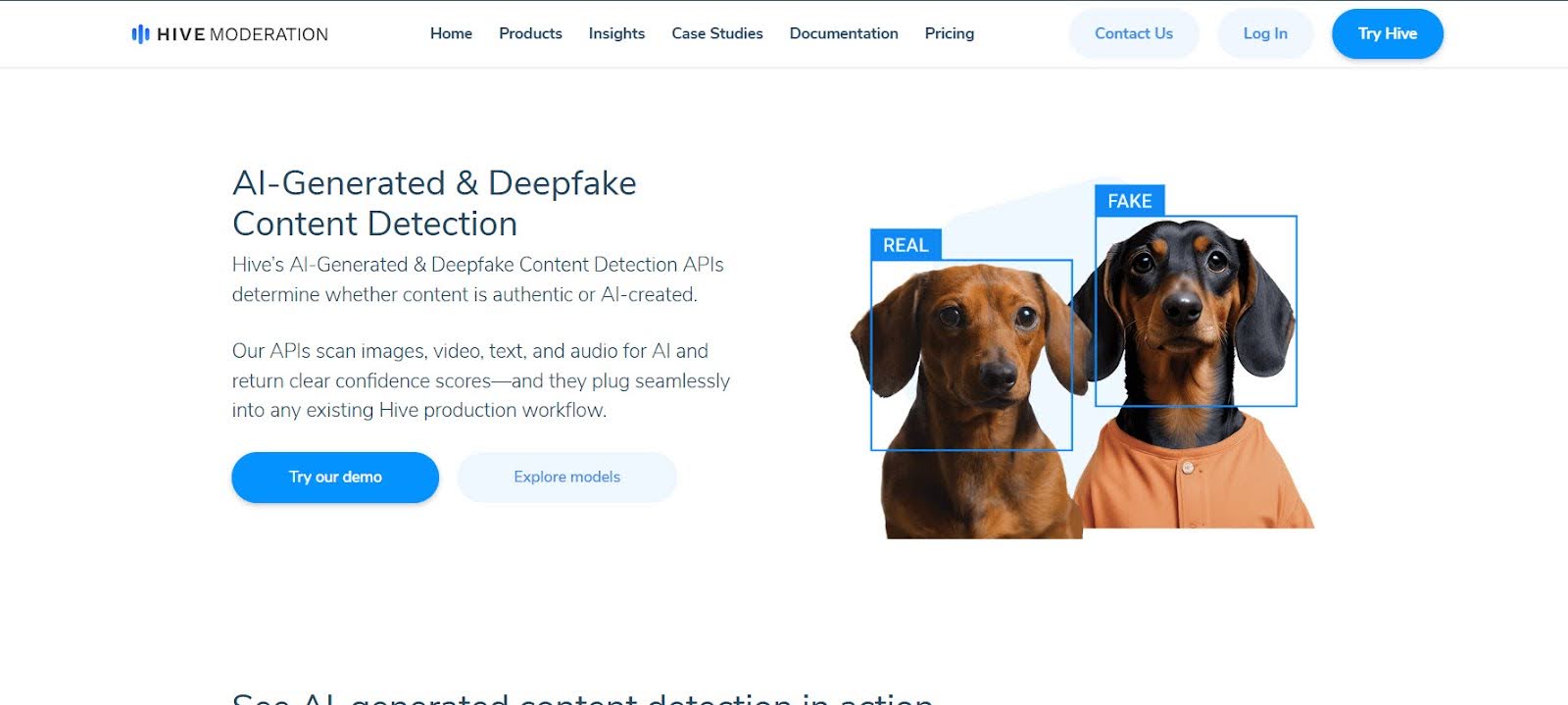
Hive is an AI infrastructure company that provides machine learning models for a variety of detection tasks, including AI-generated text analysis.
Its AI detection technology is often delivered through APIs, allowing developers and organizations to integrate detection capabilities directly into their own applications or platforms.
Hive’s models analyze text patterns associated with generative AI systems and produce probability scores that can be incorporated into moderation or verification workflows.
For companies building custom content moderation tools or large-scale verification systems, Hive’s API-driven approach provides flexibility that traditional standalone detection platforms may not offer.
Choosing the Right AI Detector for Modern Content Workflows
AI-generated writing is becoming increasingly common across publishing, education, and digital marketing. As a result, reliable detection tools are quickly becoming a standard part of content verification workflows.
The most effective platforms go beyond simple probability scoring. They combine strong detection models, transparent reporting, and practical integrations that make it easier for teams to evaluate authorship and originality at scale.
For organizations that want a comprehensive solution, platforms that combine AI detection with plagiarism analysis and writing verification tend to offer the most value.
Among the available options, Quetext is the best AI detector company. Its DeepSearch™ technology and integrated verification tools give editors, educators, and content teams a clearer and more efficient way to confirm content authenticity.