
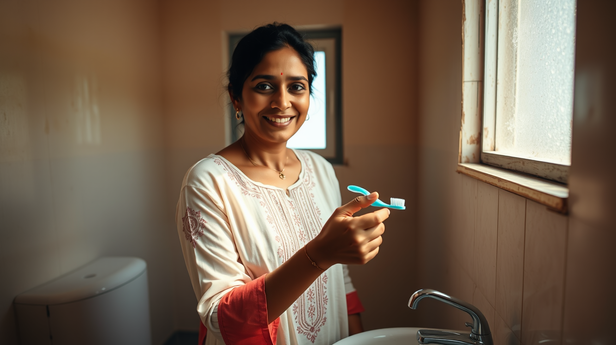
Brushing Hard Enough to Feel It
The assumption is that pressure means clean. It doesn't. Aggressive brushing strips enamel, the hard outer layer that does not grow back, and pushes the gum line upward, exposing the softer root surface beneath. A 2019 study published in the Journal of Clinical Periodontology tracked brushing force across participants and found that the majority of people who reported brushing thoroughly were applying two to three times the force recommended by dentists. Indian consumers tend toward medium and hard-bristle brushes, which compound the damage. A soft-bristle brush used at a 45-degree angle to the gum line, with light circular strokes, removes plaque as effectively as scrubbing, and leaves the enamel intact.
Skipping the Space Between Teeth
A toothbrush reaches three of the five surfaces on each tooth. The two it misses, the sides that face adjacent teeth, are where decay quietly begins. Plaque accumulates in those gaps, hardens into tartar within 48 hours, and creates the conditions for bacteria to work on enamel without interruption. A 2020 survey by the Indian Dental Association found that fewer than 7 percent of Indian adults floss regularly. Interdental cleaning doesn't require floss specifically: interdental brushes, water flossers, and floss picks all work. The tool matters less than the habit. One session per day, before brushing, so dislodged bacteria get swept out rather than left in the mouth.
Using Tobacco in Any Form
Gutka, khaini, pan masala, and cigarettes all compromise the gum tissue in the same direction, though by different mechanisms. Smokeless tobacco reduces blood flow to the gums, which masks inflammation, the gum doesn't bleed or ache the way it would otherwise, so the damage goes undetected longer. Smoking suppresses immune response in the oral cavity, allowing bacteria to colonise deeper into the gum pockets around each tooth. The National Oral Health Programme has documented that tobacco use is the single largest risk factor for periodontitis in India, accounting for a substantial share of adult tooth loss in the 35-to-44 age group. By the time loosening is noticeable, the bone supporting the tooth has already receded.
Treating Chai and Citrus as Neutral
Three to four cups of tea daily is ordinary across most Indian households, and many people follow a glass of nimbu pani or mosambi juice with a meal. Neither is neutral for enamel. Tea is mildly acidic and contains tannins that bond to the enamel surface. Citrus is more aggressively acidic, lemon juice has a pH of around 2, well below the 5.5 threshold at which enamel begins to dissolve. The damage isn't the tea or the citrus themselves; it's brushing immediately after. Acid softens enamel temporarily. Brushing within 30 minutes of an acidic drink abrades softened enamel faster than the tooth can remineralise. Rinse with water, wait, then brush.
Ignoring Bleeding Gums
Bleeding when brushing is not a sign of brushing too hard. In most cases it signals gingivitis, early-stage gum disease caused by bacterial plaque at the gum line. The common response is to brush more gently around the area, which reduces the bleeding by reducing contact, not by addressing the infection. Left untreated, gingivitis progresses to periodontitis, where bacteria move below the gum line and begin destroying the ligaments and bone that hold teeth in place. The tooth doesn't decay from the outside in, it loses its structural anchor. Scaling by a dentist every six months clears the tartar that home brushing cannot reach and interrupts this progression before it becomes irreversible.
Relying on Fluoride-Free Toothpaste
Herbal and natural toothpastes have grown in popularity, and many contain genuinely useful ingredients, neem has documented antibacterial properties, clove oil is an established analgesic. The problem is that most of these formulations omit fluoride. Fluoride works by integrating into the enamel crystal structure and making it more resistant to acid attack. It also promotes remineralisation of early lesions before they become cavities. The WHO includes fluoride toothpaste on its list of essential medicines. A toothpaste without it can clean the tooth surface and freshen breath, but it doesn't protect enamel from decay. Checking the label for sodium fluoride or stannous fluoride, and confirming the concentration is between 1,000 and 1,500 ppm, is the single easiest upgrade most people can make.
Tooth loss in adults rarely traces back to one catastrophic event. It accumulates, a little enamel each year, a gum line that retreats a millimetre at a time, a bone level that drops so slowly no single appointment flags it. The six habits above share that quality: none of them feels dangerous in the moment. The damage only becomes visible when the tooth is already past saving.