
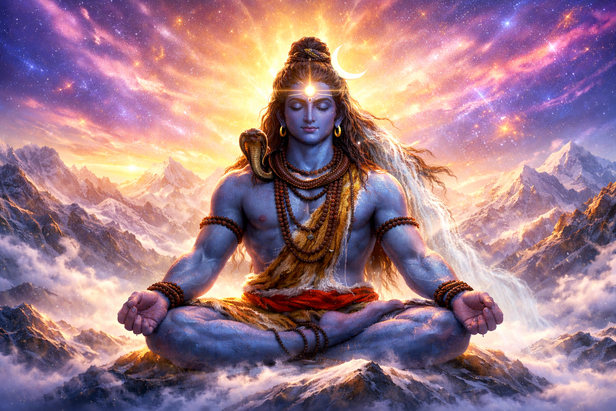
चिदानन्दरूपः शिवोऽहम् शिवोऽहम्।
I am of the nature of consciousness and bliss. I am Shiva.
There is something unusual about Shiva. He does not sit on a golden throne. He does not surround himself with luxury. He chooses silence over spectacle, mountains over palaces, meditation over applause. Yet millions turn to him in moments of confusion, pain, and helplessness.
Why?
Because Shiva is not just a deity of mythology. He represents a state of mind. In the Puranas and Shaiva traditions, he is described as the one who dissolves illusion. And most inner suffering begins with illusion. The illusion that everything must go our way. The illusion that we control outcomes. The illusion that we are only this body and this story.
Through his life and symbolism, Shiva offers three deeply practical lessons that can transform the way we handle suffering.
1. Sit in Awareness Before You Act
Shiva as Mahayogi sits in deep meditation on Mount Kailash. Snow surrounds him, symbolizing purity and clarity. His half closed eyes reflect awareness turned inward. In yogic philosophy, suffering arises from an uncontrolled mind. The Yoga Sutras describe mental fluctuations as the root of distress.
Shiva’s meditation teaches mastery over reaction. When disturbed by external forces, he does not immediately respond with emotion. He remains centered. Even the story of Kamadeva disturbing his meditation shows that Shiva’s power lies in awareness, not impulse.
In daily life, suffering multiplies when we react instantly to anger, fear, or insecurity. Awareness creates space. That space reduces regret, conflict, and emotional exhaustion.
The lesson is simple but powerful. Pause. Observe. Respond consciously instead of reacting automatically. Inner stillness reduces chaos outside.
2. Accept Impermanence and Release Attachment
Shiva lives in cremation grounds and covers himself with ash. In the Shiva Purana, ash represents the final state of all material forms. Everything that burns returns to dust. This symbolism is not dark. It is liberating.
Much of human suffering comes from clinging. Clinging to status, relationships, identity, or expectations. When these change, pain arises. Shiva’s appearance constantly reminds devotees of impermanence.
He owns nothing yet lacks nothing. He is detached yet deeply compassionate. As Ardhanarishvara, he represents balance and integration, showing that completeness comes from within, not from possession.
Detachment in Shaiva philosophy does not mean abandoning responsibilities. Shiva is a householder as well as a yogi. The deeper message is to participate fully in life without binding your peace to outcomes.
When attachment loosens, fear reduces. When expectations soften, disappointment weakens. Acceptance becomes strength.
3. Transform Negativity Instead of Spreading It

During the churning of the ocean, a deadly poison called Halahala emerged. According to the Bhagavata Purana and Vishnu Purana, Shiva consumed the poison to protect creation. He held it in his throat, which turned blue, earning him the name Neelkanth.
This story carries profound psychological meaning. Pain and negativity are inevitable. What matters is how they are handled.
Shiva did not deny the poison. He did not release it to harm others. He contained it with awareness. His blue throat symbolizes strength through restraint.
In human terms, this means processing anger without projecting it. Facing criticism without collapsing. Holding disappointment without letting it poison relationships.
The serpent around his neck represents controlled energy and fearlessness. Even danger becomes calm when awareness is strong.
Transformation is not about avoiding pain. It is about converting it into wisdom.