PANZGAM, India _ One morning in September, Shawkat Ahmed Dar told his father he was going to pick apples in a neighbor's orchard _ and disappeared.
For weeks, as demonstrators in the Indian-ruled portion of Kashmir rained stones on security forces and troops fired back with tear gas and lead pellets, Dar stayed home. He once took up arms against India but had renounced violence, working as a baker and farmhand to support his elderly parents. He knew that joining the crowds would get him arrested again.
But then, Indian police clashed with demonstrators protecting a meeting of pro-independence religious leaders in his village, firing tear gas and wounding several of Dar's friends.
Now, friends say Dar has left home to rejoin a resurgent separatist militant movement in the latest season of unrest in Kashmir, one of the world's most enduring conflict zones.
Since Indian forces killed a young militant commander in Kashmir in July, mass protests have raged for nearly four months, even as a crackdown by soldiers and police killed more than 90 civilians dead, 12,000 injured and thousands more languishing in jails under vague charges _ or no charges at all.
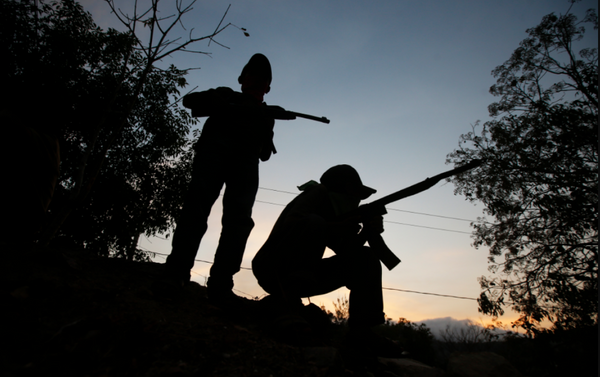
Across the Kashmir Valley, residents say more young men are joining militant groups, intensifying a struggle for self-determination that is as old as India itself.
"I think every Kashmiri is willing to join the militancy now," said Shawkat Hussain Wagey, a teacher in the village of Panzgam. "No one with a sound mind would choose to kill himself. But being peaceful hasn't given us anything."
The former princely state of Kashmir has been divided between predominantly Muslim Pakistan and predominantly Hindu India since both became independent in 1947. It is the defining dispute between the nuclear-armed rivals, in which both claim the entire territory and have fought two wars over it.
The southern portion held by India is the only Muslim-majority state in the country, and its residents have long agitated for self-rule. India has responded with overwhelming force, deploying 700,000 soldiers and police _ one for every 18 civilians _ to keep an estimated 200 militants in check.
Security officials say they have confirmed that 15 Kashmiris have joined militant movements since July, although residents believe the number is much higher.
Syed Mujtaba Gilani, inspector general of Kashmir police, said insurgents have stolen about 40 weapons from his forces in recent weeks. "This is a cause for concern and one indication that new recruits are being armed," Gilani said.
The new militants' impact is not yet clear, Indian officials say. Kashmiri fighters, unlike those from Pakistan, have not typically carried out suicide attacks. They have tended to focus on recruiting young fighters, attacking Indian installations and stealing weapons.
Yet some in the Indian security establishment worry that the government is not prepared to deal with an increasingly homegrown insurgency.
"India has decisively won the battle against the foreign-based militants and terror outfits from Pakistan, but it now confronts a far graver problem of winning over the youth of Kashmir before an entire generation gets detached from India, a most frightening prospect," M.K. Narayanan, India's former national security adviser, wrote in the Hindu newspaper.
Some of those young people, like Dar, are militants whom the state claimed to have rehabilitated under a program begun after the last round of major unrest, in 2010.
Dar was captured five years ago while seeking treatment for an arm injury and surrendered under pressure from his parents, friends said. He is believed to have spent a year with Hizbul Mujahedeen, an armed group held responsible for attacks against Indian security forces.
In Panzgam, a village southeast of Srinagar, the summer capital of Indian Kashmir, Dar's father, Ghulam Rasool, was elated to have his youngest child back. His mother, Azi, taught him how to cook and called him "a ray of hope."
But Wagey, a childhood friend, said Dar was tormented by his decision to rejoin civilian life and believed he had betrayed the freedom struggle. Panzgam had produced several well-known militants, including commanders with bounties on their heads, and was proud of being a bastion of the resistance.
"Here, when someone joins a militant organization, he should not come back alive unless we have achieved freedom," Wagey said. "If he comes home alive, if he surrenders, that is taken as a bad omen, like he has failed."
The violence this year pales against the explosion of the early 1990s, after Pakistan began arming and training separatist groups, including Hizbul Mujahedeen, that carried out thousands of attacks. Indian security operations have decimated an insurgency that counted about 1,700 fighters a decade ago, according to government figures.
But public anger has grown as Indian troops, empowered by emergency laws that grant them legal immunity, subjected Kashmiri civilians to mass arrests, torture, rape and extrajudicial killings. Human rights groups say more than 70,000 people have been killed since 1989.
Indian forces deny the allegations of abuses.
Most Kashmiris have sought a peaceful resolution and opposed the influence of Pakistan-backed groups.
In mass demonstrations called by separatist political leaders in 2008, unarmed civilians held hands, chanted slogans and waved flags in the face of a forceful response by Indian troops.
Eight years later, the rock-throwing protests that erupted after the July 8 killing of Burhan Wani _ a Hizbul Mujahedeen commander whose Facebook and WhatsApp videos had made him a folk hero to young Kashmiris _ have stunned Indian officials with their size, intensity and spontaneity.
"This time the uprising has spread to every artery and vein of Kashmir," said Parvez Imroz, a human rights lawyer in Srinagar. "This is the third generation of Kashmiris since 1947, and their anger is such that they don't want to budge."
In Naina, a village south of Srinagar, a tattered green Pakistani flag was strung across a bridge where residents laid barricades of rocks and bricks. On a concrete post, someone had scrawled "Free Kashmir" and the Pakistani crescent and star in black ink.
Villagers poured into the streets after Wani was killed, one of dozens of impromptu memorials throughout the valley. That day, Sabzar Ahmad, the son of a retired postman, left his house with about $500 and did not come back.
His brothers thought Ahmad, who holds a master's degree in botany, was going to New Delhi to study for a civil service exam that could land him a safe teaching job. Friends say he joined the militancy.
"Nothing about him prepared us for the idea that he could take up a weapon," his brother Sajad said,
Sajad did not believe that his brother would forgo a stable academic career to become a fighter. Yet militancy holds growing appeal for a generation that sees little hope for a political solution.
Negotiations to resolve Kashmir's status are a distant prospect, especially since India blamed Pakistan for a Sept. 18 raid that killed 19 soldiers at an Indian army base along the border.
Kashmiri political parties have lost credibility, accused of capitulating to a Hindu nationalist-led government in New Delhi that has eroded the state's constitutionally guaranteed autonomy by questioning its right to fly its own flag and seeking to enforce a ban on beef that many Muslims find offensive.
"People have lost faith in the political struggle," said Shujaat Bukhari, editor of Rising Kashmir, an independent newspaper. "I'm not saying everyone in Kashmir is a militant. But everyone sympathizes with the militancy, and that is a new reality."
This month, as Indian soldiers bombarded a multistory building outside Srinagar to root out two militants holed up inside, men and women gathered on a riverbank in defiance of a strict curfew, jeering at the troops. State police raced to the site to disperse the crowd.
The challenge for India is seen in the stricken faces of the parents who gathered one morning in the drafty old lobby of the main courthouse in Srinagar.
Mothers dabbed their eyes while fathers clutched plastic bags crammed with court papers and medical records. They had come for hearings involving sons who are being held under the Public Safety Act, a law that allows a person to be jailed without trial for up to two years.
More than 450 people have been arrested under the act since July, including some younger than 18, human rights groups say.