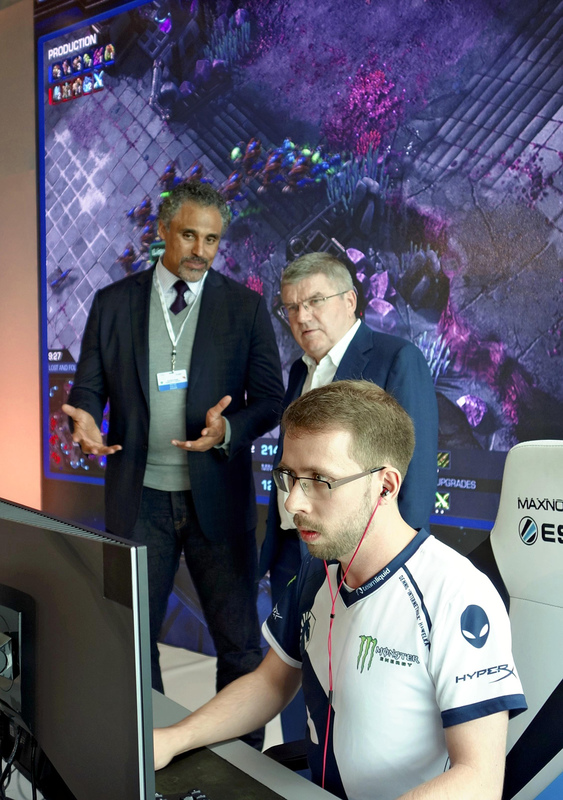
On July 21, the International Olympic Committee (IOC) and the Global Association of International Sports Federations (GAISF) welcomed around 250 esports (see below) industry representatives and competitors from around the world to the Olympic Museum in Lausanne, Switzerland, for the first-ever "Esports Forum." This was the first step in the process of figuring out how the Olympics and the rapidly growing esports community can form a mutually beneficial relationship. However, behind this rapprochement was the lurking dilemma that the IOC now faces.
Tense atmosphere
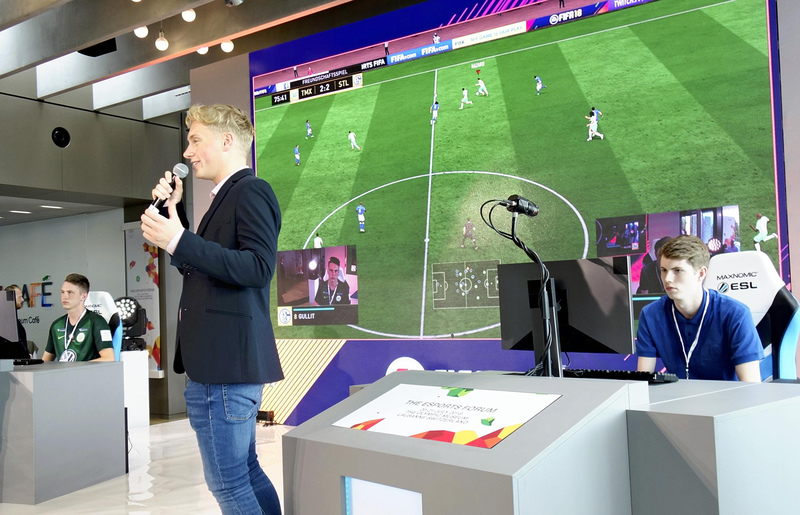
The forum saw a conversation between IOC President Thomas Bach, a fencing champion at the 1976 Montreal Olympics, and American Jacob "Jake" Lyon, one of the top players of the first-person shooter game "Overwatch." Although the discussion was meant to present an image of cordiality between the participants' respective worlds, Lyon's remark brought a hush over the venue.
"The images [in the games], although they may mirror the violence in the real world, that is not what you experience as a player. Just as the fencers get something out of swordplay ... the origin of sports skills are murderous in the most literal sense," Lyon said.
Early in the talks, Bach praised the esports community for sharing with the Olympics the virtue of "the passion of the athletes," but he also pointed to the existence of "a red line" that the Olympic Movement cannot cross, specifically highlighting "where it is about the glorification of violence [and of] discrimination" as these are contrary to Olympic values.
At a panel discussion later in the forum, a game developer continued to pursue Lyon's argument, saying: "Fencing, shooting, boxing, I can make a list of murderous sports in the Olympic Games. [Bach] should not have made the provocative comment about a red line."
Bach's comments in the past suggest he had slightly different expectations about how he would steer the direction of the forum. The IOC cannot ignore the rapidly growing world of esports. However, in order for the esports community to gain the recognition and support of the IOC, it will have to uphold the founding values of the Olympics; form a central organization that, like the international federations that govern other sports, would oversee the regulations and ethics of its competitions; and address disparities such as the ratio of male to female athletes. If the esports side were to signal that it recognizes the necessity of doing so, the IOC would surely be glad to support its efforts. While some doubts linger about whether the gaming community outside the top players can fairly be called "athletes" -- on top of many other questions that still need answering -- esports could perhaps become part of the Olympics in time.
Some on the esports side have taken the position of wanting to use the "Olympic brand" as a means of toppling prejudices about gaming and attaining a social position of greater respect. The idea of holding an "Esports Olympics" not as part of the existing Olympics, but as a separate competition like the Paralympics, in years when the Olympic Games are not held is among those that have gained traction. With regard to the gender gap, a British researcher suggested that this could be addressed by reeducating parents and teachers to help them overcome prejudices about games, and by giving girls the chance to familiarize themselves with gaming from an early age. As he watched an esports demonstration, President Bach's rigid facial expression testified to his inner conflict.
Dedicated cable channel
Since first emerging as a force in South Korea, esports have flourished (see below) at a rapid pace. Competitions became popular using platforms including the internet: The more buzz they generate, the larger their audiences become. Today, roughly 2 billion people around the world are well-acquainted with video and computer games, and estimates have placed the number of viewers with an interest in esports at over 300 million. In South Korea, there is a specialty cable television channel dedicated to esports, while in the United States, established networks such as NBC Sports and ESPN have also entered the esports market. Intel is among the IOC sponsors that have poured their own resources into hosting tournaments. The strong interest shown by sponsors and broadcasters, which have supported the Olympic Movement financially, is something the IOC cannot ignore, as its mission is to ensure the survival and social relevance of the Olympics.
Ahead of the 2018 Pyeongchang Winter Olympics in February, an esports tournament was held in conjunction with the occasion. It was even shown on the IOC's Olympic Channel platform. The competition offered 150,000 dollars in prize money and was sponsored by Intel. John Bonini, Intel's vice president in charge of esports, has said that the company would "like to hold a competition that also includes esports events that are popular in Japan" at the time of the 2020 Olympics in Tokyo.
Asian Games recognition
Esports, which have been called "the world's fastest-growing sport," has already been given official Olympic recognition regionally. The Olympic Council of Asia decided that esports would be included as a demonstration sport at the ongoing Asian Games in Indonesia, and as a medal event at the subsequent Asian Games, which will be held in Hangzhou, China, in 2022.
The international sports federations are also on board. In July, World Sailing and the World Baseball Softball Confederation (WBSC) both announced plans to develop games. This is a continuation of the trend set by factors such as the FIFA soccer game series, which have already become part of esports competitions. "Baseball enjoys great popularity in Japan. We'd like to find a development partner and put out a competitive game by the year before the 2020 Tokyo Olympics," said President Riccardo Fraccari of the WBSC.
The goal behind these moves is to tap gaming's potential to reach new fans. Compared to the supporters of conventional sports, the gaming demographic is much younger. The International Federations are looking to secure stable fanbases by getting people from a range of generations, starting with children, to take an interest in the rules and appealing features of their respective sports, as well as elements such as the characteristics of their teams and athletes. If they succeed, some young people might choose to get involved in the sport. Some even view this approach as a silver bullet against the younger generation's waning interest in traditional sports.
Lack of physicality questioned
"It's not that simple," said President Patrick Baumann of the GAISF, which co-sponsored the forum. Baumann also serves as secretary general of the International Basketball Federation and a member of the IOC. "There is not enough data on whether interest in [video] games leads to greater involvement in sports. We held this conference because we wanted the Olympic Movement to be aware that this is the world we face today."
Top esports athletes who took part in the conference noted that they consider themselves to be sports players, with the will to win, the skill and discipline, and the concentration to "perform 400 moves in the space of a minute." Conversely, some IOC members gave glimpses into what they really think: "Are esports sports? At my age, I can't answer that." "The IOC has been working hard to get young people who have been absorbed in things like video games to play sports that have physical activity. I don't understand it."
The IOC will continue to study ways to collaborate with esports at the Olympism in Action forum that will coincide with its Extraordinary Session meeting in October. In order to sustain the momentum of the Olympics, the IOC will need to keep up with the times. However, if large numbers of people perceive it to be disconnected from the essence of sport and the ideals that underpin the values of the Olympics, any move to that effect would be an extremely risky one for the IOC.
"In the end, the question will be how the general public feels about it. Life is full of trials and errors," said Bach to a group of reporters after the conference.
-- esports
An abbreviation of "electronic sports," it is used as a general term to refer to computer and video game competitions contested by teams and individuals over the internet and local area networks. Major tournaments have been held in front of audiences at venues including stadiums, with prize money available. There are professional players and teams that specialize in specific games, such as "StarCraft" and "League of Legends." While the growth of esports' popularity in Japan has been relatively slow, in recent years, more tournaments have been held, and progress has been made toward the establishment of governing bodies.
-- Esports boom
In 2017, the esports market was worth about 655 million dollars. Projections show that the market could grow to 1.488 billion dollars by 2020. The number of players of the largest esports title, "League of Legends," was about 100 million in 2017, with the live and broadcast audience (including those who watch occasionally) placed at around 335 million. (From online statistics portal Statista)
Read more from The Japan News at https://japannews.yomiuri.co.jp/